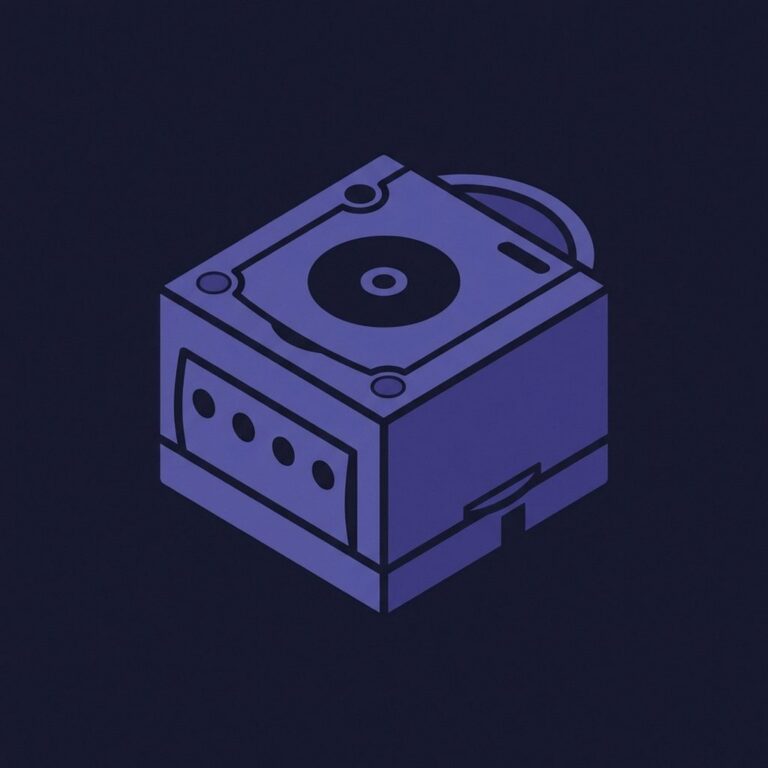
The Nintendo GameCube launched in Japan on September 14, 2001, North America on November 18, 2001, Europe on May 3, 2002, and Australia on May 17, 2002. It was Nintendo’s sixth-generation console and its first to use optical discs instead of cartridges.
The Nintendo GameCube is one of gaming’s great contradictions: a commercial underperformer that has become one of the most beloved and collectible consoles ever made. Released on September 14, 2001 in Japan and November 18, 2001 in North America at $199 USD, the GameCube finished last in its generation behind the PlayStation 2 and Xbox, moving 21.74 million units. Yet its library of exclusives, rock-solid hardware, and distinctive design have driven collector demand to heights its sales numbers never predicted.
History & Development
Internally codenamed “Dolphin” — a name that survives today in the popular GameCube/Wii emulator — the console represented Nintendo’s rethinking of its hardware strategy after the N64 era. The cartridge format was gone. Nintendo partnered with Matsushita (Panasonic) to develop a proprietary optical disc format and with IBM and ATI/ArtX for the CPU and GPU respectively. The goal was straightforward: build a developer-friendly console with strong technical specifications at an aggressive price point.
The design broke every convention. Where the PS2 was sleek and the Xbox was massive, the GameCube was a compact, colorful cube with a carry handle molded into the back. It launched in Indigo purple — a bold choice that reinforced the “toy-like” perception Nintendo both cultivated and struggled against. The console’s miniDVD format (8 cm proprietary discs holding 1.5 GB) prevented DVD movie playback, a feature the PS2 leveraged as a major selling point. Nintendo argued the console was a dedicated gaming device, not a media center. The market largely disagreed.
The timing was brutal. The GameCube launched just two days after the original Xbox in North America, and over a year after the PS2, which had already built an enormous installed base. Third-party publishers, still wary from the N64’s limited library and cartridge costs, often treated the GameCube as a secondary platform. Multi-platform titles frequently arrived later or with fewer features on Nintendo’s hardware.
Hardware & Technical Specifications
Under the hood, the GameCube was quietly powerful. Its IBM PowerPC Gekko CPU ran at 485 MHz — a customized version of the PowerPC 750CXe architecture. The ATI/ArtX Flipper GPU at 162 MHz handled geometry, lighting, and rendering with dedicated hardware for texture environment mapping and anti-aliasing. On paper and in practice, the GameCube matched or exceeded the PS2 in raw graphical capability, though it fell slightly behind the Xbox’s more powerful Nvidia GPU.
Memory was generous: 24 MB of 1T-SRAM (an extremely fast, low-latency memory type) for the main system, plus 16 MB of DRAM as auxiliary memory. The 1T-SRAM’s bandwidth was remarkable for the era, giving developers fast access to textures and geometry data. This is one reason GameCube exclusives often looked better than multi-platform titles would suggest the hardware could produce — Resident Evil 4, Metroid Prime, and F-Zero GX all showcased visual fidelity that punched well above the console’s market position.
The GameCube controller is widely regarded as one of the finest ever designed. Its asymmetric layout placed a large, central A button surrounded by smaller B, X, and Y buttons — a design that made the primary action instantly intuitive. The analog sticks offered precise resistance, the triggers featured analog travel with a digital click at full depression, and the overall ergonomics fit comfortably in hands of all sizes. The controller proved so popular that Nintendo continued manufacturing it for use with Super Smash Bros. on Wii, Wii U, and Switch — over 20 years after the console’s launch.
Early production models included a Digital AV Out port alongside the standard Analog AV Multi Out. This digital port supported 480p component video through an official component cable that Nintendo produced in very limited quantities. These cables now sell for $200-300+, though third-party HDMI adapters (like the Carby or GCHD) have made high-quality video output accessible and affordable.
Game Library & Legacy
The GameCube’s library of 653 games is modest compared to the PS2’s massive catalog, but it contains a remarkable concentration of quality. Nintendo’s first-party output was exceptional: Super Smash Bros. Melee (still played competitively decades later), Metroid Prime (a masterful reinvention of the franchise in 3D), The Legend of Zelda: The Wind Waker (controversial cel-shaded art style, now universally praised), Luigi’s Mansion, Pikmin, Mario Kart: Double Dash, and Animal Crossing (the franchise’s Western debut).
Third-party exclusives added crucial depth. Capcom’s partnership with Nintendo produced the stunning Resident Evil remake, Resident Evil 4 (initially exclusive before later ports), and Viewtiful Joe. Sega contributed Super Monkey Ball, F-Zero GX, and Sonic Adventure 2: Battle. Factor 5 delivered the technically jaw-dropping Star Wars Rogue Squadron II: Rogue Leader as a launch title.
The GameCube also connected to the Game Boy Advance via a link cable, enabling unique cross-device gameplay. The Legend of Zelda: Four Swords Adventures, Final Fantasy Crystal Chronicles, and Pac-Man Vs. used this feature, with the GBA serving as a secondary screen — a concept Nintendo would later refine with the Wii U’s GamePad and the Switch’s hybrid design.
Super Smash Bros. Melee deserves special mention. Released as a launch title, it became the console’s best-selling game at 7.41 million copies and spawned a competitive community that continues to hold major tournaments. Melee’s demanding, technical gameplay created a grassroots esports scene years before the term was mainstream.
Models & Variants
The GameCube launched in Indigo and Jet Black, with Platinum (silver) following in 2002. Regional exclusives expanded the palette: Spice Orange was initially Japan-only, though it later appeared in limited quantities elsewhere. Special edition bundles paired colored consoles with matching controllers and specific games.
The most distinctive variant is the Panasonic Q, a Japan-exclusive hybrid console released in December 2001 at approximately $439 USD. Manufactured by Matsushita under license from Nintendo, the Q combined full GameCube hardware with a DVD/CD player, MP3 playback, and a premium brushed-metal design. Production was limited and discontinued in 2003. Today, Panasonic Q units in good condition sell for $500-1000+, making them one of the most coveted console variants of any generation.
Late in the console’s life, Nintendo released a revised model (DOL-101) that removed the Digital AV Out port to cut manufacturing costs. These units are less desirable to collectors seeking high-quality video output, though the difference is only relevant to those using component or digital video connections.
Collecting & Value Today
The GameCube has experienced one of the most dramatic value increases in recent collecting history. A console that could be found for $30 at garage sales a decade ago now commands $80-150 for a standard loose unit with controller. Boxed consoles in good condition regularly sell for $150-300+ depending on color and completeness.
The game library is where prices have truly exploded. Fire Emblem: Path of Radiance routinely sells for $150+ loose. Pokémon Box: Ruby & Sapphire, Gotcha Force, Cubivore, and Chibi-Robo all command three-figure prices. Even common first-party titles like Melee, Double Dash, and Wind Waker have climbed well above their original retail prices. The GameCube’s relatively small install base means fewer copies of most games exist compared to PS2 equivalents, and nostalgia-driven demand from millennials who grew up with the console continues to push prices upward.
When buying a GameCube, check whether the unit is a DOL-001 (with Digital AV Out) or DOL-101 (without). The DOL-001 is worth more and offers better video output options. Test all four controller ports and both memory card slots. The GameCube is famously durable — stories of consoles surviving falls, water damage, and years of neglect are common — but the disc laser can weaken over time, causing read errors on dual-layer discs (primarily Smash Bros. Melee and a few other titles).
Japan September 14, 2001; North America November 18, 2001; Europe May 3, 2002. 21.74 million worldwide (Nintendo's last official figure) — last in its generation behind the PS2 and Xbox. Proprietary 8 cm miniDVD-based GameCube Game Discs of about 1.5 GB; it was Nintendo's first optical-disc console. US $199, undercutting both the PlayStation 2 and the Xbox. No — it launched without a Mario title. Super Mario Sunshine arrived in 2002. February 2007.
Frequently Asked Questions
When did the GameCube come out?
How many GameCubes were sold?
What kind of discs did the GameCube use?
What was the launch price of the GameCube?
Was there a Mario game at GameCube launch?
When was the GameCube discontinued?