The Sega Saturn launched in Japan on November 22, 1994, in North America on May 11, 1995 and in Europe on July 8, 1995. The launch price was ¥44,800 in Japan and $399 in the United States.
The Sega Saturn is the great “what if” of gaming history. A console with dual 32-bit processors, the most powerful 2D sprite hardware ever built, and a Japanese game library that rivals any system’s best — undermined by corporate dysfunction, a disastrous North American launch, and architecture so complex that most developers never unlocked its potential. The Saturn sold 9.26 million units worldwide, a fraction of the PlayStation’s 102 million. Yet among collectors and enthusiasts, the Saturn commands a reverence that few consoles match.
History & Development
Development began in the early 1990s under the codename “GigaDrive” — a deliberate reference to the Mega Drive, suggesting an evolutionary successor. Sega of Japan’s engineers initially designed it as the most powerful 2D console ever made, with 3D capabilities based on their Model 1 arcade hardware. The goal was to surpass the 3DO, which had been generating industry buzz.
Everything changed in November 1993, when Sony’s PlayStation specifications leaked. Panicked by Sony’s 3D capabilities, Sega’s engineers scrambled to enhance the Saturn’s 3D performance. The solution was adding a second Hitachi SH2 CPU — creating the dual-processor architecture that would prove to be both the Saturn’s greatest strength and its fatal weakness.
The Saturn launched in Japan on November 22, 1994 and was an immediate success, initially outselling the PlayStation. Virtua Fighter was the killer app, and Japanese consumers embraced the system. But the North American launch was a catastrophe. At E3 1995, Sega of America president Tom Kalinske announced the Saturn was available immediately at select retailers for $399 — four months ahead of schedule. Retailers who weren’t included were furious. Developers were blindsided. And Sony’s Steve Race stepped to the podium and delivered the most devastating counterpunch in gaming history: a single word — “$299” — before walking off stage.
The Saturn never recovered in North America. Despite price cuts and solid software releases, consumer trust was shattered. Sega discontinued the Saturn in North America in 1998 and worldwide in 2000.
Why the US Launch Came Four Months Early
Kalinske had announced September 2, 1995 as the North American date. Sega of Japan pushed for something sooner, and the earlier date was forced on the American office. At the first E3 in Los Angeles on May 11, 1995, the Saturn went on sale that same day with a copy of Virtua Fighter included. Sega had shipped about 30,000 units, all of them to four chains: Toys “R” Us, Babbage’s, Electronics Boutique and Software Etc.
Best Buy and Walmart had not been told. KB Toys reacted by refusing to carry the Saturn or its games. Sony’s Steve Race answered the same day with “Two ninety-nine,” a console $100 cheaper than the Saturn’s $399.
Hardware & Technical Specifications
The Saturn’s architecture was a beast: two Hitachi SH2 CPUs at 28.6 MHz (each capable of 25 MIPS), a custom VDP1 for sprite and polygon rendering, a custom VDP2 for background and scroll planes, a Motorola 68EC000 for sound control, a Yamaha FH1 DSP at 22.6 MHz for audio processing, and a dedicated Saturn Control Unit (SCU) with its own DSP. That’s eight processors working in parallel.
The problem was that the two SH2 CPUs couldn’t access memory simultaneously without bus conflicts. Developers had to manually partition tasks between processors, a laborious process that most third-party studios — accustomed to single-CPU architectures — simply couldn’t or wouldn’t invest time in mastering. Early multi-platform games often used only one SH2, leaving half the Saturn’s power untapped.
For 2D gaming, the Saturn was unmatched. The VDP1’s sprite capabilities and VDP2’s background layer handling (up to five simultaneous scroll planes with rotation and scaling) produced 2D visuals that no other consumer hardware could touch. This made the Saturn the definitive platform for arcade ports of 2D fighters and shoot-em-ups.
How the Two SH-2 Processors Share the Work
The two SH-2 chips run as a master and a slave. The master sends commands to the slave, and both reach memory over one shared 32-bit bus. Two CPUs therefore do not mean twice the speed, because that bus is prone to congestion.
Between the processors and the video chips sits the Saturn Control Unit, which contains a DMA controller and a fixed-point DSP used for geometry maths. VDP1 draws sprites and 3D shapes, and its only drawing primitive is the quadrilateral, so a textured 3D surface is a sprite stretched and distorted into place. It has no hardware depth sorting. Sega’s SGL library sorted polygons in software, which gave only an approximate sense of depth. VDP2 builds the backgrounds on the fly without a frame buffer, with scrolling planes of up to 4096 by 4096 pixels that can rotate and scale.
Game Library & Legacy
The Saturn’s 540 games (across all regions) split dramatically by market. The North American library was thin and lacked marquee third-party titles. The Japanese library was extraordinary.
Panzer Dragoon Saga (1998) is frequently cited as one of the greatest RPGs ever made — an atmospheric, cinematic masterpiece produced in limited quantities that now sells for $800-1,500+ complete. NiGHTS into Dreams (1996) showcased the Saturn’s capabilities and Sonic Team’s creative ambition. Radiant Silvergun (1998) defined the modern shoot-em-up. Guardian Heroes blended beat-em-up action with RPG progression.
Release dates show how differently the regions were served. Virtua Fighter shipped on launch day in Japan, November 22, 1994, and during the launch window sold at close to one copy per console. Guardian Heroes, from Treasure, arrived in Japan on January 26, 1996, in North America on April 24 and in Europe on June 20. NiGHTS into Dreams followed on July 5, 1996 in Japan, August 20 in North America and September 5 in Europe (Naoto Ohshima directed, Yuji Naka produced and programmed), with some copies bundled with the analog 3D Control Pad. Panzer Dragoon Saga, four discs from Team Andromeda, reached Japan on January 29, 1998, Europe on April 17 and North America on May 5. Radiant Silvergun came out on the Saturn on July 23, 1998, in Japan only, two months after the arcade original.
The Saturn’s 2D fighting game library is arguably the best on any platform: Street Fighter Alpha 3, X-Men vs. Street Fighter, Marvel Super Heroes vs. Street Fighter, The King of Fighters ’97, Vampire Savior, and Dead or Alive. With the 4 MB RAM expansion cartridge (a Japan-exclusive accessory that slotted into the cartridge port), Capcom’s CPS2 arcade fighters ran with virtually no compromises — animation frames, loading times, and visual fidelity intact.
Japan Versus the West
The Saturn was a Japanese success and a Western disappointment. Of the 9.26 million sold worldwide, about 5.75 million went to Japan, about 1.8 million to the United States and about 1 million to Europe. The Japanese launch shipment of 200,000 consoles sold out on the first day, and in April 1995 the Saturn was selling about 17,241 units a day in Japan against 15,789 for the PlayStation.
Western owners saw a thinner library. Panzer Dragoon Saga got a first North American run of about 20,000 copies, which sold out in two days, and Europe received around 1,000. Radiant Silvergun and Marvel Super Heroes vs. Street Fighter stayed in Japan on Saturn.
RAM Cartridges and ROM Cartridges
The Saturn’s cartridge port took a backup memory cartridge for saves, RAM expansions and, in a few cases, ROM cartridges that held part of a game. Two RAM expansions were made, both released in Japan only. The 1 MB cartridge (HSS-0150) added memory to the internal 2 MB and shipped with The King of Fighters ’96 and Metal Slug, among others. The 4 MB cartridge (HSS-0167) arrived in 1997 with the Saturn port of X-Men vs. Street Fighter and lifted work RAM to 6 MB. Vampire Savior, Street Fighter Zero 3 and Marvel Super Heroes vs. Street Fighter also supported it.
Publishers could sell the same game with or without the cartridge. A separate ROM cartridge also existed for The King of Fighters ’95, which was released in Europe but not in North America.
Models & Variants
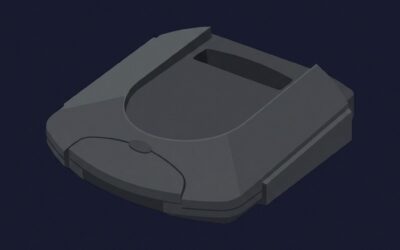
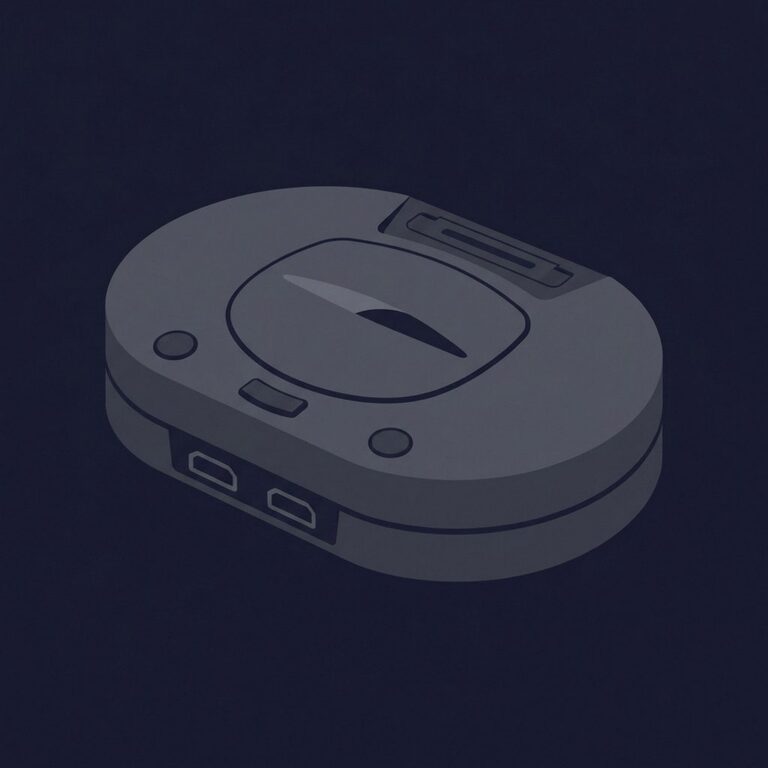
The Saturn was produced in two primary hardware revisions. The Model 1 (HST-3200) featured oval-shaped controller buttons and a larger, heavier chassis. The Model 2 (HST-3220) introduced round buttons, a smaller form factor, and cost-reduced internals. Both models performed identically.
Japan received numerous special editions: the Skeleton Saturn (translucent case), Derby Stallion Saturn (white), and various color variants. Licensed manufacturers produced their own models: Hitachi Hi-Saturn (with built-in MPEG card for Video CD playback), Victor V-Saturn, and the Samsung Saturn for the Korean market. The Hitachi Hi-Saturn Navi included a built-in GPS navigation system — making it perhaps the most unusual console variant ever produced.
How the Saturn Ended
Sega’s management changed repeatedly while the Saturn was still on sale. On July 16, 1996 the company announced that Tom Kalinske would leave after September 30. Bernie Stolar became executive vice president and later president of Sega of America, and at E3 1997 he said that “the Saturn is not our future.” The New York Times reported on March 14, 1998 that Sega had pulled the console from the American market.
The Dreamcast launched in Japan on November 27, 1998 and in North America on September 9, 1999. The Saturn lasted longer in Japan, where Sega kept supporting it after its successor arrived; production there ended in 2000, against 1998 in Europe.
Collecting & Value Today
The Saturn has experienced dramatic collector appreciation, particularly for Japanese titles. A working console sells for $80-150 USD depending on model and condition. The Japanese market offers the best value: Japanese Saturns are region-locked but can play imports with an Action Replay cartridge (which also provides the 4 MB RAM expansion). These cartridges sell for $30-50 and are essential for any serious Saturn collector.
Panzer Dragoon Saga is the holy grail — $800-1,500+ for a complete North American copy. Radiant Silvergun (Japan-only) commands $200-400+. Burning Rangers, Shining Force III (all three scenarios), and Magic Knight Rayearth (the last US Saturn release by Working Designs) are all highly sought after.
When purchasing, test the CD-ROM drive thoroughly — laser assemblies weaken over time. The internal battery (CR2032) maintains save data and the system clock; dead batteries are common and should be replaced immediately. The Saturn’s cartridge slot contacts can corrode, affecting RAM expansion and save cartridge functionality. Overall, the Saturn is a reliable console mechanically, with the optical drive being the primary point of failure.
The two main revisions are easy to tell apart. The Model 1 has angled, oval power and reset buttons and a CD access light. The Model 2 has round buttons and no light. In RetroRGB’s side-by-side tests the Model 1 picture looked slightly sharper, though both were rated excellent.
Region matters more than revision. The Saturn is region-locked, and the 1 MB and 4 MB RAM cartridges were never sold outside Japan. Anyone who wants the Capcom fighters, Radiant Silvergun or the Japanese-only RPGs is looking at a Japanese console, or an adapter cartridge as described above.
Frequently Asked Questions
When did the Sega Saturn come out in the US?
The Sega Saturn went on sale in North America on May 11, 1995, the day Sega announced it at the first E3 in Los Angeles. The planned date had been September 2, 1995. The launch price was $399, and about 30,000 units shipped to four retail chains.
How many Sega Saturns were sold?
About 9.26 million worldwide: roughly 5.75 million in Japan, 1.8 million in the United States and 1 million in Europe.