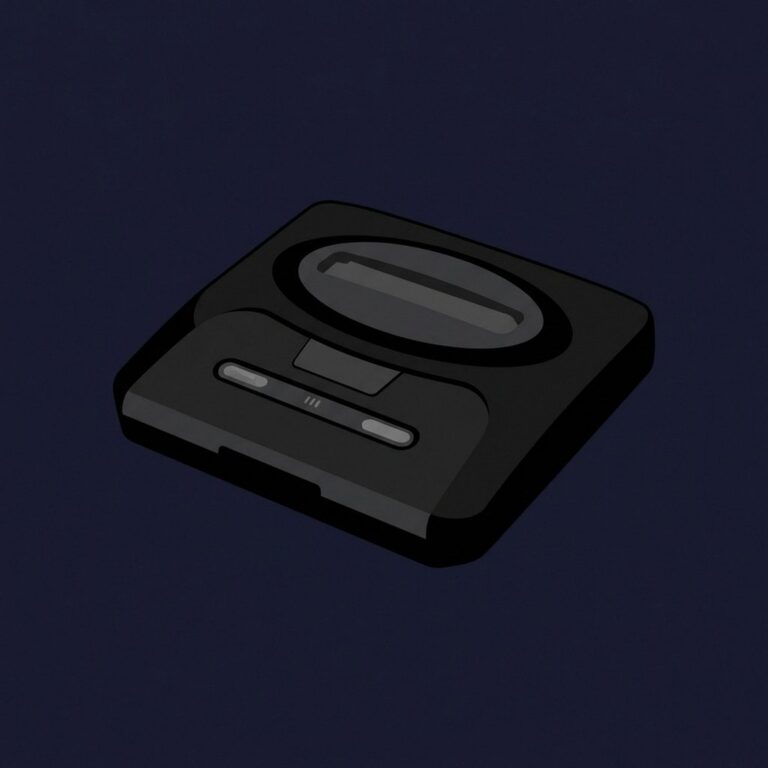
The Sega Genesis — known as the Mega Drive outside North America — was the console that made video gaming a two-horse race. Before the Genesis, Nintendo’s NES monopolized the market so thoroughly that “Nintendo” was practically a synonym for video games. Sega shattered that dominance through aggressive marketing, arcade-quality hardware, and a blue hedgehog that became one of gaming’s most recognizable icons. Selling 30.75 million units worldwide, the Genesis didn’t just compete with Nintendo — it forced the entire industry to grow up.
History & Development
Sega’s first console, the SG-1000, launched in Japan on the same day as the Famicom in 1983 — and was immediately overshadowed. The follow-up Master System performed well in Europe and Brazil but barely dented Nintendo’s dominance in Japan and North America. Sega needed a generational leap, and they needed it fast.
The Mega Drive launched in Japan on October 29, 1988, powered by the same Motorola 68000 CPU that ran Sega’s popular arcade boards. This wasn’t coincidence — it was strategy. By using arcade-compatible architecture, Sega made porting their hit arcade games to the home console straightforward. Altered Beast, Golden Axe, and Streets of Rage could look and feel remarkably close to their coin-op originals. The Japanese launch was modest, but Sega’s real target was North America.
The Genesis arrived in the US on August 14, 1989 at $189 USD, rebranded because “Mega Drive” was trademarked in the US. Sega of America, under the leadership of CEO Tom Kalinske (appointed in 1990), launched one of the most aggressive marketing campaigns in gaming history. The tagline “Genesis does what Nintendon’t” was confrontational, directly attacking Nintendo by name — something unheard of in the relatively genteel console market. Sega positioned the Genesis as the cool, mature alternative to Nintendo’s family-friendly image, targeting teenagers and young adults with edgier advertising and content.
The arrival of Sonic the Hedgehog in June 1991 was the tipping point. Sonic was designed from the ground up as an anti-Mario: fast where Mario was methodical, attitude-laden where Mario was cheerful, and rendered in a visual style that showcased the Genesis’s processing speed. Bundling Sonic with the console was Kalinske’s masterstroke. By Christmas 1991, the Genesis had outsold the SNES in North America — a lead Sega would maintain until 1994. The “console wars” became a cultural phenomenon, with schoolyard arguments about Genesis vs. SNES defining a generation of young gamers.
Sega’s “blast processing” marketing campaign deserves special mention. The term referred to a real but narrow technical capability — the Genesis’s ability to rapidly manipulate the VDP’s direct memory access during horizontal blanking intervals. In practice, it amounted to marginally faster background scrolling in certain scenarios. As marketing, though, it was genius: “blast processing” sounded powerful, was difficult to disprove in a pre-internet world, and gave Genesis owners ammunition for playground debates.
Hardware & Technical Specifications
The Genesis was built around the Motorola 68000 CPU running at 7.6 MHz, a 16/32-bit processor that was the workhorse of Sega’s arcade hardware and numerous other systems of the era (Amiga, Atari ST, early Macintosh). A secondary Zilog Z80 CPU at 3.58 MHz handled the PSG sound chip and provided backward compatibility with the Master System (via an adapter in some regions). This dual-processor design gave the Genesis genuine 16-bit muscle while maintaining a link to Sega’s 8-bit legacy.
Graphics were handled by the Yamaha YM7101 VDP (Video Display Processor), which output at 320×224 or 256×224 resolution. The color palette was 512 colors with up to 61 on-screen simultaneously (4 palettes of 16 colors minus shared transparency). This was the Genesis’s most visible limitation versus the SNES, which could display 256 colors from a 32,768-color palette. Genesis games tend to have a grittier, more contrast-heavy look — partly by necessity, partly by design philosophy. The VDP could display 80 sprites on screen with 20 per scanline, and its faster DMA allowed smooth scrolling at speeds that could challenge the SNES.
The audio system was a tale of two chips. The Yamaha YM2612 FM synthesis chip produced the Genesis’s signature sound: punchy, metallic, and distinctly electronic. In skilled hands — composers like Yuzo Koshiro (Streets of Rage), Masato Nakamura (Sonic 1 & 2), and Jesper Kyd (Sub-Terrania) — the YM2612 created soundtracks with a driving energy that perfectly matched the console’s persona. The secondary TI SN76489 PSG (inherited from the Master System) added three square wave channels and one noise channel, often used for supplemental effects. The Genesis sound is polarizing: devotees love its raw, edgy character, while detractors find it harsh compared to the SNES’s sample-based audio. Both sides are correct — it’s a matter of taste and compositional skill.
The original three-button controller (D-pad, A, B, C, Start) was simple and effective. In 1993, Sega released the six-button controller, adding X, Y, Z, and a Mode button, primarily to support Street Fighter II and other fighting games. The six-button pad is widely considered one of the best controllers of the 16-bit era, with a comfortable shape and responsive inputs.
Game Library & Legacy
The Genesis library of 915 games (North America) was defined by speed, sports, and Sega’s arcade heritage.
Sonic the Hedgehog and its sequels were the crown jewels. Sonic 2 (1992), with the introduction of Tails and the spin dash, sold 6 million copies and is often considered the series’ peak. Sonic 3 & Knuckles (1994), which used a unique “lock-on” cartridge mechanism, represented the technological ceiling of the platform. Sonic CD (on the Sega CD peripheral) added time-travel mechanics and an outstanding soundtrack.
Sports games were a Genesis stronghold, largely thanks to Electronic Arts. EA’s relationship with Sega was pivotal — the publisher reverse-engineered the Genesis hardware early on and negotiated favorable licensing terms. The result was a flood of quality sports titles: Madden NFL, NHL Hockey, FIFA Soccer, NBA Live, and the beloved Mutant League series. EA Sports’ Genesis output essentially created the modern sports game template. NBA Jam (by Midway, via Acclaim) brought arcade basketball to living rooms with its over-the-top dunks and “He’s on fire!” commentary.
Sega’s arcade ports delivered experiences that felt premium. Streets of Rage 2 is arguably the finest side-scrolling beat-em-up ever made. Shinobi III perfected ninja action. Gunstar Heroes (by Treasure) pushed the hardware to its absolute limits with screen-filling bosses and relentless action. Phantasy Star IV and Shining Force II proved the Genesis could handle RPGs with depth and charm, even if the SNES had more of them.
The Genesis ecosystem expanded with two add-on peripherals: the Sega CD (1992) and the 32X (1994). The Sega CD added CD-ROM capability and produced genuine gems (Sonic CD, Lunar, Snatcher) alongside a mountain of terrible FMV games. The 32X was a 32-bit upgrade that arrived too late, too expensive, and with too few worthwhile games — it’s widely considered one of gaming’s biggest hardware missteps. Both add-ons are collectible today, partly for their historical significance and partly for their libraries of oddities.
Models & Variants
The Genesis went through three major hardware revisions, each progressively cost-reduced.
The Model 1 (1988-1993) is the most distinctive and desirable. Its larger size, top-mounted “16-BIT” label, and rounded design are iconic. Critically, the Model 1 includes a headphone jack with volume slider on the front and higher-quality audio output — the audio circuitry in Model 1 units produces a noticeably richer, less distorted sound than later revisions. For audiophiles and enthusiasts, Model 1 with a high-definition graphics (HDG) designation on the label is the preferred version. Model 1 also outputs S-Video and RGB natively, offering the best video quality options.
The Model 2 (1993-1997) was smaller, lighter, and cheaper to manufacture. It removed the headphone jack, simplified the audio circuitry (resulting in slightly lower audio quality), and used a revised A/V output that dropped S-Video. The Model 2 is the most common Genesis variant and functions perfectly for gaming, but purists prefer the Model 1’s superior audio and video.
The Model 3 (1998), manufactured by Majesco under license after Sega had moved on to the Saturn, was a budget unit sold for $30. It was significantly smaller but removed compatibility with the Sega CD and 32X. Build quality was noticeably cheaper. Model 3 units are uncommon and have some collector interest as curiosities.
Regional variants include the Japanese Mega Drive (identical hardware, different shell design), the PAL Mega Drive (which ran at 50Hz, causing slower gameplay and border bars), and the Sega Nomad (1995) — a portable Genesis that played standard cartridges on a built-in LCD screen. The Nomad was ahead of its time but suffered from terrible battery life (2 hours on 6 AA batteries) and arrived too late in the Genesis lifecycle. Today, Nomads in good working condition sell for $150-250+.
Collecting & Value Today
The Genesis is a strong collecting platform with accessible hardware pricing and a game library that balances affordable common titles with genuinely rare high-end finds. Working Model 1 consoles sell for $50-80 USD, Model 2 for $30-60. A six-button controller is the preferred standard and adds $15-25 if not included.
Common games are cheap: Sonic 2, Streets of Rage, Golden Axe, and most EA Sports titles run $5-15. Mid-tier classics like Gunstar Heroes, Shinobi III, and Phantasy Star IV fall in the $30-60 range. The high end is populated by late-release titles and limited prints: Crusader of Centy sells for $200+ loose. MUSHA (a shoot-em-up by Compile) regularly exceeds $200. Mega Turrican, Eliminate Down (Japanese import), and Panorama Cotton command similar prices.
When purchasing Genesis hardware, the Model 1 vs. Model 2 decision matters primarily for audio quality and video output options. Both play games identically. Check the cartridge slot for bent or corroded pins — the Genesis’s top-loading mechanism is generally reliable but can accumulate debris. For Sega CD bundles, test the CD laser separately, as these are prone to failure and replacement lasers are increasingly difficult to source. The 32X sits atop the Genesis and can cause connection issues — ensure all cables seat firmly and the unit powers on with a game inserted.