
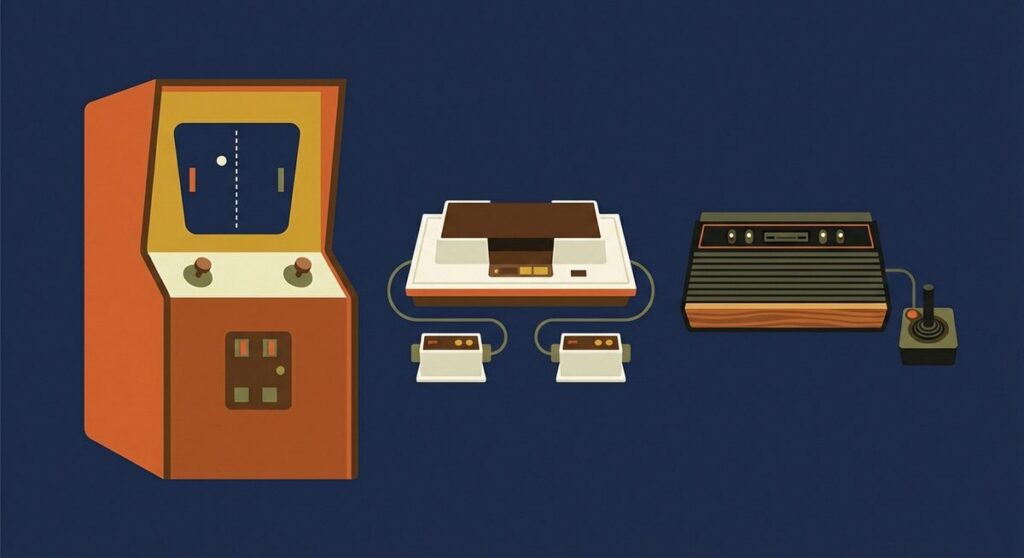
The 1970s gave birth to home video gaming. What began with a crude brown box displaying white dots on a television screen evolved, in less than a decade, into a multi-billion-dollar industry built on interchangeable cartridges and arcade fever. Every console that followed — from the NES to the PlayStation 5 — traces its lineage back to the innovations and experiments of this foundational decade.
1972: The Magnavox Odyssey Starts It All
Ralph Baer, a German-American engineer at defense contractor Sanders Associates, spent the late 1960s developing what he called the “Brown Box” — a prototype device that could generate and manipulate dots on a standard television. Licensed to Magnavox, it became the Magnavox Odyssey, released in 1972 as the world’s first commercial home video game console. The Odyssey was primitive by any standard: it displayed white squares and lines against a black background, had no sound, kept no score, and relied on plastic overlays taped to the TV screen to provide visual context. Games were “programmed” by inserting circuit cards that changed the console’s internal wiring.
Despite its limitations, the Odyssey proved the concept. It sold approximately 350,000 units and included accessories like playing cards, poker chips, and even a plastic rifle peripheral. Magnavox’s restrictive retail strategy (selling it primarily through Magnavox TV dealerships, leading many consumers to believe it only worked with Magnavox televisions) limited its reach, but the seed was planted.
1975-1977: The Pong Era
While the Odyssey pioneered home gaming, it was Atari’s Pong that captured the public imagination. Nolan Bushnell’s arcade Pong machine (1972) was a sensation, and the home version — released through Sears in 1975 — brought electronic table tennis to living rooms across America. The home Pong console was a dedicated device: it played Pong and nothing else, but its simplicity was its strength.
The success of Pong spawned an avalanche of imitators. General Instrument’s AY-3-8500 chip, released in 1976, contained the logic for several Pong-style games on a single affordable integrated circuit. This enabled dozens of manufacturers — from Coleco to Radio Shack to no-name electronics companies — to produce their own Pong clones at low cost. By 1977, the market was saturated with dedicated Pong-style consoles, creating a mini-crash that foreshadowed the larger collapse of 1983.
Notable dedicated consoles from this period include the Coleco Telstar series (Coleco produced 14 different Telstar models between 1976 and 1978), the APF TV Fun, and various branded units from Sears, Radio Shack, and others. These consoles typically offered variations on Pong — tennis, hockey, handball, squash — with progressively more features (on-screen scoring, multiple paddle sizes, serve mechanics).
1976: The Cartridge Revolution Begins
The Fairchild Channel F, released in August 1976, changed everything. Designed by engineer Jerry Lawson — one of the few Black engineers in the semiconductor industry at the time — the Channel F was the first console to use interchangeable ROM cartridges. Called “Videocarts,” these cartridges contained game software that could be swapped in and out, transforming a single console into a platform for an expandable library. The Channel F also featured the first microprocessor-based console architecture (using the Fairchild F8 CPU) and introduced the pause function.
The Channel F was technologically ahead of its time, but Fairchild lacked the marketing muscle and game development resources to compete with what came next. It sold approximately 250,000 units before being overwhelmed by Atari’s entry into the cartridge market.
The RCA Studio II, also released in 1976, was another early cartridge-based system, but its black-and-white graphics and lack of joystick controllers (it used built-in keypads) made it uncompetitive. It was discontinued within two years.
1977: The Atari 2600 Changes the Game
The Atari Video Computer System (VCS), later renamed the Atari 2600, launched in September 1977 at $199 USD. It was not the first cartridge console, but it was the one that defined the model. Powered by a MOS 6507 CPU (a cost-reduced version of the 6502) running at 1.19 MHz with just 128 bytes of RAM, the 2600’s specifications were modest even by 1977 standards. But its combination of color graphics, joystick controllers, and — crucially — a growing library of compelling software made it the dominant platform of the late 1970s and early 1980s.
The 2600 didn’t take off immediately. Its first year was slow, and Atari nearly went bankrupt before Warner Communications acquired the company for $28 million in 1976 (before the console launched). The turning point came in 1980 with the licensed home version of Space Invaders — the first officially licensed arcade-to-console port, which quadrupled 2600 sales and established the killer-app model that drives console launches to this day. The 2600 would ultimately sell over 30 million units and remain in production until 1992.
Other notable 1977 releases include the Bally Professional Arcade (Astrocade), designed by a team at Midway that included the creators of Pac-Man. The Astrocade featured impressive graphics capabilities and a built-in BASIC programming cartridge, but its high price ($299) and limited game library kept it niche. It remains a collector favorite today for its unusual library and distinctive design.
1978-1979: The Market Expands
The late 1970s saw several more consoles enter the increasingly competitive market:
The Magnavox Odyssey 2 (1978) was Magnavox’s cartridge-based successor, featuring a built-in membrane keyboard and voice synthesis module (The Voice). It found its largest audience in Europe (sold as the Philips Videopac G7000) and Brazil, where it remained popular well into the 1980s. Its most iconic game, K.C. Munchkin, was so similar to Pac-Man that Atari successfully sued to have it pulled from shelves — one of gaming’s first major intellectual property lawsuits.
The APF Imagination Machine (1978) was an ambitious hybrid console/computer that combined a game console (the APF-M1000) with a detachable computer add-on featuring a full keyboard, cassette tape drive, and BASIC programming. At $599 for the complete system, it was expensive but forward-thinking. Only 15 cartridge games were released.
The Mattel Intellivision, test-marketed in 1979 and widely released in 1980, represented the first serious challenge to Atari’s dominance. With notably better graphics and sound than the 2600, the Intellivision marketed itself as the premium alternative. Its disc-shaped controller (with a 16-direction pad and numeric keypad) was innovative but divisive — many players found it uncomfortable. The Intellivision sold over 3 million units and featured the first sports games with licensed team names, the first console game with synthesized speech (B-17 Bomber), and the first console-to-console network gaming via PlayCable.
The 1292 Advanced Programmable Video System
One of the more unusual stories of the late 1970s involves the 1292 Advanced Programmable Video System family. Based on the Signetics 2636 chip, this architecture was licensed to numerous manufacturers across Europe, producing a confusing array of consoles — Interton VC-4000, Voltmace Database, Acetronic MPU-1000, and dozens of others — that were largely compatible with each other’s cartridges despite carrying different brand names. This family of consoles sold primarily in Europe and represented an early example of platform fragmentation that would recur throughout gaming history.
Technology & Innovation of the Decade
The 1970s established several technological foundations that persist in gaming today:
Joystick controllers became the standard input device, replacing the rotary dials (paddles) of Pong-era systems. The Atari CX40 joystick — a single stick with one fire button — became iconic and influenced controller design for years.
ROM cartridges created the software marketplace model that drove the industry. The ability to buy, collect, and trade game cartridges established gaming as a hobby beyond just playing, laying the groundwork for the collector culture that thrives today.
Arcade-to-home ports proved that console gaming’s growth was linked to arcade gaming’s popularity. The success of Space Invaders on the 2600 created a template — hot arcade game drives console sales — that held true through the 1990s.
Color graphics and sound evolved from non-existent (Odyssey) to capable of rendering recognizable versions of arcade games (2600’s Space Invaders). The visual language of gaming — score displays, lives counters, level progression — was established during this decade.
Complete List of 1970s Home Consoles
The 1970s produced a remarkable number of gaming devices. Major releases include:
- 1972 — Magnavox Odyssey
- 1975 — Atari Home Pong
- 1976 — Fairchild Channel F, Coleco Telstar, RCA Studio II, 1292 APVS family
- 1977 — Atari VCS/2600, Bally Astrocade, Coleco Telstar Arcade, PC-50X Family
- 1978 — Magnavox Odyssey 2, APF Imagination Machine, Interton VC-4000
- 1979 — Mattel Intellivision, Bandai Super Vision 8000
Plus dozens of Pong clones and dedicated consoles from manufacturers worldwide. Many of these obscure systems are now prized by collectors for their rarity and historical significance.
Legacy
The 1970s were gaming’s experimental phase — a decade of firsts, false starts, and foundational breakthroughs. The Magnavox Odyssey proved games could exist on television. Pong proved millions of people wanted them there. The Fairchild Channel F proved that interchangeable software was the future. And the Atari 2600 proved that a single platform could sustain a massive, ongoing software ecosystem. Every generation that followed built directly on these foundations. The 1980s would bring both the industry’s darkest hour and its most dramatic resurrection, but none of it would have been possible without the pioneers of the 1970s.