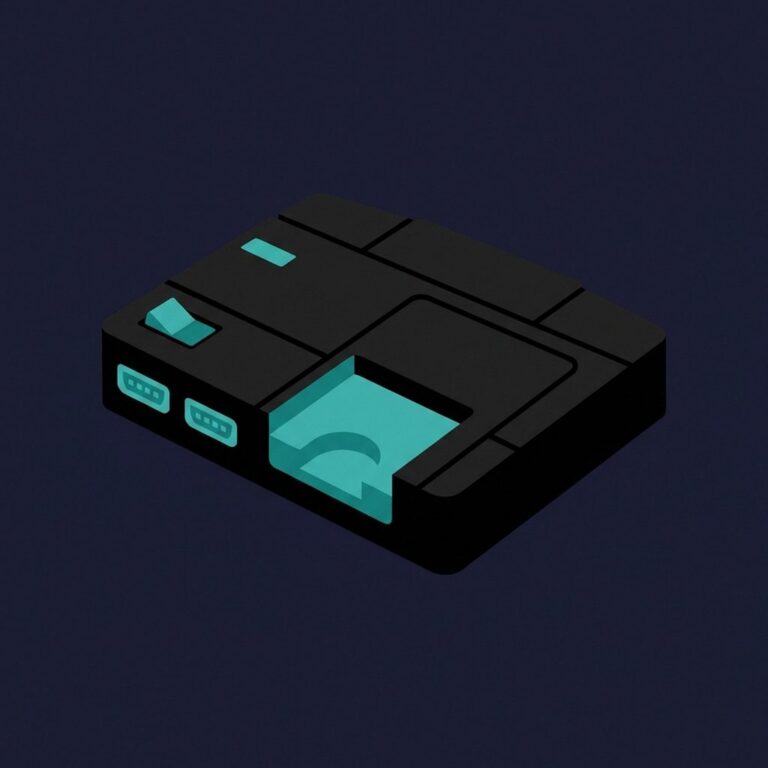
The PC Engine launched in Japan on October 30, 1987. NEC released it in North America as the TurboGrafx-16 in late August 1989. A planned European release was cancelled, so the PC Engine reached Europe mainly as an import.
The NEC TurboGrafx-16 — known as the PC Engine in Japan — is the great forgotten console of the 16-bit era. In North America, it’s a footnote. In Japan, it was a genuine rival to the Famicom, the first console to offer a CD-ROM peripheral, and home to some of the era’s finest shoot-em-ups and platformers. The PC Engine’s dual identity — massive success in Japan, commercial obscurity in the West — makes it one of the most fascinating platforms in gaming history.
History & Development
NEC, one of Japan’s largest electronics corporations, partnered with game developer Hudson Soft to enter the console market. Hudson designed the custom chipset; NEC manufactured and marketed the hardware. The PC Engine launched in Japan on October 30, 1987 — making it the first major 16-bit era console (though its CPU was technically 8-bit; the GPU was 16-bit). Its compact form factor — roughly the size of a paperback book — was revolutionary in an era of bulky consoles.
The North American launch as the TurboGrafx-16 on August 29, 1989 at $199.99 was poorly executed. NEC’s marketing was ineffective against Sega’s aggressive Genesis campaign and Nintendo’s established NES dominance. The console’s Japanese name (“PC Engine”) was abandoned for a clunky rebrand, and many of the PC Engine’s best Japanese games were never localized. The TurboGrafx-16 sold poorly in North America while the PC Engine thrived in Japan.
The PC Engine CD-ROM² (1988) was the first CD-ROM peripheral for any console — predating the Sega CD by three years. It added 650 MB of storage, CD-quality audio, and enabled games with voice acting and cutscenes. The TurboDuo / PC Engine Duo (1991) combined the base console and CD-ROM into a single unit. Several hardware variants were produced, making the PC Engine family one of the most diverse in console history.
The PC Engine in Japan
The PC Engine started as a partnership between a software company and a PC maker. Hudson Soft had taken its ideas to Nintendo in 1985 and been turned down. NEC, which dominated Japanese personal computers with the PC-88 and PC-98 lines, became the partner instead. When the console launched on October 30, 1987, the Famicom still held most of the Japanese market, and the PC Engine offered a clear jump in graphics. The case measured 14 by 14 by 3.5 centimeters, the smallest major home console released.
NEC had sold more than 1.2 million consoles in Japan by 1989, and the PC Engine reached about 10 million units there by 1995. It was reportedly Japan’s top-selling console at one point, and the Mega Drive finished third there throughout its life. PC Genjin, released on December 15, 1989 and sold in North America from April 1990 as Bonk’s Adventure, was created to promote the console in Japan. Red Company designed it, Atlus did most of the development and Hudson supervised. Bomberman ’93, released on December 11, 1992 in Japan and in March 1993 in North America, supported up to five players.
Regional compatibility is built into the cards. HuCards have 38 pins, and the TurboGrafx-16 version reverses eight of them as a region lockout.
CD-ROM² and the First Console CD Add-On
The CD-ROM² add-on went on sale in Japan on December 4, 1988 and made the PC Engine the first console to use CD-ROM as a storage medium. It sold 60,000 units in its first five months, and by 1989 NEC had sold more than 80,000 CD-ROM units in Japan. The Super CD-ROM² of 1991 updated the BIOS to version 3.0 and raised buffer RAM from 64 KB to 256 KB, and the Arcade Card of March 12, 1994 raised onboard RAM to 2 MB. It never appeared in North America.
Ys Book I & II showed what the format could do. It came out on the PC Engine CD-ROM² in Japan on December 21, 1989 and in North America on May 23, 1990, with recorded music, voiced dialogue and animated cutscenes. Castlevania: Rondo of Blood followed on the Super CD-ROM² on October 29, 1993, and was first released only in Japan. The North American TurboGrafx-CD arrived in November 1989 at $399.99 with no games included.
Why the TurboGrafx-16 Struggled in North America
NEC felt the name “PC Engine” lacked energy for American buyers and that a tiny console would not suit American tastes. It renamed the system and redesigned it as a large black unit, which delayed the launch. Test markets in New York City and Los Angeles opened in late August 1989, about two weeks after the Genesis test markets. The “16” in the name drew criticism as misleading for a machine with an 8-bit CPU. The pack-in game, Keith Courage in Alpha Zones, was an unfamiliar Hudson title, while Sega packed Altered Beast with the Genesis.
Supply outran demand. NEC’s Chicago operation built 750,000 units, far above what stores sold, and by March 1991 NEC reported 750,000 consoles sold in the United States and 500,000 CD-ROM units worldwide. Nintendo’s exclusivity terms kept most big publishers from supporting a second platform in the US. In mid-1992 NEC and Hudson moved North American management to a joint venture, Turbo Technologies Inc., and released the TurboDuo. In May 1994 the company said it would drop support for the Duo.
Hardware & Technical Specifications
The PC Engine used a Hudson Soft HuC6280 CPU at 7.16 MHz — a modified MOS 6502 variant, technically an 8-bit processor but running at roughly double the speed of the NES’s CPU. The HuC6270 VDC (Video Display Controller) and HuC6260 VCE (Video Color Encoder) handled graphics with impressive capabilities: up to 482 colors on screen from a palette of 512, smooth hardware scrolling, and large sprites. The system could display 64 sprites of up to 32×64 pixels — enabling detailed, arcade-quality character animation.
The game media was one of the PC Engine’s most distinctive features: HuCards — credit-card-sized ROM cartridges that slotted into the front of the console. HuCards were small, lightweight, and cheaper to manufacture than traditional cartridges. They held up to 2.5 Mbit of data.
Audio came from a 6-channel wavetable PSG integrated into the HuC6280 CPU. The sound quality was good — comparable to or slightly better than the Genesis’s FM synthesis for certain types of music, though less versatile. CD-ROM titles, of course, had access to Red Book CD audio for full orchestral soundtracks.
Game Library & Legacy
The combined PC Engine / TurboGrafx-16 library spans 686 games across HuCard and CD-ROM formats. The library’s strengths were shoot-em-ups and platformers.
The shooter library is arguably the best on any platform: Blazing Lazers, Soldier Blade, Gate of Thunder, Lords of Thunder, Super Star Soldier, and the legendary R-Type (split across two HuCards). Bonk’s Adventure served as the platform’s mascot — a caveman with an oversized head who attacked by headbutting. Castlevania: Rondo of Blood (PC Engine CD, Japan-only) is considered the best pre-Symphony of the Night Castlevania game. Ys Book I & II (CD-ROM) was a landmark action-RPG with voice acting and Red Book audio.
The Japanese library was substantially larger and included many genres underrepresented in Western releases — visual novels, dating sims, and RPGs that remained Japan-exclusive. This has made Japanese PC Engine games particularly sought after by importers and collectors.
Models & Variants
Release dates in Japan show how quickly the line grew: the Shuttle on November 22, 1989 at ¥18,800, the CoreGrafx and SuperGrafx on December 8, 1989, the GT in December 1990, the CoreGrafx II on June 21, 1991, the Duo on September 21, 1991, the LT on December 13, 1991 at ¥99,800, the Duo-R on March 25, 1993 and the Duo-RX on June 25, 1994. The SuperGrafx drew five exclusive games plus two hybrid Darius titles. Konami, which acquired Hudson Soft in 2011, released the PC Engine Mini in 2020, in North America on May 22 and in Europe on June 5.
The PC Engine family includes an extraordinary number of variants: the original PC Engine (white, HuCard only), CoreGrafx and CoreGrafx II (revised base units), PC Engine SuperGrafx (enhanced hardware, only 5 dedicated games), PC Engine Shuttle (budget model), PC Engine GT / TurboExpress (portable with LCD screen, played standard HuCards), PC Engine LT (laptop-style with built-in screen), PC Engine Duo / TurboDuo (integrated CD), and Duo-R and Duo-RX (cost-reduced Duo variants). The sheer variety makes the PC Engine family a collector’s ecosystem unto itself.
Collecting & Value Today
The PC Engine/TurboGrafx-16 is a premium collecting platform. North American TurboGrafx-16 consoles sell for $150-250 USD. Japanese PC Engines are more affordable at $80-150. The TurboExpress portable (with its notoriously failure-prone capacitors) commands $200-400+ for working units. The TurboDuo sells for $300-500+.
Game prices are steep for rarities. Magical Chase (TurboGrafx-16) is one of the most expensive North American cartridge games at $3,000-5,000+ complete. Sapphire (PC Engine CD) reaches similar figures. Common HuCard games are more reasonable at $20-60. Japanese titles are generally much cheaper — the PC Engine’s large Japanese user base means more copies in circulation. Capacitor replacement is essential maintenance for all CD-ROM equipped models and the TurboExpress.
Frequently Asked Questions
What is the difference between the PC Engine and the TurboGrafx-16?
They are the same system sold under two names. NEC launched the PC Engine in Japan on October 30, 1987 and renamed it the TurboGrafx-16 for North America, where it appeared in late August 1989 in a larger black case. HuCards for the two regions have eight pins reversed, which acts as a region lockout.
Was the PC Engine the first console with a CD-ROM drive?
It was the first console to use CD-ROM as a storage medium. The CD-ROM² add-on went on sale in Japan on December 4, 1988, and the PC Engine Duo of September 21, 1991 later built the drive into the console.