
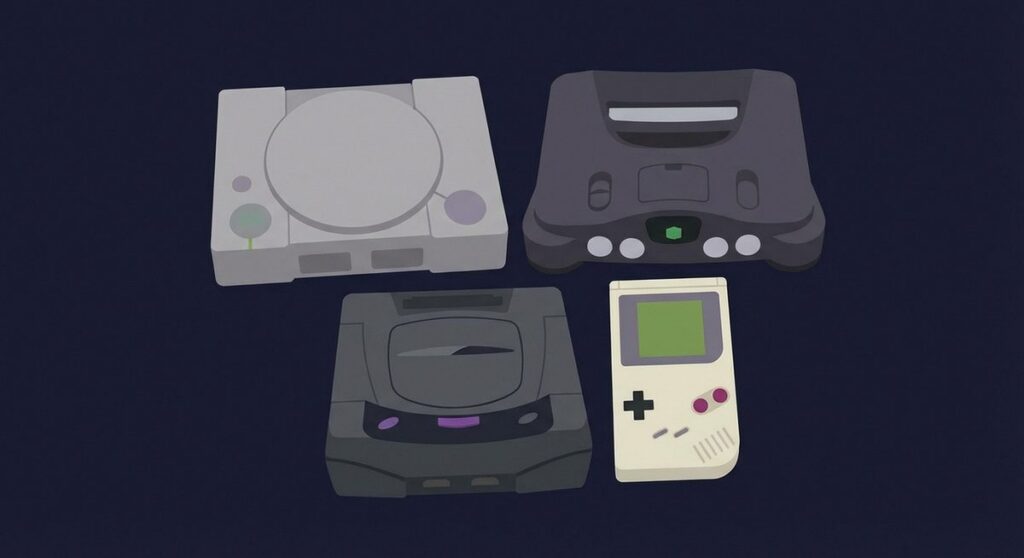
The 1990s were gaming’s most transformative decade. The industry entered the decade as a two-player contest between Nintendo and Sega fighting over 2D sprites. It exited with Sony as the new king, 3D polygons as the standard, and optical media replacing cartridges forever. In between came the fiercest console war in history, the most dramatic technology leap gaming had ever seen, and enough corporate missteps to fill a business school textbook. More major consoles launched in the 1990s than in any other decade — and every single one left a mark.
1990-1992: The 16-Bit Wars Rage
The decade opened with the Sega Genesis already established in North America and the Super Famicom launching in Japan on November 21, 1990. The SNES arrived in North America on August 23, 1991 at $199, bundled with Super Mario World. What followed was the most intense corporate rivalry gaming had seen.
Sega had the head start and the attitude. The “Genesis does what Nintendon’t” campaign targeted older gamers with edgier marketing. Sonic the Hedgehog (June 1991) gave Sega a mascot to rival Mario — faster, cooler, and designed to showcase the Genesis’s processing speed. The marketing term “blast processing” became Sega’s battle cry, regardless of its limited technical meaning. Under CEO Tom Kalinske, Sega of America captured the North American market lead by Christmas 1991.
Nintendo countered with technological superiority. The SNES’s Mode 7 rotation and scaling, 32,768-color palette, and the Sony SPC700 sound chip produced visuals and audio that the Genesis couldn’t match. RPGs flourished: Final Fantasy IV, VI, Chrono Trigger, EarthBound, Secret of Mana. Platformers peaked: Super Mario World, Donkey Kong Country, Super Metroid, Mega Man X. The SNES ultimately outsold the Genesis globally (49.10 million vs. 30.75 million), though Sega held North America for several years.
The NEC TurboGrafx-16 (1989 in NA) entered as a third competitor but couldn’t secure enough shelf space or third-party support in North America. In Japan, the PC Engine was far more successful, and its CD-ROM² add-on was influential — it proved that optical media could deliver superior audio and cinematic content years before the PlayStation.
The SNK Neo Geo AES (1990) occupied a unique niche: arcade-perfect gaming at a staggering $649 console price with games costing $200+. It was never a mass-market product, but for fighting game enthusiasts willing to pay, nothing else came close. The Neo Geo MVS arcade hardware was identical, meaning home versions were literally the arcade game. SNK later released the more affordable Neo Geo CD (1994) with the same game library on CDs, though load times were punishing.
1992-1993: CD-ROM and Multimedia Experiments
The early 1990s saw a wave of consoles betting on CD-ROM technology and “multimedia” capabilities. Most failed, but they pointed toward the future.
The Sega CD (Mega-CD) launched in 1992 as a Genesis add-on, promising full-motion video and CD-quality audio. It produced genuinely excellent games — Sonic CD, Lunar: The Silver Star, Snatcher — but also a deluge of terrible FMV “interactive movies” that became cautionary tales. The Sega CD sold approximately 2.24 million units.
The Philips CD-i (1991) was a multimedia player that happened to play games — most of them terrible. It’s remembered primarily for its notoriously bad Zelda and Mario games, licensed from Nintendo as part of a collapsed SNES CD-ROM partnership deal. The Commodore CDTV (1991) was Commodore’s attempt to market the Amiga as a living room media device. Both failed commercially.
The Panasonic 3DO (1993) was more ambitious. Designed by Trip Hawkins (EA founder), the 3DO was an open platform — any manufacturer could build a 3DO console. Panasonic, Goldstar, and Sanyo all produced models. The hardware was powerful for its time, but the $699 launch price was prohibitive. Despite strong titles like Road Rash, Need for Speed, and Gex, the 3DO sold only about 2 million units before the PlayStation rendered it obsolete.
The Amiga CD32 (1993) was the world’s first 32-bit CD-based console, built on Commodore’s Amiga architecture. It launched in Europe to reasonable interest but never reached North America, as Commodore filed for bankruptcy in April 1994.
1993-1994: Atari’s Last Stand and Sega’s Overextension
The Atari Jaguar launched in November 1993 with the claim of being the first “64-bit” console — a dubious marketing assertion based on the combined bus widths of its Tom and Jerry co-processors, while its main CPU was a 32-bit Motorola 68000. The Jaguar was powerful but notoriously difficult to program, and its game library was thin. Alien vs. Predator and Tempest 2000 were genuine highlights, but they couldn’t sustain a platform. The Jaguar sold fewer than 250,000 units, and the Jaguar CD add-on (1995) fared even worse. It was Atari’s last console — the company merged with disk drive manufacturer JTS Corporation in 1996.
Sega, meanwhile, was diluting its own market. The Sega 32X (November 1994) was a $159 add-on for the Genesis that promised 32-bit gaming as a bridge to the Saturn. Released just weeks before the Saturn’s Japanese launch, the 32X confused consumers, angered retailers, and split developer attention. It produced only 40 games and is widely cited as one of gaming’s worst hardware decisions. Combined with the Sega CD, Genesis owners now faced a Frankenstein tower of stacked hardware that was expensive, unwieldy, and directionless.
Other notable entries from this period include the Capcom CPS Changer (1994), a home version of Capcom’s arcade board that played genuine CPS1 arcade cartridges (priced at $399 with games costing $80-100), and the NEC PC-FX (1994), a Japan-only successor to the PC Engine that bizarrely focused on 2D sprite gaming and anime FMV while the rest of the industry moved to 3D. The PC-FX sold just 400,000 units.
1994-1996: The 3D Revolution
The mid-1990s brought the most significant technological shift in console history: the transition from 2D to 3D.
The Sega Saturn launched in Japan on November 22, 1994 and was initially successful, particularly with its library of 2D fighting games and arcade ports. But Sega of America, under Tom Kalinske, made a catastrophic decision: a surprise US launch at E3 1995, four months ahead of schedule, at $399. Retailers who weren’t included in the surprise launch — including major chains — were furious and pulled support. Sony’s Steve Race famously countered Sega’s announcement by walking to the E3 podium, saying “$299” (the PlayStation’s price), and walking off. The Saturn never recovered in North America, selling approximately 9.26 million units globally despite a strong Japanese library.
The Sony PlayStation transformed the industry. Launched in Japan on December 3, 1994 and in North America on September 9, 1995, it offered powerful 3D hardware, CD-ROM storage (enabling cinematic games with full soundtracks), and a developer-friendly architecture. Sony aggressively courted third parties with better licensing terms than Nintendo or Sega offered. The results were transformative: Final Fantasy VII moved from Nintendo to PlayStation, Metal Gear Solid defined cinematic stealth gaming, Resident Evil created survival horror, and Gran Turismo set the standard for racing simulations. The PlayStation sold 102.49 million units.
The Nintendo 64 arrived on June 23, 1996 in Japan and September 29, 1996 in North America. Its 64-bit NEC VR4300 CPU was powerful, and its launch with Super Mario 64 — which redefined 3D game design overnight — was spectacular. The N64 pioneered analog stick controls (now universal), rumble feedback (via the Rumble Pak), and four-player local multiplayer as standard. But its insistence on cartridges drove away third parties, and the library of just 387 games couldn’t compete with the PlayStation’s 2,400+. The N64 sold 32.93 million units.
1995-1996: The Oddities and the Fallen
The mid-1990s produced several consoles that, while commercially unsuccessful, are fascinating historical footnotes:
The Nintendo Virtual Boy (1995) was Gunpei Yokoi’s ill-fated attempt at “portable” 3D gaming. Its monochrome red-and-black display, headache-inducing stereoscopic effects, and tripod-mounted design made it one of Nintendo’s rare outright failures. It was discontinued within a year, with only 22 games released. Today, it’s highly collectible.
The Bandai Pippin ATMARK (1995) was an Apple-designed multimedia console based on the Power Macintosh architecture, marketed by Bandai. At $599 with a confusing value proposition, it sold fewer than 42,000 units and is one of the rarest major-brand consoles.
The Casio Loopy (1995), a Japan-only console marketed exclusively at girls with a built-in sticker printer, and the Funtech Super A’Can (1995), a Taiwanese console with only 12 games, round out the decade’s more obscure entries.
1998-1999: The Dreamcast and the End of an Era
The Sega Dreamcast launched in Japan on November 27, 1998 and in North America on September 9, 1999, kicking off the sixth console generation. Powered by the Hitachi SH-4 CPU and NEC PowerVR2 GPU, the Dreamcast was a genuine leap forward. It featured a built-in 56K modem for online gaming (a first for consoles), the innovative Visual Memory Unit (VMU) memory card with its own screen and controls, and a library of critically acclaimed games: Sonic Adventure, SoulCalibur, Shenmue, Jet Set Radio, Crazy Taxi.
The Dreamcast’s North American launch was the most successful in console history at that point, with $98.4 million in first-day sales. But the looming arrival of the PlayStation 2 — with its DVD playback and massive hype — cast a shadow that Sega couldn’t escape. Sega’s damaged brand reputation (thanks to the 32X, Saturn, and perceived lack of commitment to each platform) made consumers and retailers cautious. The Dreamcast was discontinued on March 31, 2001, and Sega exited the hardware business permanently, becoming a third-party publisher. The Dreamcast sold approximately 9.13 million units — modest numbers for a console of its quality, and a bittersweet end to Sega’s hardware legacy.
Complete List of Major 1990s Home Consoles
- 1990 — Super Famicom (JP), SNK Neo Geo AES, Commodore 64GS, Amstrad GX4000
- 1991 — SNES (NA), Philips CD-i, Commodore CDTV, Sega CD
- 1992 — Sega CD (NA), Victor Wondermega / JVC X’Eye
- 1993 — Panasonic 3DO, Atari Jaguar, Amiga CD32, Fujitsu FM Towns Marty, Pioneer LaserActive
- 1994 — Sega Saturn, Sony PlayStation, Sega 32X, Sega CDX, SNK Neo Geo CD, Capcom CPS Changer, NEC PC-FX, Bandai Playdia
- 1995 — Nintendo Virtual Boy, Bandai Pippin, Atari Jaguar CD, Casio Loopy
- 1996 — Nintendo 64
- 1998 — Sega Dreamcast (JP)
- 1999 — Sega Dreamcast (NA/EU), Nintendo 64DD (JP only)
Legacy
The 1990s reshaped gaming more fundamentally than any other decade. The transition from 2D to 3D changed what games could be. The shift from cartridges to CDs changed how games were distributed and how much content they could contain. Sony’s entrance proved that new players could not just compete but dominate. Sega’s decline proved that even beloved brands could fall if corporate strategy fractured. And the games themselves — Super Mario 64, Ocarina of Time, Final Fantasy VII, Metal Gear Solid, Resident Evil — didn’t just define a generation. They defined what video games could aspire to be.