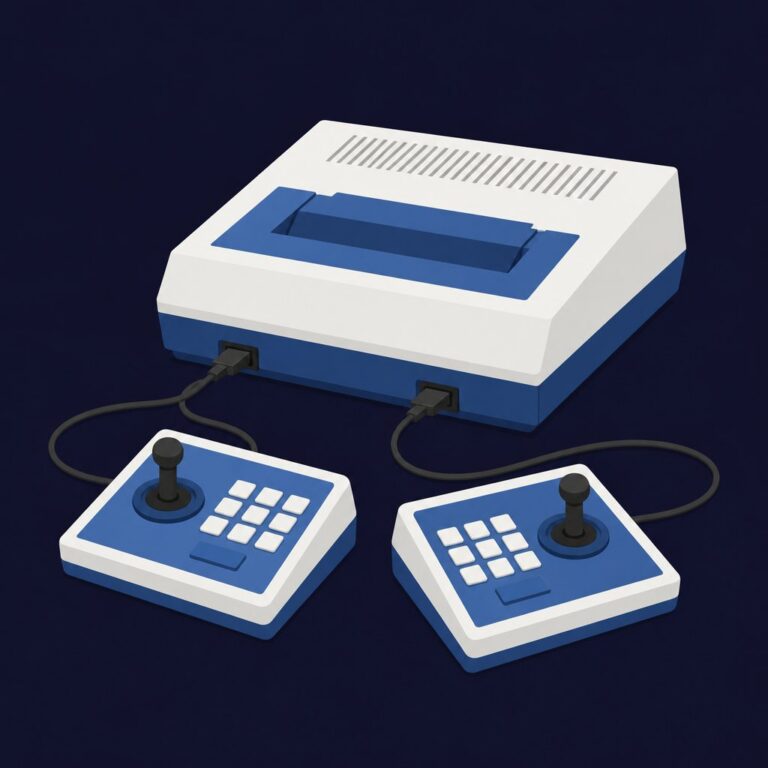
The Super Vision 8000 is a second-generation cartridge console made by Bandai. It went on sale in Japan in December 1979 at ¥59,800. It ran on a Z80-compatible processor and was Bandai’s first programmable console after a run of Pong-style machines.
The Bandai Super Vision 8000 is one of the earliest cartridge consoles built in Japan, and one of the least documented. It sits at the end of a family of fixed-game television sets and ahead of Bandai’s turn toward distributing other companies’ hardware. Its life was short, its library came to seven cartridges, and it was sold only in Japan. During development it carried the name TV-Jack 8000, taken from the line of machines that came before it.
From TV Jack to Super Vision
Bandai entered video games in 1977 with Pong-style consoles sold under the TV Jack name. Six of them appeared in about two years. They were discrete-logic machines with the games built in, so a player got whatever the box already contained.
Work on the Super Vision 8000 began in 1978 under the working name TV-Jack 8000, also given as the TV Jack Micro Computer System. Bandai built it with an outside firm, L.S.I., and a custom LSI chip. The machine was the last of the TV Jack series and the first of them to use a CPU, and it has been billed as the first programmable game cartridge system released in Japan.
Bandai unveiled it at the Tokyo International Toy Fair in autumn 1979, and Japanese newspaper coverage dates to September of that year. It went on sale in December 1979 for ¥59,800. Some materials give 12 December as the day. Ordinary TV game machines of the time cost around ¥20,000, so the Super Vision 8000 sold at roughly three times that level.
| Year | Event |
|---|---|
| 1977 | Bandai starts in video games with Pong-style TV Jack consoles |
| 1978 | Development of the TV-Jack 8000 begins |
| Autumn 1979 | Unveiled at the Tokyo International Toy Fair |
| December 1979 | Super Vision 8000 goes on sale at ¥59,800 |
| 1980 | Bandai becomes sole Japanese maker of the Mattel Intellivision |
| 1982 | Latest date for the end of production |
Hardware
The earlier TV Jack machines could only play the games built into them. The Super Vision 8000 loaded its programs from cartridges and ran them on a microprocessor, which fits the TV Jack Micro Computer System name it carried in development.
The processor was an NEC D780C-1, a Z80 clone. Most descriptions give its clock as 3.58 MHz, although MAME models it at about 1.79 MHz and notes that the clocks are unverified. System RAM was 1 KB, with 3 KB of video RAM.
Graphics came from an AMI S68047, a clone of the Motorola 6847 video chip. It offered a 256 by 192 mode with two colors (used for a 32 by 16 text display with an 8 by 12 font), a 128 by 192 bitmap mode with two colors, and a 128 by 96 bitmap mode with four colors. Sound came from a General Instrument AY-3-8910 with three channels plus noise, although MAME flags the exact sound chip for verification. An NEC D8255C handled input and output.
The modes explain what games on the system looked like. The text screen of 32 by 16 characters held 512 characters at a time. The 128 by 96 four-color bitmap was the only mode with more than two colors, and it held 12,288 pixels. The 256 by 192 mode was the sharpest, but with two colors only.
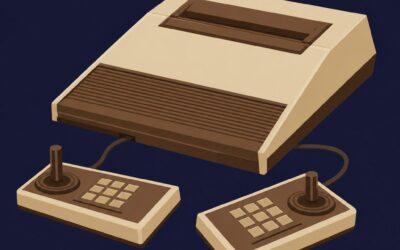
Two controllers were supplied. Each combined a 12-button keypad with a joystick, and both were hardwired to the console and cradled at its sides.
The console connected to the television directly over RF. It ran from AC 100 V at 50 or 60 Hz, drawing 18 VA, and its power supply delivered 9 V DC at 800 mA and at 100 mA on two outputs. Games came on ROM cartridges.
The Library
All seven games came from Bandai itself. Missile Vader was the launch title. The other six were Space Fire, Othello, Gun Professional, Pac Pac Bird, Submarine and Beam Galaxian. MAME’s cartridge list dates Missile Vader to 1979 and the other six to 1980, while other sources give 1979 for all seven. Beam Galaxian was bundled with the console in later production runs. MAME lists Gun Professional under the name Gun Fighter.
A tank game, Super Tank, was cancelled. Bandai also planned a keyboard that would have turned the console into a home computer, and it never reached the market.
Why It Ended Quickly
Sales were weak. The price was high, and the Japanese market was changing. In 1980 Bandai took the rights to be the sole Japanese maker of the Mattel Intellivision and refocused on it; for the American machine, see the Mattel Intellivision page. From 1982 Bandai distributed foreign consoles such as the Intellivision rather than developing its own. The Super Vision 8000 therefore stayed Bandai’s only programmable cartridge console of the period. Production ended no later than 1982, and one account says it stopped within a year of release.
Sources disagree on what followed. One lists the Bandai Arcadia as the successor, another names the Playdia of 1994 as Bandai’s next home console. Bandai’s later CD-based hardware is covered in the Bandai Pippin entry. The wider period appears in the 70s game consoles overview and on the console timeline.
Preservation Today
MAME includes a driver for the Super Vision 8000 dated 1979, with save-state support. Its colors are marked imperfect, and its authors list the clocks, sound chip and colors as items to verify. The cartridge list in MAME holds all seven games.
Frequently Asked Questions
When was the Bandai Super Vision 8000 released?
It went on sale in Japan in December 1979, after being shown at the Tokyo International Toy Fair that autumn. Some materials give 12 December as the exact day.
How much did the Super Vision 8000 cost?
It launched at ¥59,800. Ordinary TV game machines of the time cost around ¥20,000.
How many games were released for the Super Vision 8000?
Seven: Missile Vader, Space Fire, Othello, Gun Professional, Pac Pac Bird, Submarine and Beam Galaxian. All were published by Bandai.
What processor did the Super Vision 8000 use?
An NEC D780C-1, a Z80 clone. Most descriptions give 3.58 MHz, while MAME models about 1.79 MHz.
Why did the Super Vision 8000 fail?
Its price was high and the Japanese market was changing. In 1980 Bandai took the rights to make the Mattel Intellivision in Japan and refocused on it.
Can the Super Vision 8000 be played today?
MAME has a driver for it with imperfect colors, and its cartridge list covers all seven games.