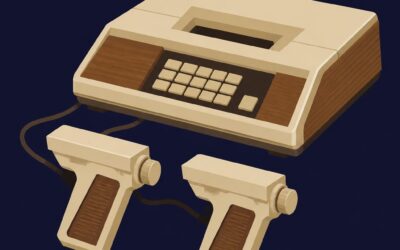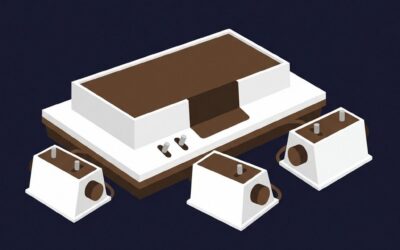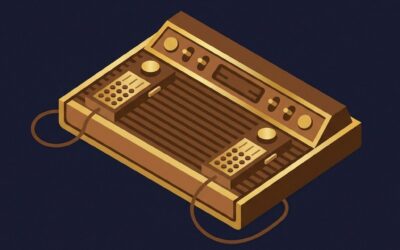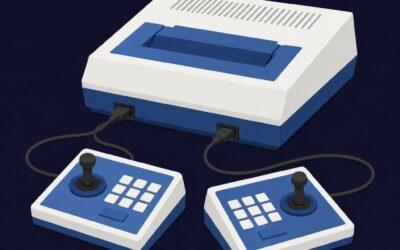
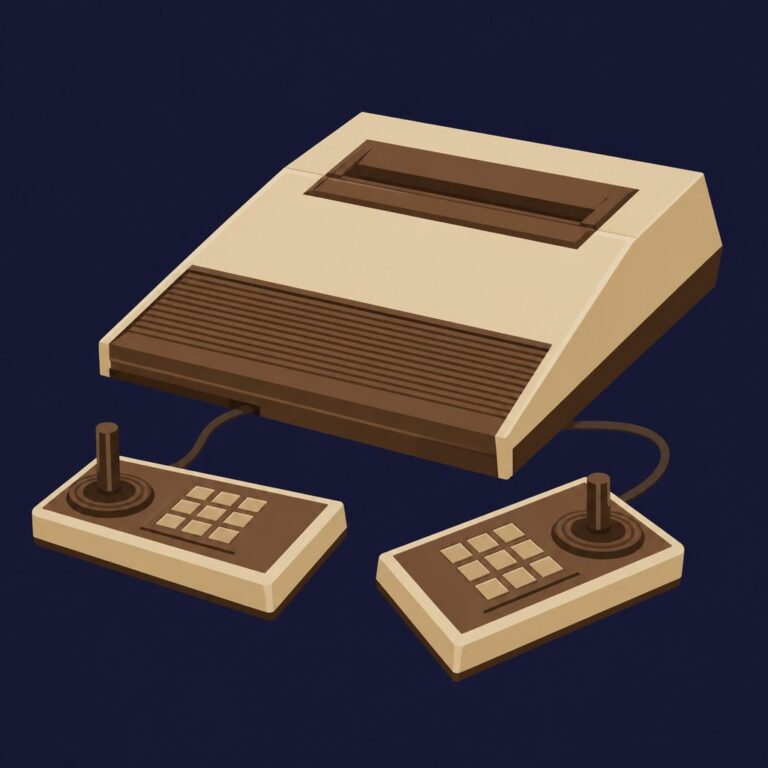
The Interton VC 4000 is a second-generation cartridge console made by the German hearing-aid company Interton and launched in 1978 at DM 298. The same Signetics 2650 hardware was sold in the late 1970s and early 1980s under dozens of names, including the 1292 Advanced Programmable Video System from Radofin, across Europe, Australia and Argentina.
The Interton VC 4000 and the 1292 Advanced Programmable Video System are not one console but a family. A handful of firms bought or licensed the same chipset and wrapped it in different cases, with new names for each country. The best-known members are the Interton VC 4000 from Germany, the Radofin 1292 and the British Acetronic MPU-1000. Collectors treat them together because their games share a format, even where the cartridges will not physically fit each other.
Interton and the VC 4000
Interton was founded in Cologne in 1962 as a hearing-aid maker and later added calculators. From 1975 it produced consoles licensed from the Magnavox Odyssey, sold as Video 2000. Its computer business ended in 1983.
The VC 4000 launched in 1978 at DM 298, and the Heinz Nixdorf MuseumsForum calls it the first German video game console. Cartridges cost DM 40 to 50 each. Per the museum, the VC 4000 was based on the 1292 APVS from Radofin, which it places in London. Other accounts reverse the order and say the 1292 group began selling after the VC 4000, and describe Radofin as a Hong Kong company. The VC 4000 was sold in Germany, England, France, Spain, Austria, the Netherlands and Australia.
Dating the 1292
The 1292 APVS has no firm launch date. MAME lists it under 1976. A 2009 reference book lists the VC 4000 and the Audiosonic PP-1292 as the oldest of the family, both from 1978, and a Radofin manual carries a 1979 copyright. A late-1970s window of 1978 to 1979 covers the evidence, with the VC 4000 firmly in 1978.
Hardware
All members use a Signetics 2650 processor running at about 0.887 MHz. A museum entry gives 4.43 MHz, which is the crystal rate rather than the processor clock. Video comes from a Signetics 2636 programmable video interface at 3.58 MHz. It offers four sprites, one of which can show up to eight colors, a score line and a simple background. The Heinz Nixdorf MuseumsForum describes the image as 128 by 200 pixels, and sound is basic and comes from the same chip.
Main memory was tiny, 37 bytes in one description and 43 in others. Cartridges added the rest: 2 KB or 4 KB of ROM, or 4 KB or 6 KB with an extra 1 KB of RAM. The console ran from a 250 V, 50 Hz mains supply and used the PAL standard.
Controllers and the Hobby Module
Two controllers were hardwired to the console. Each combined a keypad with a two-axis stick, and sources give 12 and 14 buttons for the keypad. Interton shipped overlay templates to label the keypad per game. On the Interton and Voltmace models the sticks centered themselves, while the Acetronic MPU-1000 and the Radofin 1292 did not. The console itself had Select, Start and Reset buttons.
Interton cartridges are not physically compatible with the Radofin models, although MAME notes the ROM contents are. In 1980 Radofin added a Hobby Module with a 5-pin DIN cassette interface, 2 KB of monitor ROM and 2 KB of RAM, for writing assembly programs. Radofin also sold a Tank War pack with two controllers and a Target Gallery pack with two light guns.
The Clone Family
MAME’s driver for the family covers 25 machines. Most of them date to 1979. The Audiosonic PP-1292 is listed for 1978, the Spanish TRQ H-21 for 1982, and the French ITMC MPT-05 for 1980 in MAME and 1983 in a reference table.
| Brand and model | Country |
|---|---|
| Interton VC 4000 | Germany |
| Grundig Super Play Computer 4000 | Germany, Austria |
| Radofin 1292 / 1392 APVS | Europe |
| Audiosonic PP-1292 / PP-1392 | Europe |
| Acetronic MPU-1000 / MPU-2000 | UK |
| Voltmace Database | UK |
| Rowtron / Teleng Television Computer System | UK |
| Prinztronic VC 6000 | UK |
| Hanimex HMG-1292 / HMG-1392 | Australia, New Zealand, Europe |
| Fountain Force 2 / 1392 | Australia, New Zealand |
| Lansay 1392 | France |
| SOE OC Jeu Video TV Karvan / OC-2000 | France |
| ITMC MPT-05 / Video Ordinateur | France |
| Palson CX 3000 Tele Computer | Spain |
| TRQ Video Computer H-21 | Spain |
| Koerting TVC-4000 | Argentina |
The Radofin 1292 used an external power supply and the 1392 an internal one. The Elektor TV Games Computer of 1979 appears in the same MAME driver but is a kit design with separate hardware. The Spanish TRQ H-21 is only partly compatible with the VC 4000 library.
Games
Interton numbered 37 cartridges, starting with Car Races, a module of ten car-race programs. A community cartridge list that includes the other brands reaches 49 titles, and the other makers numbered their own cartridges: Acetronic 33, Voltmace 26, Cabel, Rowtron and TRQ 24 each, Karvan 11.
Module 23 holds eight pinball programs, and a flight simulator, Cockpit, received the top mark in a German handbook. The list also includes Super Invaders, Chess, Backgammon, Draughts and Monster Man, a Pac-Man style game. Super Knockout packs 128 programs, Hunting 64 and Shooting Gallery 32. Radofin and Acetronic added Head On, Laser Attack, Shoot Out and Grand Prix, with the first three at £14.95 each and Grand Prix at £18.95. Come Come, known as Come-Frutas, appeared in Spain only.
British magazines of the 1980s priced cartridges at £13 to £23, and the Cockpit console at just under £100. Hanimex distributed Cockpit and Super Invader in the UK.
The End and Preservation
Interton ended its computer business in 1983, and the family faded with it. The same Signetics lineage, a 2650 with a 2637 video chip, reappeared in the Emerson Arcadia 2001 line; see Emerson Arcadia 2001. For broader context, see the 70s game consoles and the console timeline.
MAME emulates every machine in the family, although all carry an imperfect-graphics flag. Its cartridge list holds 37 entries, 36 of them Interton. A community reference has scanned 47 of the 49 manuals, with German and Dutch translations. Only the Crazy Crab and Leapfrog manuals are missing. The Museo del Videojuego documents the Radofin 1292 online.
Frequently Asked Questions
How much did the Interton VC 4000 cost?
The console launched at DM 298 and cartridges cost DM 40 to 50 each. In the UK of the 1980s the Cockpit console sold for just under £100.
When was the Interton VC 4000 released?
In 1978, in Germany and neighbouring markets. The 1292 Advanced Programmable Video System is dated between 1978 and 1979 depending on the source.
What is the 1292 Advanced Programmable Video System?
It is Radofin's console on the same Signetics 2650 hardware as the VC 4000. It was sold as well under names such as Acetronic, Hanimex, Audiosonic, Prinztronic and Voltmace.
How many games were released for the VC 4000?
Interton numbered 37 cartridges. A community list that includes the other brands' cartridges reaches 49 titles.
Which clones of the VC 4000 exist?
They include the Grundig Super Play Computer 4000, Acetronic MPU-1000, Voltmace Database, Hanimex HMG-1292, Lansay 1392, Palson CX 3000 and Koerting TVC-4000, sold in Germany, the UK, France, Spain, Australia and Argentina.
Can the VC 4000 be emulated?
Yes. MAME's driver covers 25 machines of the family, though all are flagged with imperfect graphics.