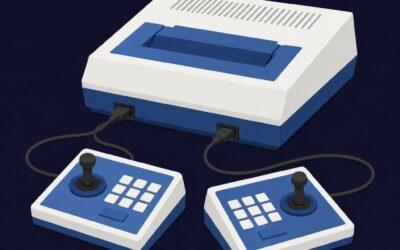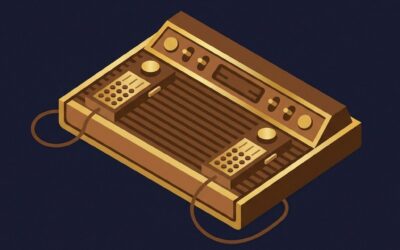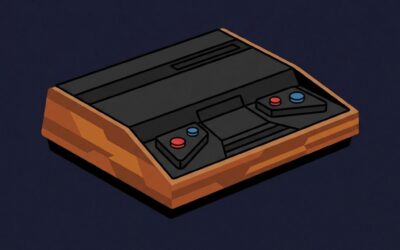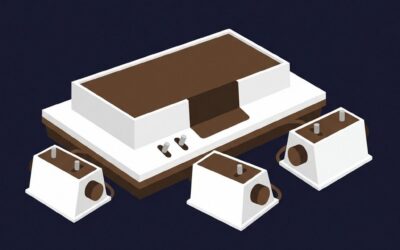
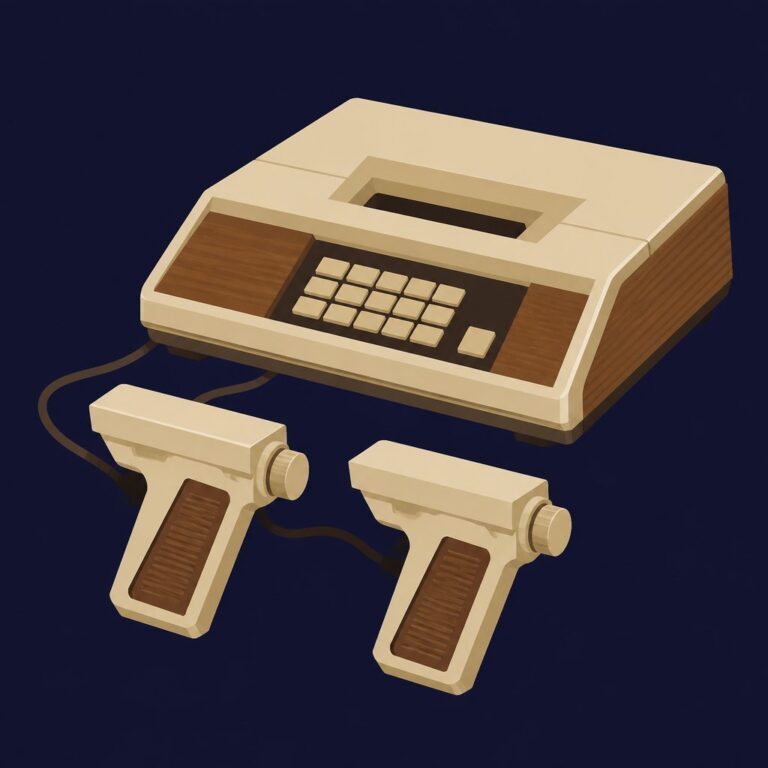
The Bally Astrocade is a second-generation cartridge console designed by Dave Nutting Associates for Bally’s Midway division. It was announced in October 1977 as the Bally Home Library Computer, and the first units shipped in January 1978 in the United States at US$299. It was sold as the Bally Professional Arcade, later as the Astrovision and Astrocade.
The Bally Astrocade is a console with a computer’s ambitions and an arcade company’s graphics chip. It had a built-in calculator and BASIC programming, an expansion port that took it to 64 KB of memory and a pistol-grip controller with a twisting joystick. It also carried at least four names during its life, which is the main reason it is hard to look up. Names aside, all the versions run the same hardware and the same cartridges.
From Home Library Computer to Professional Arcade
Bally’s Midway division hired Dave Nutting Associates to design one video chip for both arcade games and a home computer. The chip family later ran Midway arcade boards such as Gorf and Wizard of Wor. The Computer History Museum describes Nutting’s work as a powerful graphics processor paired with a Zilog Z80.
Bally announced the machine in October 1977 as the Home Library Computer. It was sold first by mail order through the Chicago firm JS&A, which collected more than 8,000 orders, but nothing shipped in 1977. The console failed FCC radio-frequency interference tests, and first units reached buyers in January 1978. By then it had been renamed the Bally Professional Arcade. The launch games were Sea Wolf, 280 ZZZAP and Panzer Attack, and the price was US$299, which some listings give as $299.95.
Bally’s BASIC cartridge followed in 1978 (sources give August and October). It was based on Li-Chen Wang’s Palo Alto Tiny BASIC, and Jamie Fenton wrote it.
Names and Owners
| Name | Period | Notes |
|---|---|---|
| Bally Home Library Computer | 1977 announcement | Mail-order name |
| Bally Professional Arcade | 1978 | Woodgrain case with a black base; a limited white version and a Montgomery Ward private-label version also existed |
| Bally Computer System | 1981 | Relaunch under Astrovision |
| Astrocade | From 1982 | Astrovision’s trademark licence lapsed; sold with the Arcade Plus bundle and Astrovision BASIC |
In August 1980 Bally agreed to sell its consumer products division to Astrovision, a Columbus company that also controlled E. F. Johnson, the maker of the motherboard. Astrovision relaunched the console in 1981 as the Bally Computer System. Its licence to use the Bally trademark lapsed in 1982, and the product became the Astrocade, with Astrovision renamed Astrocade Inc.
Hardware
The processor was a Zilog Z80 at 1.789 MHz. One description gives 3.579 MHz, the color-burst master clock. The base machine had 4 KB of RAM, shared with the screen, and the expansion port raised that to 64 KB. The system ROM held 8 KB and carried four built-in programs: Gunfight, Checkmate, Calculator and Scribbling.
Nutting’s custom chip drew a 160 by 102 picture, usable in practice. A 320 by 204 mode existed but could not be used on the console because its pins were not connected. Each pixel took one of four colors from a palette of 256, and a split-screen register swap allowed up to eight on screen. There were no hardware sprites. With BASIC loaded, the screen shrank to 160 by 88. Sound came from three square-wave voices plus noise and hardware vibrato.
Controllers, memory and add-ons
Four controller ports sat on the back, along with a 50-pin expansion connector and a light-pen port. The controller was a pistol grip with a trigger and an 8-way joystick that twisted to act as a paddle, and a 24-key hex pad was built into the console. Games came on cassette-sized Videocade ROM cartridges of 8 KB, and the case had a compartment for up to 15 of them. A data cassette interface worked through BASIC.
Memory options came from third parties. Blue RAM arrived in June 1980 in 4 KB and later larger sizes, and R&L Enterprises sold a 64 KB board. The Viper System 1 of April 1981 added 16 KB of RAM, tape BASIC and a 62-key keyboard. Midway planned a ZGRASS-100 keyboard computer, but Bally never released it.
Games
The library numbered about 28 distinct cartridges, with 19 listings from Bally, 7 from Astrovision and 6 from Astrocade Inc., plus the four built-in programs. Counts vary with how BASIC and utility cartridges are included: one tally reaches 31 cartridges and 51 games and applications with the built-in programs.
Bally’s 1978 line-up included Sea Wolf and 280 ZZZAP. Space Invaders arrived in October 1979 and was later reissued as Astro Battle. Under Astrovision came Galactic Invasion, a Galaxian game, in August 1981, Demolition Derby and Grand Prix in September 1981 and Space Fortress in October 1981. The Incredible Wizard followed in August 1982 and Artillery Duel in October 1982. Astrocade Inc. released Muncher in March 1983. Late releases continued until December 1985 and included Bowling, Checkers, Conan the Barbarian, Missile Attack, Music Maker, Soccer, Songs by George Moses and Video Story Book.
The console had a strong hobbyist scene around BASIC. Unlicensed tape and cartridge games were published later, and prototypes of Conan the Barbarian, Mazeman, Soccer and Fawn Dungeon survive. Games magazine placed the console in its Top 100 Games of 1981, and in 1983 Danny Goodman praised its graphics and sound.
Why It Ended
Sales were small. One account counts only 28,000 units by mid-1979. Bally withdrew from the consumer business in 1980, and Astrovision refocused on gaming just in time to be caught by the crash of 1983. Astrocade Inc. filed for Chapter 11 in 1984, and the Computer History Museum records the console as taken off the market in 1985. Sources therefore give end dates between 1983 and 1985. Roughly 110 BASIC cartridges sold to about 25 people in 1986.
Other consoles of the same years include the Atari 2600 and the Mattel Intellivision. For the era in general, see the 70s game consoles.
Preservation Today
MAME has drivers for the Professional Arcade, the Home Library Computer and the Computer System, with save-state support and no flags marking it as not working. The Astrocade software list holds 127 entries, including prototypes. The Computer History Museum holds a console, a gift of Michael Walter. A service manual and a 1982 Astrocade cartridge catalog survive online, and no clones of the console are known.
Frequently Asked Questions
How much did the Bally Astrocade cost?
It launched at US$299, which some listings give as $299.95.
When was the Bally Astrocade released?
Bally announced it in October 1977 as the Home Library Computer. Mail-order orders were taken in 1977, but nothing shipped until January 1978 after FCC interference delays.
How many games did the Astrocade have?
About 28 distinct cartridges plus four built-in programs: Gunfight, Checkmate, Calculator and Scribbling. Tallies vary, and one counts 31 cartridges and 51 games and applications.
Is the Bally Professional Arcade the same as the Astrocade?
Yes. The Home Library Computer, Professional Arcade, Computer System and Astrocade are the same hardware sold under different names and owners.
Who designed the Astrocade?
Dave Nutting Associates designed the custom video chip and the system for Bally's Midway division.
Why did the Astrocade fail?
Sales were small, at 28,000 units by mid-1979. Bally left the consumer business in 1980, and Astrocade Inc. filed for Chapter 11 in 1984 after the crash of 1983.