
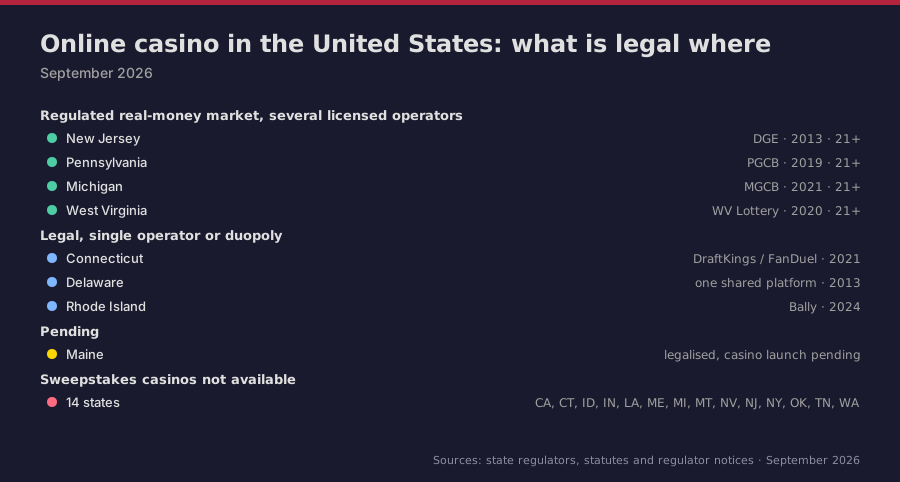
Two different products share the word “casino” online in the United States. Seven states run legal online casinos through a licensed operator and a state gaming regulator: New Jersey, Pennsylvania, Michigan, West Virginia, Connecticut, Delaware and Rhode Island. Everywhere else, whether a sweepstakes casino, a Gold Coins and Sweeps Coins model that carries no purchase requirement, can fill that gap depends on the state. Utah and Hawaii prohibit all forms of gambling outright; Delaware, Illinois (cease-and-desist letters to 65 platforms, February 2026), Mississippi (cease-and-desist letters, April 2026) and Kentucky (an Attorney General lawsuit against VGW) restrict sweepstakes platforms through enforcement; and Oklahoma’s ban under SB 1589 takes effect 1 November 2026.
 Pulsz
PulszEstablished 2020, 700+ titles, one of the most consistently reviewed platforms
Free Gold Coins and Sweeps Coins on sign-up No purchase necessary. Void where prohibited.
- Age
- 21+
- Games
- 300+ games
- Payments
- Credit/debit card · Apple Pay · Online banking
- Registration
- Sweepstakes model, no purchase necessary
- Gold Coins + Sweeps Coins
- No purchase necessary
- 21+
- Prize redemption where available
No purchase necessary. Void where prohibited. 21+ Bet with your head, not over it. If you or someone you know has a gambling problem and wants help, call 1-800-GAMBLER.
 WOW Vegas
1,800+ games, fast redemptions, proactively withdrew from restricted states
Free Gold Coins and Sweeps Coins on sign-up No purchase necessary. Void where prohibited.
- Age
- 21+
- Payments
- Credit/debit card · Apple Pay · Online banking
- Registration
- Sweepstakes model, no purchase necessary
- Gold Coins + Sweeps Coins
- No purchase necessary
- 21+
- Prize redemption where available
No purchase necessary. Void where prohibited. 21+ Bet with your head, not over it. If you or someone you know has a gambling problem and wants help, call 1-800-GAMBLER.
 High 5 Casino
Proprietary High 5 Games slots you will not find elsewhere
Free Gold Coins and Sweeps Coins on sign-up No purchase necessary. Void where prohibited.
- Age
- 21+
- Games
- 500+ games
- Payments
- Credit/debit card · Apple Pay · Online banking
- Registration
- Sweepstakes model, no purchase necessary
- Gold Coins + Sweeps Coins
- No purchase necessary
- 21+
- Prize redemption where available
No purchase necessary. Void where prohibited. 21+ Bet with your head, not over it. If you or someone you know has a gambling problem and wants help, call 1-800-GAMBLER.
 CasinoClick
Browser-based, short exclusion list, modern slot studios
Free Gold Coins and Sweeps Coins on sign-up No purchase necessary. Void where prohibited.
- Age
- 21+
- Payments
- Credit/debit card · Apple Pay · Online banking
- Registration
- Sweepstakes model, no purchase necessary
- Gold Coins + Sweeps Coins
- No purchase necessary
- 21+
- Prize redemption where available
No purchase necessary. Void where prohibited. 21+ Bet with your head, not over it. If you or someone you know has a gambling problem and wants help, call 1-800-GAMBLER.
 Ace
AceNewest platform in the set (2025), quick sign-up
Free Gold Coins and Sweeps Coins on sign-up No purchase necessary. Void where prohibited.
- Age
- 21+
- Payments
- Credit/debit card · Apple Pay · Online banking
- Registration
- Sweepstakes model, no purchase necessary
- Gold Coins + Sweeps Coins
- No purchase necessary
- 21+
- Prize redemption where available
No purchase necessary. Void where prohibited. 21+ Bet with your head, not over it. If you or someone you know has a gambling problem and wants help, call 1-800-GAMBLER.
That is deliberate: nobody is shown a product they cannot legally use. A longer look at each platform, plus the reasoning behind the list, sits on the sweepstakes casinos pillar page this ranking belongs to.
What a Regulated Online Casino Actually Is
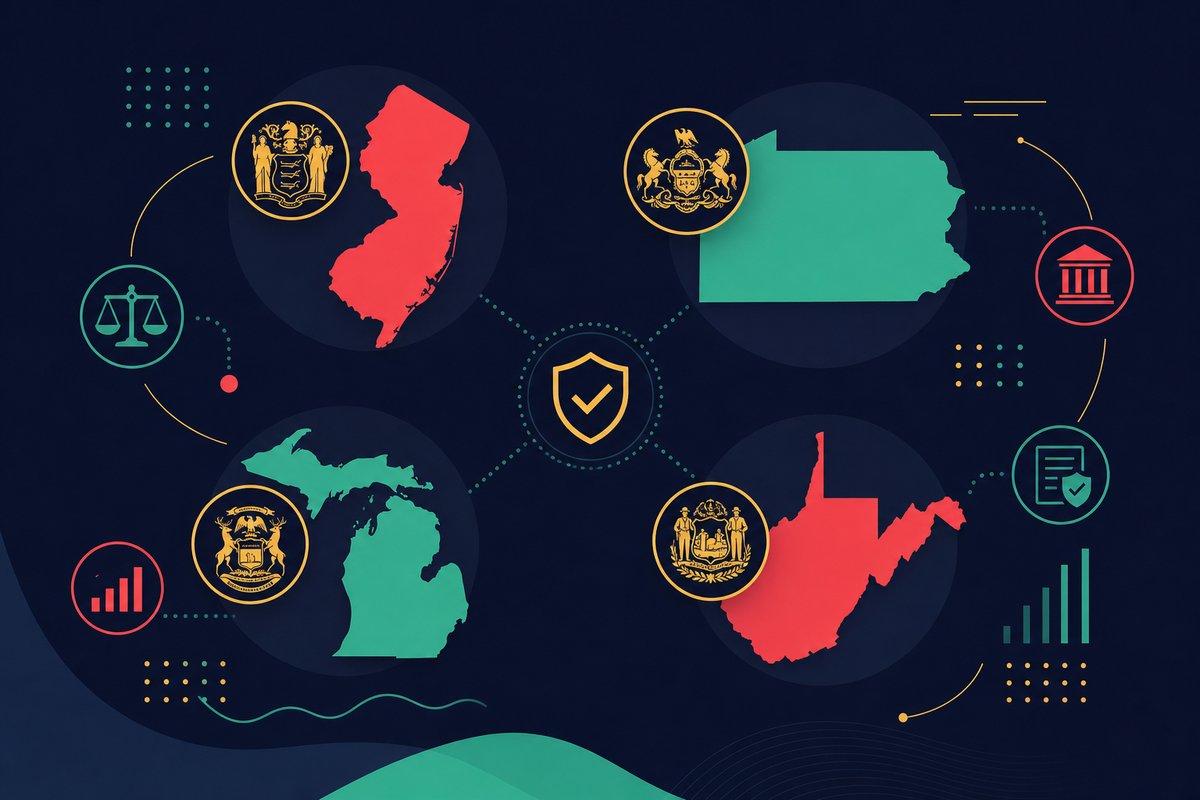
The word “casino” gets applied loosely online, so it helps to say plainly what separates a regulated site from everything else calling itself one. A regulated online casino operates under a license issued by a state gaming regulator, the same kind of body that oversees a physical casino floor, and every one of the four states this page covers in detail, New Jersey, Michigan, Pennsylvania and West Virginia, requires that license before a single game goes live. Pennsylvania’s regulator, the Pennsylvania Gaming Control Board, describes its framework as licensing-at-the-point-of-consumption, with online licenses attached directly to a land-based casino license, not issued as a standalone product; the other three states run a similar tethered structure, even where the underlying statute reads differently.
Three technical requirements sit underneath that license and apply across all four states. Geolocation software confirms, at every login and periodically through a session, that the device is physically inside the licensed state, not merely that the account holder lives there; a player who crosses a state line mid-session gets logged out. Identity verification, commonly called KYC (know your customer), confirms the player is a real adult using their own identity, checked against government-issued ID and other identity data at signup. And every game’s random number generator is independently tested and certified by an accredited laboratory before the state regulator will approve it for real-money play, the same certification process that applies to a physical slot machine on a casino floor.
Sweepstakes casinos, the subject of most of the rest of this page, sit entirely outside that structure. They hold no state gambling license, because the sweepstakes model is legally distinct from gambling in the first place; nothing above about state licensing, tethered land-based partners or gaming-regulator certification applies to them. That distinction is the reason this page treats the two categories separately, not as points on a single ranking.
How This Page Rates the Platforms Above
The five sweepstakes platforms in the ranking above are not scored on a single number pulled from a marketing page. Four factors go into how they are ordered, and each one comes from the same data used throughout this page: how clearly the operator states the no-purchase-necessary alternative to its coin model, the number of states each platform excludes (a shorter exclusion list means more readers can actually use the site), the range and speed of redemption methods on offer, and the diversity of the game-provider library behind the platform.
Pulsz tops the list on this basis: a broad game library sourced from Relax Gaming, Booming Games and more than a dozen other studios, a gift-card redemption path starting at just $10, and a platform that has operated continuously since 2020 with a long enough track record to compare against newer entrants. WOW Vegas and High 5 Casino follow for different reasons: WOW Vegas for the breadth of its redemption rails, Skrill, Trustly and Prizeout all processing within roughly a business day, and High 5 Casino for running its own proprietary High 5 Games slot catalog instead of licensing exclusively from third parties. CasinoClick and Ace round out the five with shorter track records and narrower state lists, positioned as newer names worth trying, not the most established options in the category.
None of this is a claim about which platform pays out the most or wins the most often; the games themselves run on the same third-party studio content across most of the category, so outcomes are not something a ranking can meaningfully compare. What the ranking measures is access, transparency and how the platform behaves once a Sweeps Coins balance is ready to be redeemed.
Where You Are Decides the Product
Ask “can I play an online casino game for money in the US” and the honest answer starts with a second question: which state. Real-money online casino, the kind licensed and taxed the way a physical casino is, currently exists in only seven states. Nevada, home to the country’s largest brick-and-mortar casino industry, has never licensed online casino games at all, only online poker. Most of the remaining forty-plus states have no regulated online casino framework whatsoever, and in a number of them a sweepstakes casino fills the gap instead, legally distinct from gambling because no purchase is required to participate.
Searches for online casinos USA usually mean one of two things. In the seven regulated markets, legal online casinos hold a licence from a state regulator and answer to it. Everywhere else, whether a sweepstakes platform fills that gap depends on the state. Utah and Hawaii prohibit all forms of gambling outright; Delaware, Illinois, Mississippi and Kentucky restrict sweepstakes platforms through enforcement; and Oklahoma’s ban under SB 1589 takes effect 1 November 2026. The list of online casino states is short and the map of sweepstakes availability is long, so the online casinos USA readers can actually use depend entirely on the state they sit in.
That two-track split is not a temporary quirk. Online casino expansion in the US has moved state by state since New Jersey’s 2013 launch, and it has slowed considerably since West Virginia’s 2020 launch: Connecticut followed in October 2021, and Rhode Island’s March 2024 launch through Bally’s remains the most recent addition to the list of seven. Meanwhile, sweepstakes casinos expanded into the vacuum for most of the 2020s and are now themselves being rolled back state by state, a contraction covered in detail further down this page and in full on the state-by-state legality guide.
A reader in Philadelphia, then, has access to a fully regulated real-money product through the Pennsylvania Gaming Control Board. A reader forty minutes away in Wilmington, Delaware has a different but also regulated option through the Delaware Lottery. A reader in Ohio, which has neither a regulated online casino market nor a sweepstakes ban, can use a sweepstakes casino freely. A reader in California can do neither, at least not legally, since the state has both no regulated online casino market and an outright sweepstakes ban that took effect on 1 January 2026.
The seven regulated states are not a random sample either. New Jersey and Pennsylvania sit among the biggest commercial gambling markets in the country by any measure, Atlantic City and the Pocono/Philadelphia casino corridor respectively, so extending that existing regulatory apparatus online was a comparatively small step. Michigan, home to Detroit’s three commercial casinos plus a dense field of tribal operators, followed the same logic. West Virginia, Delaware and Rhode Island are smaller markets by population, but each already ran a state lottery and land-based casino framework that made online licensing a natural extension rather than a new invention. Connecticut, uniquely among the seven, built its online market around its two existing tribal gaming compacts, with Foxwoods and Mohegan Sun as the anchor brands behind the licensed platforms. The pattern holds across all seven: online casino followed land-based casino infrastructure, it did not precede it.
The Regulated Real-Money States, One by One
Seven states run legal, regulated online casino markets, but only four of them, New Jersey, Michigan, Pennsylvania and West Virginia, license multiple competing operators against each other the way a comparison page normally expects; the other three are covered separately below because their market structure is genuinely different. Dedicated, state-by-state rankings of the licensed sites in New Jersey, Michigan, Pennsylvania and West Virginia follow in a later phase of this site’s casino coverage. What follows here is the regulatory skeleton: who oversees each market and where to find them.
These are the online casino states in the strict sense: places where legal online casinos exist because a legislature wrote them into law. Each one runs its own licensing body, its own helpline and its own rules on age and identity checks.
New Jersey
New Jersey was the first mover, launching regulated online casino in November 2013 under the Division of Gaming Enforcement (DGE), part of the New Jersey Attorney General’s office (njoag.gov). New Jersey remains the largest of the four markets by operator count and monthly revenue. Its helpline is 1-800-GAMBLER (800gambler.org), and the DGE runs a separate self-exclusion line, 1-833-788-4DGE.
Pennsylvania
Pennsylvania followed in 2019, regulated by the Pennsylvania Gaming Control Board (PGCB), which publishes licensing and consumer information at gamingcontrolboard.pa.gov and runs a dedicated responsible-play portal at responsibleplay.pa.gov. The state’s helpline, run through the PGCB, is 1-800-848-1880 (PA Council on Compulsive Gambling); Pennsylvania’s own regulation-approved advertising message, separately, reads “Gambling Problem? Call 1-800-GAMBLER.”
Michigan
Michigan launched in January 2021 under the Michigan Gaming Control Board (MGCB), reachable through michigan.gov/mgcb, and quickly became one of the larger regulated markets by handle. Its helpline is 1-800-270-7117 (Michigan Problem Gambling Helpline), the number the MGCB requires on every page where a wager can be placed, not the New Jersey number used elsewhere on this page.
West Virginia
West Virginia, a smaller population state, still runs a functioning regulated market under the West Virginia Lottery Commission (wvlottery.com), which has overseen the state’s casino licensing since its 2020 launch. Its helpline is 1-800-426-2537, also reachable as 1-800-GAMBLER, via First Choice Services’ 24/7 Problem Gamblers Help Network.
Legal but Single-Operator Markets: Connecticut, Delaware and Rhode Island
Three more states run legal, regulated online casino markets without the multi-operator structure New Jersey, Michigan, Pennsylvania and West Virginia use, which is why this page covers them for completeness without treating them the same way. Connecticut regulates its market through the Department of Consumer Protection’s Gaming Division (portal.ct.gov/gaming), but only two operators exist there at all, DraftKings paired with the Mashantucket Pequot Tribe’s Foxwoods and FanDuel paired with the Mohegan Tribe’s Mohegan Sun, a duopoly set by the state’s tribal gaming compacts, not open licensing. Its helpline is 1-888-789-7777 (Connecticut Problem Gambling Helpline), alongside the national 1-800-GAMBLER. Delaware goes further: the Delaware Lottery Office (delottery.com) and the Division of Gaming Enforcement (dge.delaware.gov) oversee a market where all three licensed racetrack casinos, Delaware Park, Bally’s Dover and Harrington Raceway, run on one shared platform under a single lottery contract, effectively one operator statewide. Its helpline is 1-888-850-8888 (Delaware Council on Gambling Problems). Rhode Island is the simplest case: the Rhode Island Lottery (rilot.com) grants a single exclusive license, held by Bally’s Bally Bet Casino RI since its March 2024 launch, and no second operator exists to compare it against. Its helpline is 1-877-9-GAMBLE, with Rhode Island Problem Gambling Services separately reachable at 401-499-2472.
Maine: Legal on Paper, Not Yet Live
One state deserves a note precisely because it is not yet on this list despite the paperwork suggesting it should be. Maine legalized online gaming under LD 1164, and online poker has been live there since January 2026, with each of the four Wabanaki Nations entitled to one statewide iGaming licence. Real-money online casino itself, however, had not launched as of October 2026. An original target date of 15 July 2026 passed with no launch, and trade coverage now expects an early-2027 start once the Maine Gambling Control Unit finishes its rules and licensing process. A reader who sees Maine referenced elsewhere as “legal for online gaming” should not read that as “online casino is live” yet, because it is not.
Safety and Trustworthiness of Licensed Operators
A state gambling license is not just a formality; it comes with patron-protection requirements that do not exist for an offshore site operating outside any state’s reach. Every operator licensed in New Jersey, Michigan, Pennsylvania or West Virginia is required, as a condition of that license, to keep player funds in accounts segregated from the company’s own operating capital, so a balance sitting in a player account is not exposed if the operator itself runs into financial trouble. A reader with an unresolved dispute also has somewhere to take it: each of the four states’ regulators, the Division of Gaming Enforcement in New Jersey, the Pennsylvania Gaming Control Board, the Michigan Gaming Control Board and the West Virginia Lottery Commission, accepts patron complaints against the operators it licenses, a route that simply does not exist against an unlicensed offshore site.
Self-exclusion is the other protection tied directly to the license, and it looks different in each state. New Jersey’s DGE runs a self-exclusion line, 1-833-788-4DGE, separate from the general 1-800-GAMBLER helpline, and a player who self-excludes through the DGE is barred across every operator licensed in the state at once, not just one site. Pennsylvania’s system runs through the PGCB’s Office of Compulsive and Problem Gambling, reachable at 717-346-8300, alongside the state’s required advertising message directing players to 1-800-GAMBLER. Michigan’s self-exclusion sits with the Michigan Gaming Control Board and applies the same way, across every licensed platform in the state, with Gam-Anon and Gamblers Anonymous listed alongside it as support resources in the state’s required footer disclosures. West Virginia’s process runs through the West Virginia Lottery Commission, with the Carruth Center helpline, (304) 293-4431, as the state-specific point of contact alongside the national line.
None of this exists on a sweepstakes platform, since sweepstakes casinos hold no state gambling license and are not part of any state self-exclusion registry; a player who wants to step back from one has to close that account directly, one operator at a time, a gap covered in more detail further down this page.
Red Flags: Offshore and Unlicensed Sites
Search for online casinos USA long enough and offshore sites will appear in the results, often promising real-money play in states that have no regulated market at all. These operate outside any US state’s licensing authority, and the practical difference from a licensed site shows up the moment something goes wrong. There is no regulator to file a complaint with, no segregated-funds requirement forcing the operator to keep player balances separate from its own accounts, and no state self-exclusion program covering the site.
A few signals point to an unlicensed operator reliably. No visible state license number or regulator name anywhere on the site is the clearest one; a licensed operator in New Jersey, Michigan, Pennsylvania or West Virginia names its regulator openly, because doing so is part of the license itself. A site willing to accept real-money play from a state with no regulated online casino market, instead of routing that reader to a sweepstakes alternative or declining the signup outright, is operating illegally in that state regardless of what its own terms claim. And a site with no responsible-gambling messaging, no self-exclusion tool and no link to a helpline is skipping requirements that every one of the four regulated states above imposes as a condition of licensing, not an optional courtesy.
Marketing companies that promote gambling sites carry their own version of this risk. New Jersey requires marketing affiliates to hold a license tied to their compensation model, whether that is an Ancillary Casino Service Industry Enterprise registration for revenue-share arrangements or a Vendor Registrant license for flat-fee deals, and Pennsylvania requires affiliates marketing to its licensed operators to be approved as a gaming service provider. A site that promotes gambling with no visible connection to that regulatory structure is not automatically a scam, but it is not operating inside the same accountability framework as the operators it is promoting either.
Registration and Identity Verification
Signing up for a regulated real-money account follows a similar pattern across all four states, because the identity-verification requirement comes from the state license, not from any one operator’s own preference. A new account asks for a full legal name, date of birth, current address, and the last four digits of a Social Security number, then checks that information against third-party identity databases before the account can fund real-money play. Most operators also request a government-issued photo ID at some point in the process, either at signup or the first time a player attempts a withdrawal, whichever comes first for that operator.
Age is checked as part of that same process, not as a separate step: all four states set the minimum age for real-money online casino play at 21, and an application that returns a date of birth under that threshold is rejected automatically, not flagged for manual review. Geolocation runs alongside identity verification from the very first session and continues afterward; the software confirms, using a combination of GPS, wifi and device signals, that the device is physically inside the licensed state, and it checks again periodically during play, not only once at signup. A player who travels outside the state loses access mid-session until they return.
This is also where the four regulated states diverge sharply from sweepstakes platforms. Registering for a sweepstakes casino asks for far less, commonly just an email address and birth date, since the sweepstakes model requires no purchase and carries none of the account-funding process described above.
Payment Methods and Withdrawal Speeds
Regulated real-money sites in New Jersey, Michigan, Pennsylvania and West Virginia support a fairly consistent set of banking options, shaped by what each state’s licensing framework permits, not by any single operator’s preference. A bank transfer through the ACH network is the most common way to move money in either direction, alongside a debit card for deposits and, increasingly, PayPal as a widely accepted method at licensed operators across all four states. For a player who prefers not to bank online at all, the casino cage at the operator’s land-based partner property remains an option in every state that ties its online license to a physical casino, letting a player deposit or collect a withdrawal in person.
Withdrawal speed depends heavily on the method chosen, not the state. An ACH transfer or debit-card withdrawal typically takes longer to clear than an in-person cage pickup, since the cage requires nothing more than identity verification on the spot, while a bank transfer has to move through the standard ACH settlement cycle. A PayPal withdrawal generally sits somewhere between the two once approved.
What every method shares, regardless of speed, is the verification step described above: a first withdrawal request at a regulated site typically triggers a check of the identity documents already on file, which can add a short delay to that first payout specifically, even when later ones process faster. Withdrawal speed for any one method varies by operator and by the volume a payment processor is handling at a given time; a player relying on a specific timeline should confirm it directly with the operator’s own cashier page before deciding how to fund an account.
Promotions and Wagering Terms Explained
Licensed operators in the four regulated states routinely offer a welcome promotion to new players, most commonly structured as a deposit match: the operator credits bonus funds calculated as a percentage of a player’s first deposit, up to a stated cap. That structure is legal and common across all four states, but it comes with conditions that matter more than the headline number attached to it.
The wagering requirement is the condition that matters most. Bonus funds are typically not available to withdraw the moment they land in an account; a player has to wager through the bonus amount some number of times, generally called a playthrough multiplier, before any winnings connected to it can be withdrawn as cash. A 10x wagering requirement on a $100 bonus, for example, means $1,000 in total wagers before that bonus-linked balance becomes withdrawable, and different game types often count toward that requirement at different rates, with slots typically counting in full and table games counting at a reduced percentage or not at all. Every regulated operator publishes these terms in full alongside the offer itself, and this page treats “full terms and conditions apply” as the standard, unavoidable line attached to any promotion it references, because the wagering requirement is where the real value of an offer gets decided, not in the headline percentage.
Pennsylvania’s regulator requires licensed operators to notify the state at least five days before a promotion runs and to file its full terms, including eligibility, wagering requirements by game type and any withdrawal restrictions, before that promotion can go live; the other three states run comparable review processes even where the specific filing window differs. A promotion that skips disclosing its wagering requirement, or buries it somewhere a player has to search for, is not meeting the standard the states themselves require of the operator running it.
Types of Casino Games at Regulated Sites
Every regulated operator in the four states above offers roughly the same categories of game, even though the specific titles and studios behind them vary by platform. Slot machines make up the largest share of any regulated site’s library by title count, mirroring the mix on a physical casino floor. Table games, blackjack, roulette and baccarat chief among them, run either as a digital simulation dealt by random number generator or, at operators offering it, as a live dealer game streamed from a studio and dealt by an actual person in real time, the closest a regulated site gets to replicating a physical casino table online. Video poker rounds out the standard library at most operators, a category that has run continuously on casino floors since well before online play existed and translates directly to a browser or app.
Every one of those games, digital or live, sits behind the same certification step described earlier: an accredited testing laboratory verifies the random number generator behind a slot or digital table game before the state regulator approves it for real-money play, and that testing extends to the shuffling and dealing software behind a live-dealer stream too, even though a human is doing the physical dealing on camera. A slot machine’s theoretical payback percentage, the share of wagers a game is mathematically designed to return to players over a very large number of spins, is established during that same certification process; some operators publish that figure for individual titles, though not every operator does, and the figure itself varies by title and by operator rather than following one fixed, state-wide number.
Sweepstakes platforms draw from a similar pool of studios in several cases, Relax Gaming and Booming Games supply both Pulsz’s sweepstakes library and regulated real-money sites elsewhere, but the legal framework underneath the games is entirely different even when the underlying software looks similar on screen.
Mobile Apps and Geolocation
Every operator licensed in New Jersey, Michigan, Pennsylvania or West Virginia offers a dedicated mobile app for iOS and Android alongside its browser site, and for most players the app is where the bulk of real-money play actually happens, not a secondary option. The app carries the same identity-verification and licensing requirements as the desktop site; there is no lighter-touch mobile version that skips KYC or geolocation, because both requirements attach to the account and the session, not to the device type.
Geolocation is where the mobile experience differs most from a desktop browser. A phone or tablet checks location through GPS in addition to wifi and device signals, generally giving a faster and more precise location fix than a desktop browser can manage on its own, which is part of why most regulated operators promote the app over the browser site during onboarding. That check runs at login and periodically through a session exactly as it does on desktop, and it is state-specific, not account-specific: a player with an active New Jersey account who crosses into New York mid-session loses access the same way a desktop player would, because the New Jersey license does not extend past the state line no matter what device is carrying the session.
This is another point where sweepstakes platforms diverge from the regulated four. Sweepstakes apps and browser sites check state eligibility against the ban list further up this page, not against a state-specific gambling license, so the underlying reason for a location check is different even when the technical mechanism looks similar from the player’s side.
How Sweepstakes Platforms Work
Outside those seven states, and outside the fourteen states that have banned the model outright, the legal alternative most readers will encounter is a sweepstakes casino such as Pulsz, WOW Vegas or High 5 Casino. The mechanics differ from a regulated real-money site in a way that matters legally, not just cosmetically.
Every sweepstakes platform runs two currencies side by side. Gold Coins are play-money: they can be purchased in packages, they can sometimes be earned free, and they carry no cash value under any circumstance. Sweeps Coins are the second currency, and they are what makes the model legal as a sweepstakes, not as gambling: platforms give Sweeps Coins away free, either bundled with a Gold Coin purchase as a bonus or through an alternative method of entry that requires no purchase at all, commonly a mail-in request. Because a player can obtain Sweeps Coins without spending money, the activity is classified as a promotional sweepstakes under US law rather than as regulated gambling. That is why every platform, and every page on this site describing one, states plainly that no purchase is necessary to play.
Once a player holds Sweeps Coins, they can play the same slot titles, table games and other content the platform offers, and if the balance grows, it can be redeemed for prizes, typically cash sent by bank transfer or a gift card. The threshold and method vary by platform. Pulsz, for instance, lists a gift card option from $10 and a cash redemption starting at 100 SC; WOW Vegas processes redemptions from 100 SC through Skrill, Trustly or Prizeout, usually within one business day; High 5 Casino sets a 50 SC gift-card floor and a 100 SC cash floor, capped at one redemption request per 48 hours. This site never frames any of that as putting money in or taking money out of an account, because those are the wrong words for what is happening: a player purchases coins, and a player redeems prizes.
Minimum age is set by each platform’s own policy, not by one uniform rule across the category. This site addresses readers aged 21 and over only, and a platform’s own terms page is the final word on the exact minimum it enforces. A state’s law sets a legal floor, and an individual platform is free to set its own minimum above that floor, which several have done.
The reader should also know what a sweepstakes casino is not. It is not a path to guaranteed income, it does not pay real money for Gold Coin play, and the games themselves are entertainment products, not an investment. A platform’s terms govern exactly how redemption works, and those terms differ enough between operators that a single blanket description would mislead; the individual reviews under the sweepstakes casinos pillar cover each platform’s specific coin model and redemption path.
The game content itself comes from third-party studios in most cases, not the platforms themselves. High 5 Casino is the exception, running its own in-house High 5 Games catalog exclusively. The others license from established slot studios: Pulsz draws on Relax Gaming and Booming Games among a stated fifteen-plus studios, WOW Vegas runs titles from Betsoft and Habanero, and CasinoClick’s browser-based library pulls from Hacksaw Gaming, Relax Gaming and Fantasma. These are the same category of studio that supplies regulated real-money casinos in the seven licensed states, which is one reason the play experience on a sweepstakes site can feel closer to a real-money slot floor than a typical free-to-play mobile game, even though the underlying currency and legal structure are entirely different.
Where the Sweepstakes Model Is Banned
The regulatory environment for sweepstakes casinos tightened considerably through 2025 and 2026. As of October 2026, the model is legally unavailable in fourteen states, either through a specific new statute or through enforcement of pre-existing gambling law. The table below lists all fourteen with the date each ban took, or takes, effect.
| State | Basis | Effective |
|---|---|---|
| California | AB 831 (dual-currency sweepstakes ban) | 1 January 2026 |
| Connecticut | Public Act 25-112 / SB 1235 | 1 October 2025 |
| Idaho | Enforcement under existing gambling law | Standing |
| Indiana | HB 1052 | 1 July 2026 |
| Louisiana | HB 53 / HB 883 | 1 August 2026 |
| Maine | LD 2007 | 14 July 2026 |
| Michigan | Enforcement under existing gambling law | Standing |
| Montana | SB 555 | 1 October 2025 |
| Nevada | SB 256, reinforcing NRS Chapter 463 | 1 October 2026 |
| New Jersey | A5447 | Effective on signing, mid-2025 |
| New York | S5935A / Chapter 605 | Effective on signing, December 2025 |
| Oklahoma | SB 1589 | 1 November 2026 |
| Tennessee | SB 2136 / HB 1885 | Effective on signing, May 2026 |
| Washington | Enforcement under existing gambling law | Standing, longest of the three |
Three of the fourteen, Idaho, Michigan and Washington, never needed a new sweepstakes-specific statute; each already had gambling law broad enough that regulators treat the dual-currency model as covered, and operators have generally self-excluded those states for years instead of testing the definition. The rest are newer, purpose-written bans, and the pace has been steady, not sudden: Montana moved first in October 2025, and by the time Oklahoma’s ban takes effect on 1 November 2026 the list will have grown by roughly one state every couple of months for over a year. Note that Oklahoma is still legal for sweepstakes casinos as of this page’s publication and will remain so until that date. Six of the fourteen states, Connecticut, Michigan, New Jersey and New York among them, also happen to be places where a regulated real-money alternative exists or, in New Jersey and Connecticut’s case, is one of the seven listed above; the state is not banning casino play outright there, only the sweepstakes route to it.
The severity of the new laws varies sharply from state to state. Louisiana’s HB 883 does not just prohibit the activity, it folds sweepstakes casino operation into the state’s racketeering statute, exposing an operator to fines up to $1 million and prison terms up to fifty years. Nevada’s SB 256, effective 1 October 2026, adds felony penalties of up to ten years and $50,000 alongside profit disgorgement, layered on top of a prohibition that already existed under the state’s broad gambling definition in NRS Chapter 463. New York’s ban followed a wave of attorney-general cease-and-desist letters sent to 26 operators in June 2025, months before the legislature made the prohibition formal under Chapter 605 that December. Not every state has gone that far; Idaho, Michigan and Washington rely on existing law over a headline-grabbing new statute, and several operators simply treat those three as long-standing no-go states without much public drama attached.
A named digression worth sitting with: Illinois has not banned sweepstakes casinos by statute at all, and does not appear in the fourteen-state list above, yet the picture there is anything but settled. The Illinois Gaming Board and the state Attorney General sent 65 cease-and-desist letters to sweepstakes operators on 5 February 2026, naming Chumba Casino, Pulsz, WOW Vegas, High 5 Casino, McLuck and dozens more. As of the last reported compliance count, only a handful had formally restricted Illinois access, meaning most of the named platforms remain live there under active legal pressure, not a clean ban. A reader in Illinois is not blocked by anything on this page, but should understand the market sits in a genuinely unsettled state that a hard yes-or-no answer would misrepresent.
Online Casinos USA Compared at a Glance
Embed this graphic
Is Online Casino Play Legal Where You Live?
Because the answer genuinely depends on a US state, not a single national rule, the lookup below checks a specific state against both tracks covered on this page: the seven regulated real-money markets and the fourteen sweepstakes bans. Someone arriving at this page from a search for a specific state name, “is online casino legal in Georgia” or “sweepstakes casino Ohio,” is better served by typing that state directly into the tool below than by reading through every section above in order; the two tracks rarely change together, and a state can be a firm no on one and a firm yes on the other.
A caveat belongs here, not buried in a footnote: state gambling law is not static, and this page reflects the picture as of October 2026, not a permanent map. Louisiana’s ban (HB 883 and HB 53) has been in force since 1 August 2026, and Nevada’s ban took effect 1 October 2026; only Oklahoma’s ban, under SB 1589, remains pending, effective 1 November 2026, and several more states have pending bills that could add to the list before the next update. Anyone making a decision based on legal status in a specific state, not simply browsing, should treat a platform’s own terms page as the final word for that exact moment, not this page or any other summary of it.
Responsible Play
Regulated real-money casino play carries the same risks as any other form of gambling, and even the no-purchase-necessary structure of a sweepstakes casino still costs time and attention when play becomes repetitive. Every one of the seven regulated states funds or endorses its own problem-gambling helpline, cited state by state above, and the national line, 1-800-GAMBLER, connects a caller in any state to local resources regardless of which track applies. The National Council on Problem Gambling, at ncpgambling.org, maintains state-by-state resource listings, text and chat support, and self-exclusion information that applies whether the underlying activity is regulated online casino or a sweepstakes platform.
Sweepstakes casinos are not exempt from good judgment just because no purchase is required to play. A player who buys Gold Coin packages repeatedly in pursuit of Sweeps Coins is still spending real money on an activity with an uncertain outcome, and the industry-standard language, “Gold Coins have no cash value” and “for entertainment purposes only,” exists precisely because that distinction gets lost in practice. Anyone whose play, on either track, starts to feel less like entertainment and more like a compulsion should treat 1-800-GAMBLER as a resource worth calling, not a footnote to skip past. A longer look at limits, self-exclusion tools and warning signs sits on this site’s responsible play guide.
Self-exclusion works differently on the two tracks as well, and it is worth being direct about that gap. Each of the seven regulated states runs a formal self-exclusion program tied to state ID, enforced across every licensed operator in that state at once; New Jersey’s DGE, for example, runs a self-exclusion line separate from its general helpline number. Sweepstakes platforms are not part of any state self-exclusion registry, since they operate under sweepstakes law, not a gambling license, so a player who wants to step away has to close the account or use the platform’s own internal cooling-off tools directly, one operator at a time. That is a structural difference worth knowing before assuming that one exclusion request covers every product a reader might encounter.
Frequently Asked Questions
How can I verify if an online casino is legal and licensed in my state?
Check whether the operator names its state regulator directly on the site: the Division of Gaming Enforcement in New Jersey, the Pennsylvania Gaming Control Board, the Michigan Gaming Control Board or the West Virginia Lottery Commission in the four states this page covers in detail. A licensed operator states this openly because doing so is part of the license itself; a site that does not is a signal to check further before playing.
What government bodies regulate online casinos in the US?
There is no single federal regulator; each state runs its own. New Jersey's Division of Gaming Enforcement, the Pennsylvania Gaming Control Board, the Michigan Gaming Control Board and the West Virginia Lottery Commission oversee the four states covered in detail on this page, and Connecticut, Delaware and Rhode Island run their own separate regulators for their smaller, single-operator markets.
What are the most important factors to compare when choosing an online casino?
For a regulated site, confirm the state license and regulator first, then compare the game library, the wagering requirement attached to any promotion, and the payment methods and withdrawal speed that matter most to you. For a sweepstakes platform, the equivalent factors are the state exclusion list, the coin model and redemption threshold, and how quickly the platform processes a redemption once requested.
How do casino promotions and their wagering requirements work?
Most welcome promotions credit bonus funds as a percentage of a player's first deposit, but that balance is not withdrawable until a wagering requirement, a set multiple of the bonus amount, has been wagered through. Different game types often count toward that requirement at different rates, and the operator's full terms, not the headline number, determine what an offer is actually worth.
Are my personal and financial details safe with licensed US online casinos?
Licensed operators in the four regulated states are required, as a condition of their state license, to keep player funds segregated from the company's own operating accounts and to verify every player's identity before real-money play begins. Each state's regulator also accepts patron complaints against the operators it licenses, a dispute route that does not exist against an unlicensed offshore site.
What is a typical payout speed for winnings at US online casinos?
It depends on the method more than the state: an in-person withdrawal at a casino cage tends to be closest to immediate, while an ACH bank transfer or debit-card withdrawal takes longer to clear, and a first withdrawal on any new account can be slowed further by identity verification. Exact windows vary by operator, so check the specific platform's cashier page for a current figure.
Do I have to be a resident of a state to play at its online casinos?
No, but you do have to be physically located inside that state while you play. Geolocation software checks the device's location at login and periodically during a session, and a player who crosses the state line loses access until they return, regardless of where they officially live.
Can I try casino games for free before playing with real money?
Regulated real-money sites in the four states above do not generally offer a free-play mode; identity verification and geolocation happen before real-money play, not as an optional trial. A sweepstakes casino works differently: Gold Coins are play-money with no cash value, and every platform in the ranking above lets a player use them without any purchase required.
What is the legal age to gamble at online casinos in the USA?
Regulated real-money online casino play requires being 21 or older in all four states this page covers in detail. Sweepstakes casinos set their own minimum age as well, and this site addresses readers aged 21 and over only, regardless of what a given state's law would otherwise allow.
What should I do if I think I have a gambling problem?
Call 1-800-GAMBLER, which connects a caller in any state to local resources, or visit the National Council on Problem Gambling at ncpgambling.org for state-by-state listings and text or chat support. Each of the four regulated states also runs its own self-exclusion program covering every operator it licenses, described earlier on this page.