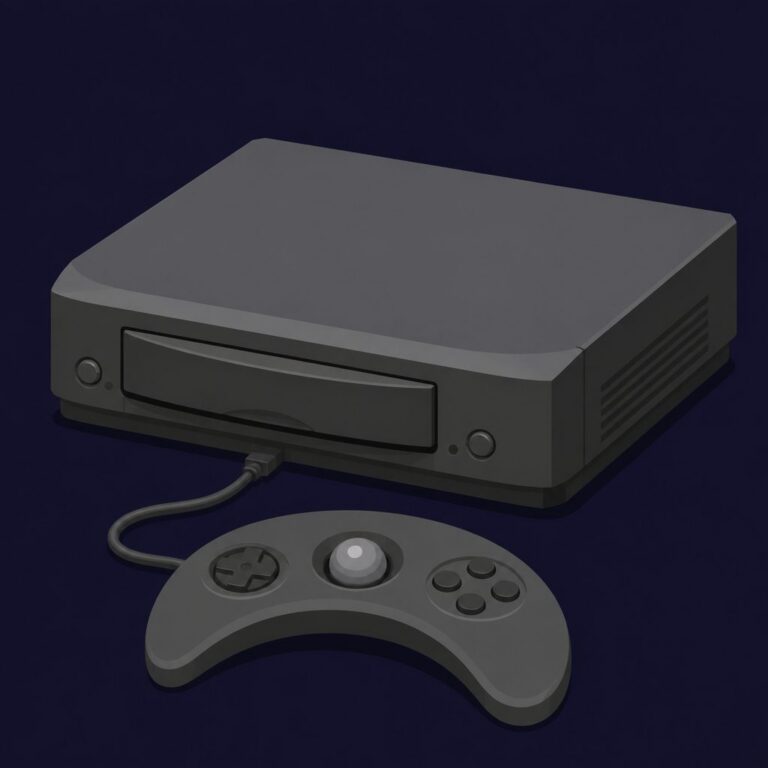
The Bandai Pippin is a CD-ROM games and internet machine designed by Apple Computer and built and sold under licence by Bandai. It launched in Japan in March 1996 at ¥64,800 and in the United States in late 1996 at US$599, and about 42,000 units were sold in total.
The Apple Bandai Pippin was a stripped-down Macintosh aimed at the living room. It plugged into a television, played CD-ROM games, and came with a modem for online use. Apple chose to license the design instead of selling it under its own name, and the first licensee was Bandai. The result was a console with a PowerPC processor, a version of the Mac operating system on every disc and a price that made it difficult to sell against the PlayStation and the Saturn.
From Announcement to Launch
Apple and Bandai announced the Pippin in Tokyo on 13 December 1994. Apple’s own FAQ said the company would not sell one under its own brand and set no limit on licensees. Earlier design work had reportedly started from a Macintosh Classic II with a 68030 processor before moving to the PowerPC 603. Bandai president Makoto Yamashina picked the Mac platform.
The Japanese launch came in March 1996 according to a Bandai statement reported by PC Watch, and heise gives 28 March 1996. The price was ¥64,800 including a modem and four CD-ROMs, which heise puts at roughly US$700. The American version, the Pippin @WORLD, followed later in 1996. Published dates for the US launch run from June to November, and heise reports that shipping slipped from a planned September to December 1996, with many stores stocking it in January 1997. The US price was $599, which the Computer History Museum also records. Electronic Gaming Monthly noted in July 1996 that the Saturn with its NetLink modem sold for under $400.
Katz Media signed a licence on 4 June 1996 and began shipping the Katz Media Player 2000 in Europe in March 1997. Mitsubishi Electric built the hardware for Bandai as an OEM maker and never signed a licence itself.
Hardware
Apple’s FAQ described the design as television-first, with an optional 640 x 480 VGA connection. The Pippin used a 66 MHz PowerPC 603 processor, which Apple’s FAQ described as derived from the second generation of Power Macintosh. Memory was 6 MB shared between system and video in the Japanese ATMARK model, and some listings give 8 MB for the @WORLD and the Katz machine. Upgrade modules of 2, 4, 8 and 16 MB were available, and 128 KB of non-volatile memory held saved data. Video output reached 640 x 480 with 8-bit or 16-bit colour, and the audio was 16-bit stereo at 44 kHz.
The operating system was Pippin OS, based on System 7.5.2 and kept on each disc. The CD drive was 4x. An internal modem ran at 14.4 kbit/s in early units and 33.6 kbit/s in later ones through the GeoPort. Two AppleJack ADB ports took the controllers, and two serial ports handled other devices. Output was by RCA composite, S-Video or VGA.
Models and Accessories
| Model | Market | Notes |
|---|---|---|
| Bandai Pippin ATMARK (PA-82001) | Japan | White in 1996, black in 1997 |
| Bandai Pippin @WORLD (PW-10001) | North America | Black |
| Katz Media Player 2000 (KMP 2000) | Europe and Canada | Aimed at vertical and set-top markets, optional SCSI port, the rarest model |
Accessories included the AppleJack controller, a wireless AppleJack (PA-82014), a keyboard and drawing pad (PA-82003), a docking station with a floppy drive (PA-82002) and an Olympus Deltis 230 magneto-optical drive. An Ethernet docking station announced at $139 never shipped. Two prototypes, the ATMARK-PD with a magneto-optical drive and the desktop-style ATMARK-EX, were shown at MacWorld Tokyo in 1997 and never released.
The Games
Counts differ widely. A commonly cited list names 56 game titles and 53 non-game titles, while MobyGames lists 21 games, so “dozens” is a fair summary. Super Marathon, a Bungie port that compiles Marathon 1 and 2, is a standout and is rare. Racing Days was the Pippin’s only racing game and only multiplayer title, according to heise. Shockwave Assault was Electronic Arts’ only Pippin release.
Software was also protected. Authentication required keys, and developers used a security dongle. Bandai sold ROM revisions called KINKA 1.0, 1.2 and 1.3, and version 1.3 disables the authentication check.
Why It Failed
The causes cited by heise and the Computer History Museum are the price, the thin software library, the mix of computer and console positioning, competition from the PlayStation and the Saturn, and Apple’s change of course. Steve Jobs came back to Apple when it acquired NeXT on 20 December 1996 and ended licensing, and a Pippin 2.0 never left the drawing board. In 1997 Bandai pulled the @WORLD from the United States and rebranded remaining stock as the black ATMARK for Japan, and production stopped by mid-1997.
On 27 February 1998 Bandai announced its withdrawal from the Pippin business and the liquidation of Bandai Digital Entertainment, with a special loss of about 27 billion yen, some 50,000 unsold units and Bandai’s first annual loss since its listing in 1986. PC Watch gives a total of about 42,000 units sold in Japan and overseas, and heise breaks that down as roughly 30,000 in Japan and 12,000 in the United States. DayStar Digital bought the remaining inventory. Bandai support ended on 31 December 2002. PCWorld ranked the @WORLD 22nd in its list of the 25 worst tech products of all time in May 2006.
Preservation
MAME includes a pippin driver, listed as Pippin @mark from Apple and Bandai, 1996. The Computer History Museum holds a Pippin in its collection, and the Bandai Pippin Museum hosts documentation, including Apple’s FAQ and development pages. The machine is also covered in the cancelled and short-lived console database, and the 1990s console overview shows the Pippin among its rivals.
Frequently Asked Questions
How much did the Pippin cost?
The Japanese price was ¥64,800 including a modem and four CD-ROMs, and the US price was $599.
When was the Pippin released?
It launched in Japan in March 1996 (heise gives 28 March 1996) and in the United States later in 1996. The European Katz Media Player 2000 began shipping in March 1997.
How many Pippins were sold?
PC Watch reported about 42,000 units in Japan and overseas, with heise giving roughly 30,000 in Japan and 12,000 in the US. Bandai also reported about 50,000 unsold units in February 1998.
Why did the Pippin fail?
The price, a thin software library, its mixed computer and console positioning and competition from the PlayStation and Saturn all counted against it. Steve Jobs ended Apple's licensing after returning to the company.
Was the Pippin an Apple console?
It was designed by Apple but built and sold by Bandai, and in Europe by Katz Media, under licence.
Can the Pippin be played today?
MAME includes a pippin driver. Games rely on authentication keys, and a developer security key (dongle) is documented.