
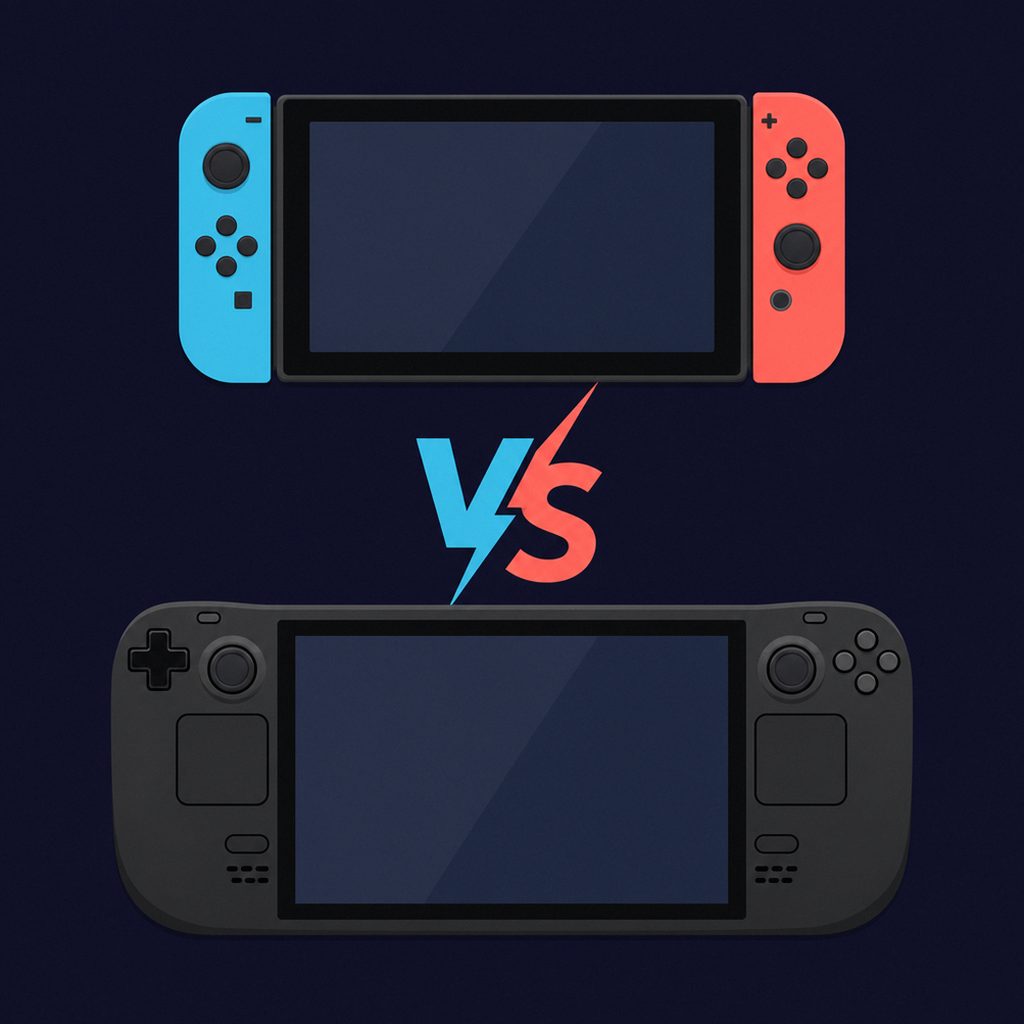
The Nintendo Switch and the Steam Deck are both hybrid handhelds, but they answer very different questions. The verdict turns on what a player wants: the Switch wins on exclusive games, polish, and mainstream success, while the Steam Deck wins on raw power and library breadth for players who already own a large PC game collection.
Hardware and Power
The Steam Deck is by far the more powerful device. It runs a custom AMD “Aerith” APU with a Zen 2 CPU and an RDNA 2 GPU capable of over 1.6 teraflops, paired with 16 GB of LPDDR5 memory — effectively a low-power gaming PC in handheld form. The original Nintendo Switch (2017) uses an Nvidia Tegra X1 with Maxwell-architecture graphics and 4 GB of memory, hardware that was modest even at launch and is now well behind modern handhelds.
The trade-offs follow from that gap. The Steam Deck has a larger, heavier body, shorter battery life under load, and far more storage flexibility, including a microSD slot and user-upgradeable M.2 SSDs. The Switch is lighter, simpler, and was the first system to fully commit to the dock-and-go hybrid concept, sliding between handheld and TV play through a docking station. The later Switch OLED improved the screen, and the Switch 2 has since raised Nintendo’s hardware considerably, but the original Switch remains far less powerful than the Deck.
Games and Library
This is where the two diverge most sharply. The Switch is a closed platform with a curated catalog built around Nintendo’s exclusives: The Legend of Zelda: Breath of the Wild and Tears of the Kingdom, Super Mario Odyssey, Mario Kart 8 Deluxe, Animal Crossing: New Horizons, and Super Smash Bros. Ultimate — games available nowhere else. Its appeal is the quality and exclusivity of that first-party lineup.
The Steam Deck plays the existing Steam library, an enormous PC catalog spanning decades, via Valve’s Linux-based SteamOS and the Proton compatibility layer. It offers vastly more games and far cheaper sales, but it has no platform exclusives of its own and some titles, particularly those with certain anti-cheat systems, do not run. Valve verifies compatibility with a “Deck Verified” rating to manage the variability.
Price and Audience
The Switch launched at $299, while the Steam Deck started at $399 for its base model. Their audiences barely overlap: the Switch is a mainstream family and on-the-go console with broad reach, while the Steam Deck is aimed at existing PC gamers who want their library to travel.
Legacy and Verdict
The sales gap is enormous. The original Nintendo Switch has sold roughly 150 million units, making it one of the best-selling consoles ever, while the Steam Deck’s sales are analyst estimates rather than official figures — most place it around 4 million units, with the broader handheld-PC market it pioneered estimated near 6 million.
Judged on significance and library rather than raw specs, the Switch is the more important and successful machine: it popularized the hybrid form factor and sold to a mass audience on the strength of unmatched exclusives. But for raw capability and sheer library size, the Steam Deck wins clearly, and it created an entire category of powerful handheld PCs. The right pick depends on whether a player values Nintendo’s games or a vast PC catalog on the go.
See full specs on the Nintendo Switch and Steam Deck pages, read the console generations guide for wider context, or set up a matchup in the console comparison tool.
| Nintendo Switch | Valve Steam Deck | |
|---|---|---|
| Released | 2017-Mar-03 | 2022-Feb-25 |
| Launch price | 299.99 USD | 399 USD (64GB) / 529 USD (256GB) / 649 USD (512GB) |
| Units sold | 143+ million | ~5 million (estimated) |
| Games released | 5,000+ | 10,000+ (Steam compatible) |
| Generation | Hybrid Console/Portable | Handheld PC |
| CPU | NVIDIA Custom Tegra X1 (ARM Cortex-A57, quad-core) | AMD APU (Zen 2, 4-core/8-thread) |
| CPU speed | 1.02 GHz | 2.4-3.5 GHz |
| GPU | NVIDIA Maxwell (256 CUDA cores, 393 GFLOPS docked) | AMD RDNA 2 (8 CUs, 1.6 TFLOPS) |
| RAM | 4 GB LPDDR4 | 16 GB LPDDR5 |
| Media | Game Card (proprietary), Digital | Digital only (Steam), microSD |
| Graphics | 7/10 | 8/10 |
| Game Library | 10/10 | 10/10 |
| Controllers | 8/10 | 8/10 |
| Gamer Value | 10/10 | 10/10 |
| Collector Value | 5/10 | 4/10 |
| Overall rating | 8/10 | 8/10 |
Open this matchup in the interactive comparison tool →
Frequently Asked Questions
Is the Steam Deck more powerful than the Switch?
Yes, by a wide margin. The Steam Deck uses a custom AMD Zen 2 and RDNA 2 APU capable of over 1.6 teraflops with 16 GB of memory, effectively a low-power gaming PC. The original Nintendo Switch uses an Nvidia Tegra X1 with Maxwell graphics and 4 GB of memory, hardware that was modest at its 2017 launch and is now well behind modern handhelds.
Which has the bigger game library, Switch or Steam Deck?
The Steam Deck, by far. It plays the existing Steam catalog, an enormous PC library spanning decades, through SteamOS and the Proton compatibility layer. The Switch has a smaller curated catalog. The trade-off is exclusivity: the Switch's library includes Nintendo games available nowhere else, while the Steam Deck has no platform exclusives of its own and some titles do not run on it.
Which sold more, the Switch or the Steam Deck?
The Switch sold far more. The original Nintendo Switch has sold roughly 150 million units, one of the best-selling consoles ever. Steam Deck sales are analyst estimates rather than official figures, with most placing it around 4 million units, and the broader handheld-PC market it helped create is estimated near 6 million.
Can the Steam Deck play Nintendo Switch games?
No. The Steam Deck cannot legally play Switch games. It runs PC games from a player's Steam library on a Linux-based system, while Switch games are exclusive to Nintendo's own hardware. The two platforms have entirely separate, incompatible game ecosystems.
Which is better for the money, the Switch or Steam Deck?
It depends on the player. The Switch launched at $299 and is best for those who want Nintendo's exclusive games and a simple mainstream experience. The Steam Deck started at $399 and is best for existing PC gamers who already own a large Steam library and want far more power and cheaper game sales on the go.