
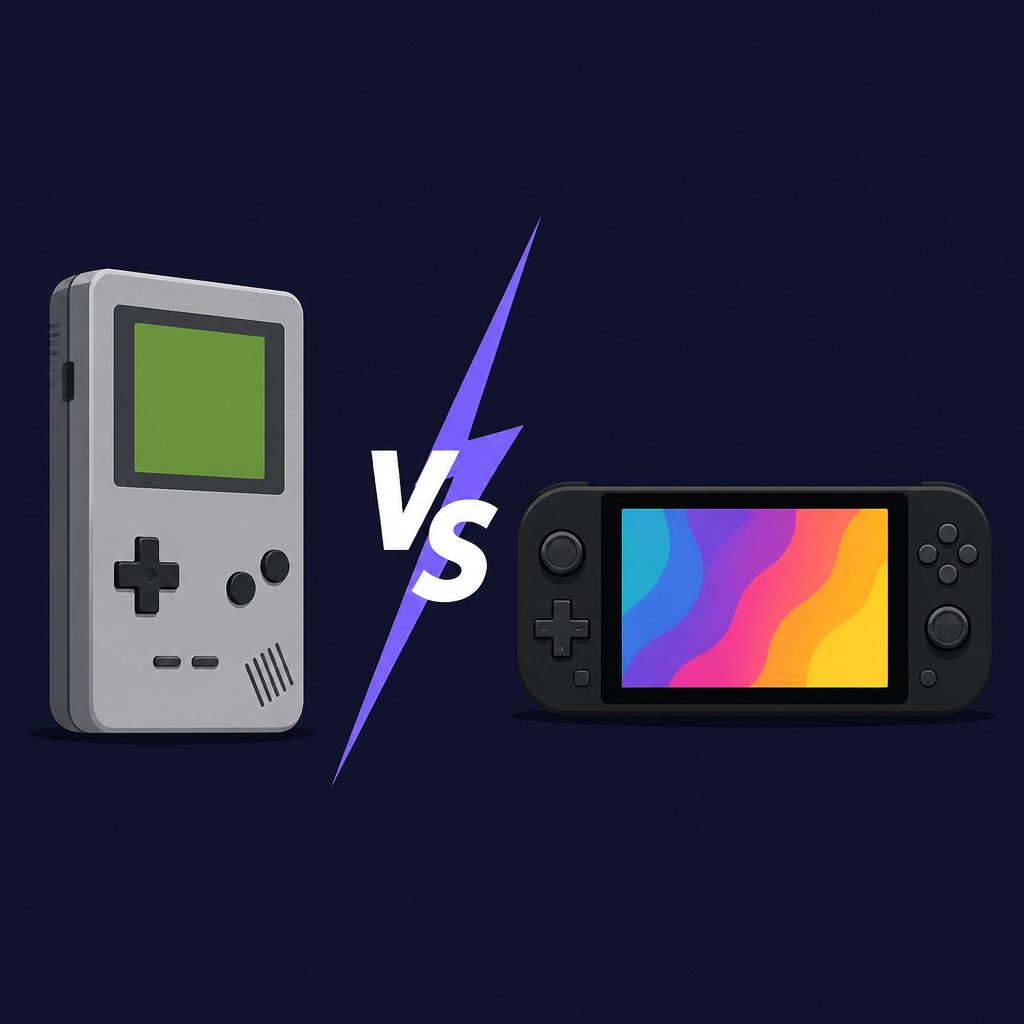
Battery life decided this war before the games did. Nintendo’s Game Boy ran roughly 30 hours on four AA batteries. Sega’s Game Gear, built around a backlit color screen that looked genuinely impressive next to Nintendo’s dim green display, burned through six AA batteries in as little as 3 to 5 hours. A kid with $10 of allowance money could keep a Game Boy running for a week. The same money bought maybe two afternoons of Game Gear.
The Screen Trade-Off
Both companies were reacting to the same obvious question shoppers asked in stores: why is this screen so hard to see? Nintendo’s answer was to keep the Game Boy cheap and power-efficient, betting correctly that game quality and battery life would outweigh screen technology for most buyers. Sega’s answer was to fix the screen and accept whatever came with that decision. Only one of those bets paid off at the scale either company hoped for.
On paper, the Game Gear should have won outright. It launched in Japan on October 6, 1990, about eighteen months after the Game Boy, and Sega used that gap to fix the most obvious complaint about Nintendo’s handheld: no color, no backlight, and a screen that was unreadable without direct light hitting it just right. The Game Gear fixed all three at once. It had a sharp, full-color LCD you could genuinely see in a dim room, four-way scrolling that felt closer to a Genesis game shrunk down, and horizontal ergonomics that many players still prefer to the Game Boy’s vertical brick shape.
It also had real problems the spec sheet didn’t capture. The backlit screen consumed power at a rate the hardware’s battery compartment couldn’t sustain for reasonable play sessions, and the LCD technology of the era introduced visible motion blur during fast-scrolling action, the kind of ghosting that made a Sonic-style platformer harder to play than it should have been. Bright outdoor light, oddly, was where the Game Gear performed worst of all, since its screen wasn’t reflective enough to compete with the sun the way the Game Boy’s simpler display did.
The Sales Gulf
The numbers settled the argument decisively. Nintendo’s own historical figures list the Game Boy and its later Game Boy Color revision combined at 118.69 million units sold worldwide. The Game Gear, across its full run from 1990 to 1997, sold around 10.62 million. Even isolating just the original Game Boy’s contribution before the Color model existed, Nintendo’s handheld was already the dominant force in portable gaming by a factor Sega never came close to closing.
Price was part of it. The Game Boy launched at $89.99 in North America; the Game Gear followed at $149.99. Battery consumption compounded that gap every single week a kid actually used the thing.
Sega’s TV Tuner Era
Sega didn’t give up easily. Beyond the console itself, Sega released a clip-on TV Tuner accessory that let the Game Gear pick up broadcast television on its screen, an odd, ahead-of-its-time attempt to reposition a game console as a pocket entertainment device rather than just a games machine. It required its own battery on top of the Game Gear’s already demanding power draw, which tells you almost everything about why it never became more than a curiosity. A Master System converter cartridge, letting the Game Gear play Sega’s home console library through its own shared hardware architecture, found a more practical audience, since it extended the handheld’s software catalog without asking for anything extra from the battery compartment.
Two Very Different Libraries
Nintendo’s library leaned on things a small, cheap, low-power screen could render clearly at any brightness: puzzle games, turn-based RPGs, and platformers built around readable, high-contrast sprites. Tetris, bundled with the console in most Western markets, sold the hardware almost by itself, and Pokemon Red and Blue later proved the format could sustain something far more ambitious without ever needing color or a backlight to work.
Sega’s Game Gear library leaned the opposite direction, chasing console-style action that showed off the color screen. Sonic the Hedgehog got its own Game Gear-exclusive entries, including Sonic Chaos and Sonic Triple Trouble, built from the ground up for the handheld rather than ported down from the Genesis. Columns, Sega’s answer to Tetris, showed off the Game Gear’s color palette in a way the Game Boy’s four shades of green simply couldn’t match. It was a genuinely strong library. It just asked more of the hardware than the hardware, and its batteries, could comfortably give back.
What Ownership Looks Like Today
Maintenance tells its own version of this story. Original Game Boy units are famously durable, with simple circuitry and a screen technology that rarely fails outright, even if the plastic yellows or the D-pad wears smooth. Game Gear units age far less gracefully. The backlight and screen ribbon cable are known weak points, and many surviving units need a capacitor replacement, a process retro repair communities refer to as recapping, before the screen displays a clean image at all. A Game Gear bought untested today has a real chance of needing that work before it’s playable, which is a maintenance bar the Game Boy essentially never asks a buyer to clear.
What Each Company Built Around Its Handheld
Nintendo treated the Game Boy as a platform to extend, not just a console to sell. The Game Boy Camera and matching Game Boy Printer, released later in the system’s life, turned the handheld into a low-resolution digital camera years before phone cameras existed, and the link cable, present since the original hardware, made two-player trading and battling in games like Pokemon a defining feature of the whole line. Sega’s accessory strategy for the Game Gear leaned toward extending battery life and utility rather than the games themselves: a rechargeable battery pack sold separately to offset the console’s biggest weakness, and the TV Tuner already mentioned. Neither company was wrong about what its own hardware needed. Nintendo built outward from a strength. Sega built around a problem it never fully solved.
Which Is the Better Collector Buy in 2026
Buy the Game Boy if you want something that just works. It’s abundant, cheap, and its simple screen technology has proven remarkably durable across three and a half decades, with no capacitor time bomb waiting inside. Buy a Game Gear if you’re specifically chasing the harder find: original units are more prone to failure, the backlight and screen ribbon are known weak points, and a genuinely working example with an unblemished picture is a real collecting achievement rather than a given.
Neither answer is wrong, but they’re answering different questions. One is about playing games. The other is about owning a piece of hardware that lost, for reasons that had less to do with its games than with how long it could stay switched on.
Sega didn’t learn the lesson right away, either. Five years after the Game Gear, the company released the Sega Nomad in 1995, a portable that played full Genesis cartridges on a backlit screen. Reviewers loved the concept and immediately flagged the same problem: battery life measured in a couple of hours on six AAs. It’s a strange kind of consistency, watching the same company hit the same wall twice in a decade, chasing power and color at a cost its battery compartment could never actually cover.
See the full specs on the Game Boy console page, and for a wider view of how handheld hardware evolved from here, the retro handheld guide picks up where this comparison leaves off.
Frequently Asked Questions
Which had better battery life, the Game Boy or Game Gear?
The original Game Boy ran roughly 30 hours on four AA batteries. The Game Gear, powered by its backlit color screen, managed only about 3 to 5 hours on six AA batteries, a gap that shaped how each console was actually used and became the deciding factor for most 1990s buyers.
Which sold more, the Game Boy or Game Gear?
Nintendo's official figures list the Game Boy and Game Boy Color combined at 118.69 million units sold worldwide. The Game Gear sold approximately 10.62 million units. Even accounting for the Game Boy Color's later contribution, the original Game Boy line outsold the Game Gear by a wide margin on its own.
Did the Game Gear have a better screen than the Game Boy?
Yes, technically. The Game Gear had a backlit color LCD, a genuine advance over the Game Boy's unlit, four-shade green display. In practice the Game Gear's screen suffered from motion blur and was hard to see in bright daylight, and its battery cost undercut the advantage.
What was the Game Gear TV Tuner?
Sega sold a clip-on TV Tuner accessory for the Game Gear that let players watch broadcast television on the handheld's screen, part of a wider push to position the Game Gear as more than a games machine. It required its own battery power on top of the console's already short runtime.
Which is the better collector buy in 2026, Game Boy or Game Gear?
The Game Boy is the easier, cheaper, more reliable buy, with abundant supply and a library that runs on original hardware for decades without maintenance drama. The Game Gear is the more interesting one for a collector specifically chasing scarcity, since surviving working units with an intact screen are considerably harder to find.