
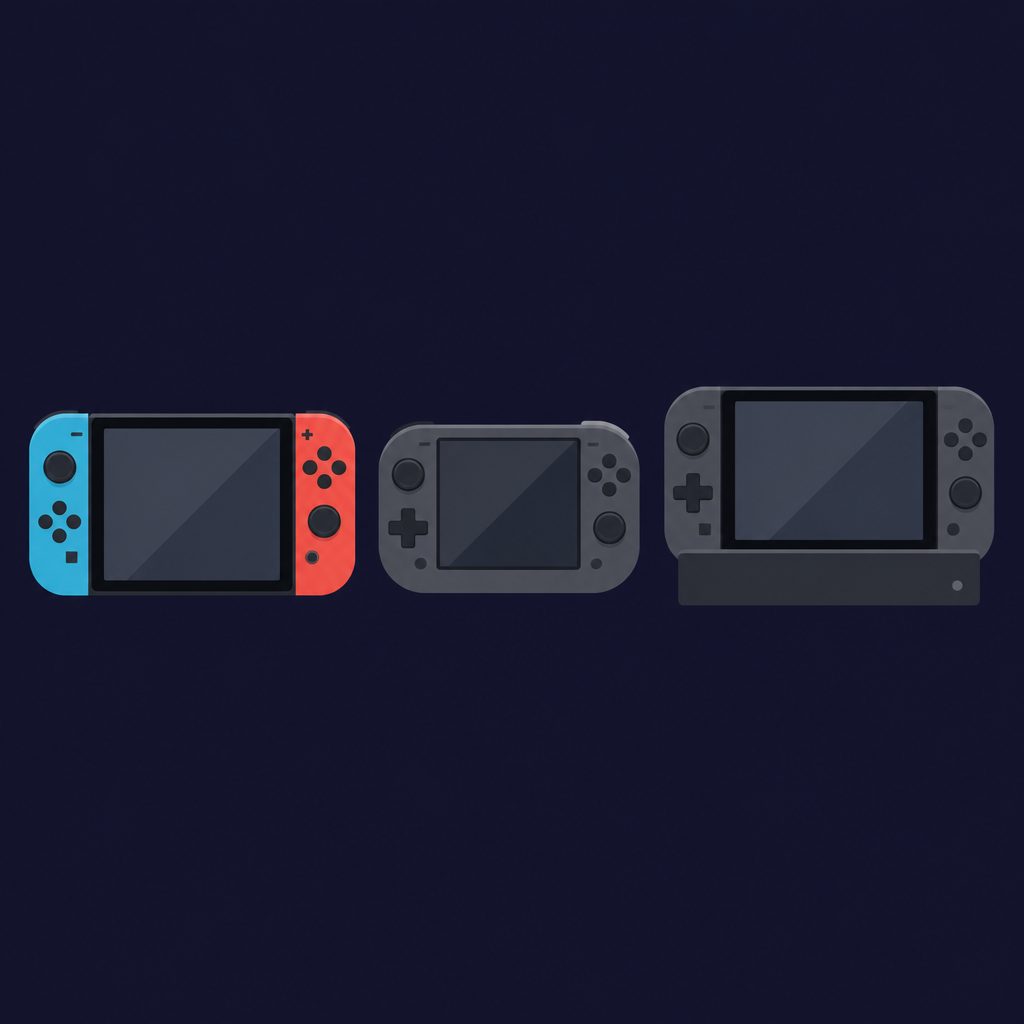
The Nintendo Switch models are the original HAC-001 from March 2017, the battery-improved HAC-001(-01) from August 2019, the handheld-only Switch Lite (HDH-001) from September 2019 and the Switch OLED (HEG-001) from October 2021. The Switch 2 (BEE-001) followed in June 2025 as a separate generation. The serial number tells the revisions apart: XAW means an original unit, XKW the improved-battery one. The four Switch versions share one library, with the Lite limited to games that support handheld mode. Battery life, screen, storage and TV output are what differ.
Nintendo sold the first Nintendo Switch on March 3, 2017 and then changed it in small steps that are easy to miss in a shop. Two of the Nintendo Switch models carry nearly identical model numbers, and a later one looks like the original from across the room. The launch covered Japan, most Western markets and the UAE at $299.99 in the US, £279.99 in the UK and ¥29,980 in Japan, and the family has since passed 155 million units shipped worldwide as of December 2025. This guide lays out every Switch version, shows where to read the numbers on a console in front of you and flags the differences that change what a used or new purchase is worth.
Nintendo Switch Models at a Glance
| Model | Model number | Release date (NA) | Launch price (USD) | Key change |
|---|---|---|---|---|
| Nintendo Switch | HAC-001 | Mar 3, 2017 | $299.99 | 6.2-inch LCD, 32 GB, rated 2.5 to 6.5 hours |
| Nintendo Switch (improved battery) | HAC-001(-01) | Aug 2019 | $299.99 | More efficient chip, rated 4.5 to 9 hours |
| Nintendo Switch Lite | HDH-001 | Sept 20, 2019 | $199.99 | Handheld only, 5.5-inch screen, built-in controls |
| Nintendo Switch OLED | HEG-001 | Oct 8, 2021 | $349.99 | 7-inch OLED, 64 GB, dock with Ethernet port |
| Nintendo Switch 2 | BEE-001 | June 5, 2025 | $449.99 | New generation, 7.9-inch 1080p screen, 256 GB |
How to Tell Which Nintendo Switch You Have
Start with the white sticker. On the Switch and the Lite it sits on the bottom of the console, and on the OLED model it is under the fully opened stand. Nintendo’s support page also lists System Settings, System, Serial Information for a console whose sticker is gone. The model number printed on the console reads HAC-001 for the launch hardware and HAC-001(-01) for the improved-battery revision, and reports on the revision describe the same suffix on the box. The bracketed suffix is the visible difference.
The serial prefix is the second check. Per Nintendo, Switch systems sold in the Americas start with XAW or XKW, Lite systems with XJW and OLED systems with XTW. Switch 2 consoles sold there start with HAW or HAU. The second letter carries the model: A marks the original HAC-001 and K the HAC-001(-01), so XAJ and XKJ are the same two revisions with the region letter for Japan. The third letter gives the region, with W for the Americas, J for Japan and E for Europe. TechCrunch’s report on the 2019 revision confirmed the same split, with XKW marking the newer hardware and XAW the older. The model decoder covers all four Switch families, and how old is my console estimates the production year.
Original Switch vs the HAC-001(-01) Battery Revision
The 2017 console has a 6.2-inch LCD at 1280 by 720, 32 GB of internal storage of which 25.9 GB is usable, and detachable Joy-Con. The HAC-001(-01) keeps all of them, and Nintendo’s specification table lists the same 32 GB and 6.2-inch screen for it. The revision question is therefore the first one to settle when you inspect a used console.
Nintendo’s website revealed the revision on July 17, 2019, and it reached Japan and North America in mid-August and the UK in September. The price stayed at $299.99. The gain came from a more efficient chip and memory seen in FCC filings, and nothing else on the console changed. Nintendo rates the original at 2.5 to 6.5 hours and the revision at 4.5 to 9 hours. For Breath of the Wild, Nintendo’s figure is about 3 hours on the original and about 5.5 hours on the revision.
That makes the revision the baseline for any Switch worth buying today. An original unit with an XAW or XAJ prefix still plays every game, but it will need a charger sooner on every trip.
Switch Lite and Switch OLED: Differences That Matter
The Switch Lite launched on September 20, 2019 at $199.99. It has a 5.5-inch screen, 32 GB of storage, a 3,570 mAh battery rated at 3 to 7 hours and controls built into the body. It has no TV output, and per Nintendo it plays games that support handheld mode. Separate Joy-Con can pair wirelessly for games that need them, though you buy them separately. For a child or a commuter it is the cheapest entry. For a shared living-room console it is the wrong one.
The Switch OLED arrived on October 8, 2021 at $349.99. Nintendo’s specification table lists a 7-inch OLED panel and 64 GB of storage against 6.2 inches and 32 GB on the HAC-001(-01), with the same 4,310 mAh battery and the same 4.5 to 9 hour rating. All three screens stay at 1280 by 720, so the gain is contrast and size, not sharpness. The OLED dock replaces the USB 3.0 port with a wired Ethernet port, and the kickstand became a wide adjustable one. Every model accepts a microSD card of up to 2 TB.
Known Issues by Model
Battery life is the documented weakness of the 2017 hardware, covered above. The other widely documented complaint is Joy-Con drift. In July 2019 Nintendo said it was aware of reports that some Joy-Con controllers were not responding correctly and pointed owners to its support site, and Nintendo of America reportedly began repairing affected controllers without charge. The reports attach to the controllers, so the console revision does not decide whether drift can happen.
Switch 2: The Successor
The Nintendo Switch 2 is the only model here from a new generation. It launched worldwide on June 5, 2025 at $449.99, and Nintendo raised the US price to $499.99 on September 1, 2026. It brings a 7.9-inch 1080p screen at up to 120 Hz, 256 GB of storage and magnetic Joy-Con 2 controllers. The console is backward compatible with most Switch games, physical and digital, but it loads games only from microSD Express cards, so older microSD cards will not hold Switch 2 titles. Its dock includes an Ethernet port and HDMI 2.1.
Prices and Availability in 2026
The launch prices in the table are historic. Nintendo raised US prices on the original Switch family effective August 3, 2025, and retail listings reported by Video Games Chronicle showed $339.99 for the Switch, $229.99 for the Lite and $399.99 for the OLED model. Nintendo’s own US page now lists the OLED at $399.99. The September 2026 increase applies only to the Switch 2 in the US, Canada and Europe. In Japan, prices for the whole family rose from May 25, 2026. Nintendo also announced in July 2026 that it will stop selling the Switch, Switch Lite and Switch OLED to European retailers and on its European store from mid-February 2027, with sales continuing in other regions.
Which Nintendo Switch to Buy in 2026
The OLED model is the best of the original family for anyone who plays handheld or at a table. It is the only one with the larger screen and 64 GB. For a console that lives on the TV, a HAC-001(-01) works as well and costs less. Skip any unit with an XAW or XAJ serial unless the price is clearly lower, since it carries the shorter battery, and treat the Lite as a second console for one person. If the budget stretches to $499.99, the Switch 2 plays most of the same library on a larger 1080p screen.
Memory Cards and Game Cards
Switch cartridges work in every Switch version, including the Lite and the OLED. On the 32 GB models about 25.9 GB is usable, so a few large downloads fill them and a microSD card helps. On Switch 2 the rule differs: Nintendo restricts game loading to microSD Express cards, up to 2 TB.
Frequently Asked Questions
Which Nintendo Switch model do I have?
Read the white sticker on the bottom of the console. On the OLED model it sits under the fully opened stand. The model number is HAC-001 or HAC-001(-01) for the standard Switch, HDH-001 for the Lite and HEG-001 for the OLED. If the sticker is missing, System Settings, System, Serial Information shows the serial number on the console itself.
What is the difference between HAC-001 and HAC-001(-01)?
HAC-001(-01) is the revision Nintendo released in mid-August 2019 in Japan and North America. It uses a more efficient chip and memory, which raised the rated battery life from 2.5 to 6.5 hours to 4.5 to 9 hours. The price stayed at $299.99 and no other major component changed.
How can I tell the newer Switch from the original by serial number?
The second letter of the prefix carries the model. In the Americas, XAW marks an original HAC-001 and XKW the HAC-001(-01) revision. Japan uses XAJ and XKJ in the same way. Lite consoles start with XJW and OLED consoles with XTW in the Americas, according to Nintendo's support page.
What is the difference between the Switch Lite and the Switch OLED?
The Lite is handheld only. It has a 5.5-inch screen, 32 GB of storage, built-in controls and no TV output, and it plays games that support handheld mode. The OLED model has a 7-inch OLED screen, 64 GB, detachable Joy-Con, TV output and a dock with an Ethernet port. Nintendo rates the OLED at 4.5 to 9 hours and the Lite at 3 to 7 hours.
Is the Nintendo Switch 2 a Switch model?
It is a new generation with the model number BEE-001, released on June 5, 2025 at $449.99. Nintendo raised the US price to $499.99 on September 1, 2026. It has a 7.9-inch 1080p screen and 256 GB of storage, and it is backward compatible with most Switch games, physical and digital.
Which Nintendo Switch model should I buy in 2026?
The OLED model is the best of the original family for handheld and tabletop play, and a HAC-001(-01) suits a console that stays on the TV. Avoid an original XAW or XAJ unit unless the price is clearly lower, because its battery is rated shorter. Nintendo plans to end Switch family sales to retailers in Europe in mid-February 2027.