
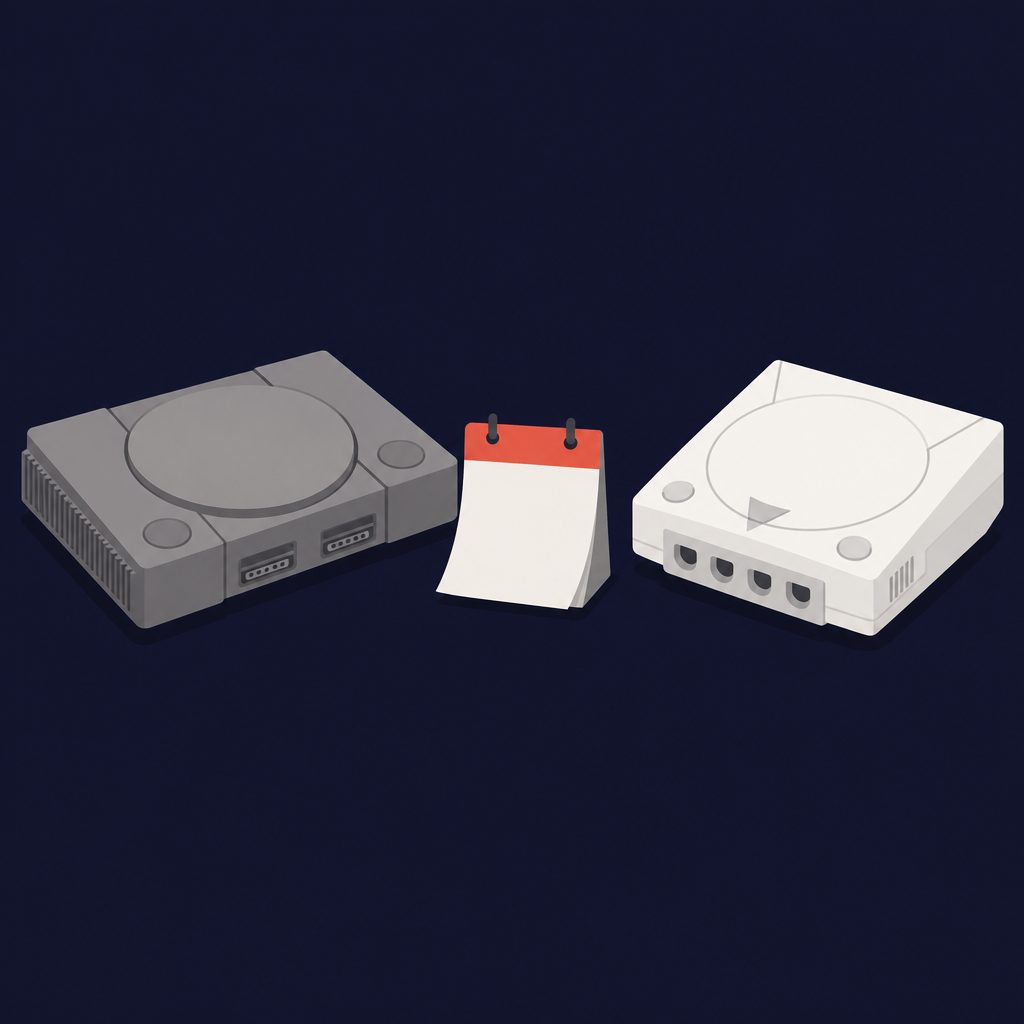
The Sony PlayStation launched in the US on September 9, 1995, at $299. Four years later, the Sega Dreamcast launched in the US on September 9, 1999, at $199, deliberately marketed around the “9/9/99” date. One company chose that date on purpose, as a callback. The other company’s date wasn’t a callback at all. It just happened to land there, and then became the reason a rival built an entire marketing campaign around a numeric coincidence years later. Here’s both stories in full, and why Sega picking that exact date wasn’t quite as flattering to Sony as it might first look.
1995: The Price That Broke Sega
Months before the PlayStation reached stores, its price was decided at a press conference that has since become one of the most replayed moments in the industry’s history. At E3 in May 1995, Sony executive Ólafur Ólafsson introduced Sony Computer Entertainment president Steve Race, who walked to the podium, said a single word, “299,” and walked off without further comment or a single slide behind him. The room erupted. Sega had announced its Saturn earlier that same day at $399, a hundred dollars higher, and Sony’s response, delivered in roughly two seconds flat, undercut it decisively in front of the entire assembled industry press.
The PlayStation carried that $299 price into its actual US retail launch on September 9, 1995, backed by a marketing campaign built around the tagline “U R Not E,” with the capital E colored red to spell out “ready,” a deliberately cryptic phrase aimed at an audience Sony wanted to see itself as older and more sophisticated than the kids still buying Genesis and Super Nintendo cartridges. Twelve titles were available on day one, including Ridge Racer and Battle Arena Toshinden, and if you walked into a store that week, the console’s dark, minimalist packaging alone told you it wasn’t aimed at children. The console went on to sell more than 102 million units over its full life, becoming the best-selling console of its generation and the platform that, more than any single machine before it, established Sony as a permanent player in a market Nintendo and Sega had previously had entirely to themselves. Full specs and launch detail sit on the PlayStation page.
The Ambush That Made “299” Land So Hard
The Race announcement only hit as hard as it did because of what Sega had just done minutes earlier on the same stage. Sega of America, worried about the approaching PlayStation launch, surprised its own retail and development partners by revealing the Saturn was already available for purchase that very day, four months ahead of the previously announced release window, at $399. It was meant as a preemptive strike, a way to get a real sales head start before Sony’s own console reached stores. Instead, it produced confusion among retailers who hadn’t stocked the console and hadn’t been told the surprise launch was coming, and it handed Sony a wide-open target. Race’s two-second “299” wasn’t just a lower number. It was a calm, confident response to a rival’s panic move delivered in front of the same room minutes later.
1999: The Biggest 24 Hours in Entertainment Retail
Sega’s own September 9 didn’t arrive by accident, unlike Sony’s four years earlier. The Dreamcast’s US launch date was chosen specifically for its numeric symmetry, and Sega’s marketing team leaned into “9/9/99” as hard as any launch campaign of the era: countdown clocks, midnight store openings, a date printed on nearly every piece of promotional material the company produced that entire year. It worked, at least in the short term. The console sold more than 225,000 units in its first 24 hours in the US, generating $98.4 million in single-day sales, a figure Sega’s marketing chief at the time, Peter Moore, compared directly to the opening-day box office of Star Wars: Episode I, which had made $28.5 million in theaters that same year. By any measure available in September 1999, it was the strongest console launch America had ever seen up to that point.
None of that changed what came next, unfortunately for Sega. The PlayStation 2’s looming late-2000 arrival, backed by Sony’s enormous marketing budget and the built-in trust of a console that had just spent four years dominating the market, drained retailer and publisher confidence in the Dreamcast almost as quickly as the launch-week numbers had built it up. Sega announced its exit from console hardware entirely on January 31, 2001, less than a year and a half after the biggest 24-hour launch in the format’s history to that date. The Dreamcast finished its life at 9.13 million units sold worldwide. More detail on the console and its short, celebrated run sits on the Dreamcast page.
Two Launch Lineups, Two Different Bets on the Buyer
The games each company chose to lead with on their respective 9/9 say something about who they thought was buying. Sony’s twelve day-one titles skewed toward Ridge Racer’s arcade-perfect racing and Battle Arena Toshinden’s fighting-game spectacle, both genres built to look impressive in a five-minute store demo and sell a skeptical adult on the hardware fast. Sega’s Dreamcast lineup leaned differently, with SoulCalibur drawing raves for graphical fidelity that genuinely surprised critics used to PlayStation-era visuals, alongside NFL 2K and Sonic Adventure aimed at a broader, more mainstream household audience than the PlayStation’s original “U R Not E” positioning had targeted. Both approaches worked, at least in the narrow window that mattered: both consoles posted the strongest opening days their companies had ever recorded to that point.
What the Two Dates Actually Share
Put side by side, the two launches make an odd pair. Both hit exactly on 9/9. Both were backed by aggressive, confident marketing built to make a specific number, a price in one case and a date in the other, do the talking instead of a slogan. Both consoles are remembered, thirty-one years and twenty-seven years on respectively, as high points for their companies: the PlayStation as the start of a still-ongoing dynasty, the Dreamcast as the beloved final chapter of Sega’s hardware ambitions. Neither one is remembered as a disappointment, which is unusual company for two consoles whose parent companies ended up on such wildly different long-term trajectories afterward.
It’s worth being direct about which of the two mattered more to the industry’s actual shape going forward, rather than dodging the question. The PlayStation reset who got to compete at all; the Dreamcast, brilliant as its library was, ended up as an epilogue rather than a new chapter for Sega. That’s not a knock on the hardware itself. SoulCalibur, Shenmue, and Jet Set Radio hold up as well as anything released in 1999 or 2000. It’s simply what happened to the company behind the console in the eighteen months following that record-setting first day.
One More 9/9, Buried a Year Earlier
Here’s the detail almost nobody brings up when this date comes around each year. SNK’s Neo Geo CD launched in Japan on September 9, 1994, a full year before the PlayStation and five years before the Dreamcast, on the exact same calendar date, entirely without fanfare or any marketing built around the coincidence at all. Nobody at Sony was thinking about SNK’s Japanese release schedule when Steve Race said “299” at E3 the following spring. Nobody at Sega was referencing a niche Japanese CD peripheral when they built the Dreamcast’s countdown clocks four years after that. Three consoles, three different companies, the same calendar date, spread across three different years, and as far as the public record shows, not one of them planned it around either of the other two.
Frequently Asked Questions
Why did the PlayStation launch at $299?
Sony announced the price at E3 in May 1995 in a now-famous stunt: president Steve Race walked to the podium, said only '299,' and left, undercutting Sega's just-announced $399 Saturn by $100 in front of the industry press.
Was the Dreamcast's 9/9/99 launch date a coincidence?
No. Sega deliberately chose September 9, 1999 for its numeric symmetry and built its entire marketing campaign around '9/9/99,' including countdown clocks and midnight store openings.
How much did the Dreamcast sell on launch day?
More than 225,000 units and $98.4 million in the US in its first 24 hours, a figure Sega compared at the time to the opening-day box office of Star Wars: Episode I.
What was Sony's PlayStation marketing campaign called?
'U R Not E,' with the capital E colored red to spell out 'ready' — a deliberately cryptic tagline meant to position the PlayStation as a more mature alternative to Genesis and Super Nintendo.
Did the Dreamcast's record launch save Sega's console business?
No. Despite the strongest US console launch to that point, retailer and publisher confidence collapsed ahead of the PlayStation 2's late-2000 arrival, and Sega announced its exit from console hardware on January 31, 2001.
Is there another console that launched on September 9?
Yes. SNK's Neo Geo CD launched in Japan on September 9, 1994, a year before the PlayStation and five years before the Dreamcast, on the same calendar date without any connection to either later launch.