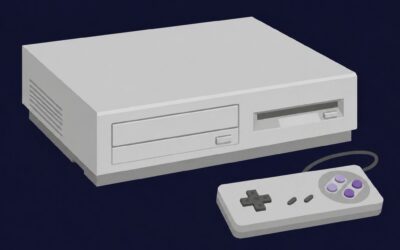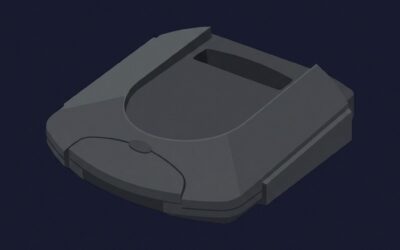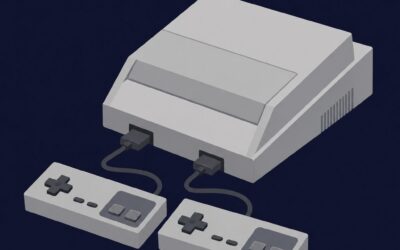
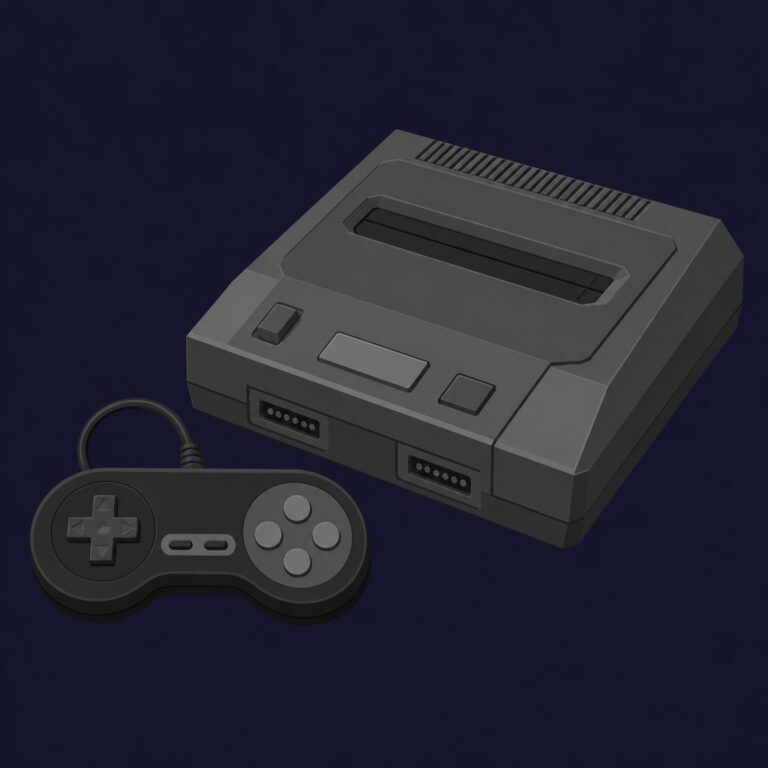
The Super A’Can is a cartridge console made by Funtech Entertainment, a unit of the Taiwanese chipmaker UMC, and launched in Taiwan on 25 October 1995 at NT$2,900. Only 12 games were released before Funtech scrapped the project in 1996.
The Funtech Super A’Can (also written Super Acan) looks like a 16-bit Super Nintendo clone and is far more unusual than that. It runs a Motorola 68000 with a 6502-family sound processor and a custom UMC video chip, and it had no 3D hardware when the PlayStation and the Saturn were already on sale. The console sold for about a year and reportedly lost its makers US$6 million. A single developer kit that surfaced in 2023 is the only one known to have appeared on the market.
Funtech, UMC and the 1995 Launch
Funtech Entertainment Corp., also referred to as Dunhuang Technology, is described as a division or subsidiary of UMC (United Microelectronics Corporation). The machine carried the internal codename F-16. Its engineers worked under non-disclosure agreements, and design diagrams were reportedly destroyed after the project ended.
The console launched on 25 October 1995, and the Centre for Computing History in Cambridge gives the same date. It was sold in Taiwan. The launch price was NT$2,900, which the Centre for Computing History describes as far more than the competition, meaning the PlayStation and the Saturn.
Time Extension, writing in September 2023 about an auction by Brandon Cobb of Super Fighter Team, reports a delayed launch and rushed game development. Developers were told to return all development materials to UMC so they could be written off. The console was discontinued on 4 April 1996, about six months after launch. Remaining systems were dumped, and some were sold to the United States as scrap parts.
Hardware
The main processor is a Motorola 68000. The published clock figure is 10.738635 MHz, while MAME’s driver derives roughly 8.95 MHz from the board’s 53.693175 MHz master crystal, using a part rated at 10 MHz. The sound processor is a W65C02 running at about 4.47 MHz. A UMC UM6618 video chip handles four tile layers and one rotation and scaling layer, plus sprites. A UM6619 chip covers sound and system control.
The listed resolution is 320 x 240 with 256 colours on screen from a palette of 32,768. MAME’s driver, which is based on inspection of the hardware, shows a visible area 256 pixels wide and at most about 224 to 232 lines high. Published specifications give 64 KB of work RAM plus 32 KB of secondary RAM and 128 KB of video RAM. The audio hardware is described as 16-channel stereo PCM, though MAME calls the sound chip completely custom and only partly implemented.
Cartridges are ROM, with a maximum of 112 Mbit and 16 to 64 KB of SRAM. Two front-mounted DE-9 controller ports resemble the Genesis connector but are not compatible. The protocol uses five lines and looks like the SNES one with the Select and Start signals swapped. Fan researcher documentation on retrogame.cyberphreak.com covers the pinout and timing. The pad has a D-pad, A, B, X and Y buttons, Start, Select, and L and R shoulder buttons. Output covers RF, composite video and RCA audio, and a later revision dropped RF.
The Games
Twelve games were released, and a further eleven were listed but never came out. Publisher and year details below follow the commonly cited list.
- Sango Fighter (Panda Entertainment, 1995), a fighting game that Time Extension calls a buggy port.
- Formosa Duel and Speedy Dragon (AV Artisan, 1995).
- The Son of Evil (Funtech, 1995), an RPG.
- C.U.G. (Funtech, 1995), a platformer that RF Generation counts among the best.
- Super Taiwanese Baseball League (Quan Wei/C&E, 1995).
- Boom Zoo and Magical Pool (Funtech, 1996).
- Super Dragon Force (Kingformation, 1996) and Gambling Lord (Panda and Funtech, 1996).
- REBEL (Horng Shen, 1996), an RPG and the rarest of the set.
The auction listing used different titles for some games, among them Journey to the Laughter, Sonic Dragon and Monopoly: Adventure in Africa. RF Generation says very few units were sold. A CD-ROM attachment and a CPU and graphics upgrade were planned but never released. The console’s external resemblance to the Super Nintendo has led to it being mistaken for a clone, according to RF Generation. It has no 3D hardware, which left it at a disadvantage against the PlayStation and the Saturn. Sources classify it as either a fourth or a fifth-generation machine.
Why It Ended
The launch was delayed and the price stood far above rival machines. Both RF Generation and the Centre for Computing History describe the console as technologically obsolete at launch. Funtech scrapped the project and its equipment after about a year. It sits alongside other short-lived hardware in the cancelled and short-lived console database and in the 1990s console overview.
Collecting and Preservation
The 2023 auction raised about US$19,814 across a console, all 12 games, a controller and a developer kit. The console fetched $2,735 and a copy of REBEL $5,655. A sealed controller sold for $97. The developer kit was described as the only one to have surfaced.
MAME emulates the system through its supracan driver, written by Angelo Salese and Ryan Holtz. Sound and graphics are both marked imperfect. Known problems include sprite sizing, rotation and scaling, the backgrounds of C.U.G., a Super Taiwanese Baseball League that does not boot and graphics faults in The Son of Evil. Hardware documentation and a controller pinout, including SNES adapter research, are published by fans on GitHub and at retrogame.cyberphreak.com. The Centre for Computing History in Cambridge catalogues one console as item CH68395.
Frequently Asked Questions
How much did the Super A'Can cost?
It launched in Taiwan at NT$2,900, which the Centre for Computing History describes as far more than the PlayStation or Saturn.
When was the Super A'Can released?
It launched on 25 October 1995 in Taiwan and was discontinued on 4 April 1996.
How many games were released for the Super A'Can?
Twelve games were released. Around eleven more were listed but never came out.
Why did the Super A'Can fail?
The launch was delayed and the price was high, with no 3D hardware against the PlayStation and Saturn, and game development was rushed. Funtech scrapped the project after about a year.
Where was the Super A'Can sold?
It was sold in Taiwan only.
How much is a Super A'Can worth?
At a 2023 auction a console sold for $2,735 and a copy of REBEL, the rarest game, for $5,655.