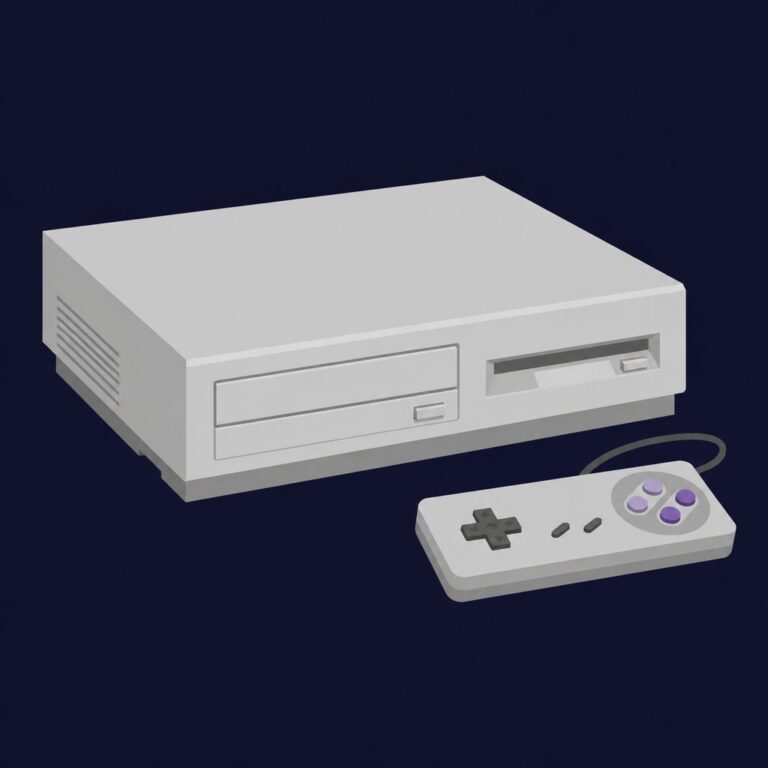
The FM Towns Marty is a CD-ROM game console made by Fujitsu and built on the hardware of its FM Towns personal computer. It launched in Japan only on 20 February 1993 at ¥98,000. A cheaper Marty 2 followed in 1994 at ¥66,000.
The Fujitsu FM Towns Marty is a personal computer wearing a console’s clothes. Fujitsu took the architecture of the FM Towns, a Japanese PC that booted from CD-ROM, and put it in a compact box with two controller ports and composite and S-Video output. The result played FM Towns software on a television, never left Japan, and sold in small numbers. It also produced one of the stranger products of the era: a version for the car dashboard.
From FM Towns Computer to Console
The parent machine came first. The FM Towns computer launched in Japan on 28 February 1989 with a bootable CD-ROM drive and its own operating system, Towns OS. Over its life the line sold about 500,000 units and stayed in production until 1997, with later models moving to 486 and Pentium processors.
Fujitsu built the Marty on that same hardware. It could run FM Towns software, although newer titles often had compatibility problems. The console went on sale in Japan on 20 February 1993 for ¥98,000. It never launched in North America or Europe.
Sales stayed low. Reasons named for the weak showing are the high price, custom hardware that was harder to expand than a DOS/V PC, and the dominance of NEC’s PC-98 in Japanese home computing. A Polish history of the machine adds that Fujitsu left the architecture unchanged in 1994, just as the Sega Saturn and the PlayStation arrived. About 45,000 units had sold by the end of 1993.
Hardware
Inside sat an AMD 386SX processor running at 16 MHz, with 32-bit internals and a 16-bit bus. The machine carried 2 MB of RAM, and a Marty-only expansion card raised that to 4 MB. Video memory was 512 KB of VRAM plus 128 KB of sprite RAM.
The display modes ranged from 256 by 240 up to 720 by 480, nine in all. The palette could reach 4,096, 32,768 or 16.77 million colors depending on the mode, with 16, 256 or 32,768 colors on screen at once. The hardware handled up to 1,024 sprites of 16 by 16 pixels.
Sound came from a Yamaha YM2612 with six FM channels and a Ricoh RF5C68 with eight PCM channels, plus CD audio playback. Media were a single CD-ROM drive and a 3.5-inch floppy drive using the 1232 KiB format. The Marty also had a keyboard port and a PCMCIA Type 1 card slot, which took the official FMM-CM301 modem.
Controllers and accessories
The standard Marty Pad had a D-pad, A, B, Select and Run buttons, and an extra shoulder button that toggled vertical zoom. A six-button pad existed for Street Fighter II. Mouse and keyboard were available as well, as was the 4 MB RAM card.
Marty 2, TC Marty and Car Marty
| Model | Date | Price | Notes |
|---|---|---|---|
| FM Towns Marty | 20 February 1993 | ¥98,000 | Launch model, Japan only |
| FM Towns Marty 2 | 1994 | ¥66,000 | Darker grey shell, same hardware |
| Car Marty | April 1994 | ¥120,000 | In-car unit; navigation kit ¥90,000 extra |
The Marty 2 arrived in 1994, although MAME lists it under 1993, and kept the same hardware as the original. Rumors of a faster processor were false; the changes were the darker shell and the lower price of ¥66,000. The MAME emulator also lists a TC Marty with the same specifications.
The Car Marty went on sale in April 1994 through Fujitsu Ten, Fujitsu’s car-audio arm. It was a Marty built for the dashboard, with a GPS connector, a PCMCIA map card, CD-ROM maps with data contributed by Zenrin, a 5.6-inch LCD screen and a one-handed controller called the navi-pad. The base unit cost ¥120,000. A navigation kit added ¥90,000, a floppy drive ¥30,000 and a video cable ¥10,000, which brought a full installation to about ¥250,000. No official sales figure exists for it, and a community estimate puts it near 5,000 units.
Games
The Marty drew on the FM Towns software library, which a published list counts at 638 titles. Notable FM Towns releases from that library include Rayxanber (Data West, April 1990), Dungeon Master: Chaos Strikes Back (December 1990), Zak McKracken (February 1991), Ultima VI (December 1991), Super Real Mahjong PII and PIII (Ving, April 1992), Prince of Persia (Riverhillsoft, June 1992) and Wing Commander (December 1992).
Later releases include Monkey Island 2 (LucasArts and Victor Entertainment, 25 February 1994), Super Street Fighter II (Capcom, 28 October 1994) and Fatal Fury Special (Japan Home Video, 13 September 1996). Ports of Indiana Jones and the Fate of Atlantis, Lemmings, SimCity and Syndicate also appeared on the platform. Third-party support continued into 1999, largely with adult titles. Discs carried no copy protection, and copying was a problem.
Why It Faded
Fujitsu discontinued the console in 1995, and the Car Marty ended the same year. The combination of a high launch price, hardware that was harder to expand than a PC, the strength of the PC-98 and a design that stayed unchanged while the fifth generation arrived left the Marty with a small audience. For another CD-based machine of the same years, see the Panasonic 3DO, and for a later Japanese multimedia console, the Bandai Pippin.
Preservation Today
MAME includes three drivers for the family, fmtmarty, fmtmarty2 and carmarty, with release years of 1993, 1993 and 1994. All three are flagged as not working, and the driver notes that video emulation is far from complete. The related FM Towns CD software list in MAME holds 952 entries. A separate free emulator, Tsugaru, supports the Marty as well.
Frequently Asked Questions
How much did the FM Towns Marty cost?
The original Marty launched at ¥98,000. The Marty 2 followed in 1994 at ¥66,000, and the in-car Car Marty cost ¥120,000 before a ¥90,000 navigation kit.
When was the FM Towns Marty released?
It went on sale in Japan on 20 February 1993. It was never released in North America or Europe.
How many FM Towns Marty consoles were sold?
About 45,000 units had sold by the end of 1993. The Car Marty is estimated by the community at around 5,000 units.
What is the Car Marty?
A Marty built for the dashboard, released in April 1994 through Fujitsu Ten. It added a GPS connector, a PCMCIA map card, CD-ROM maps and a 5.6-inch LCD screen.
Why did the FM Towns Marty sell poorly?
Reasons named are its high price, custom hardware that was harder to expand than a DOS/V PC, and the dominance of NEC's PC-98. Its architecture also stayed unchanged when the Saturn and PlayStation arrived.
Can the FM Towns Marty be emulated?
MAME has drivers for the Marty, Marty 2 and Car Marty, but all are flagged as not working and video emulation is incomplete. The Tsugaru emulator also supports the Marty.