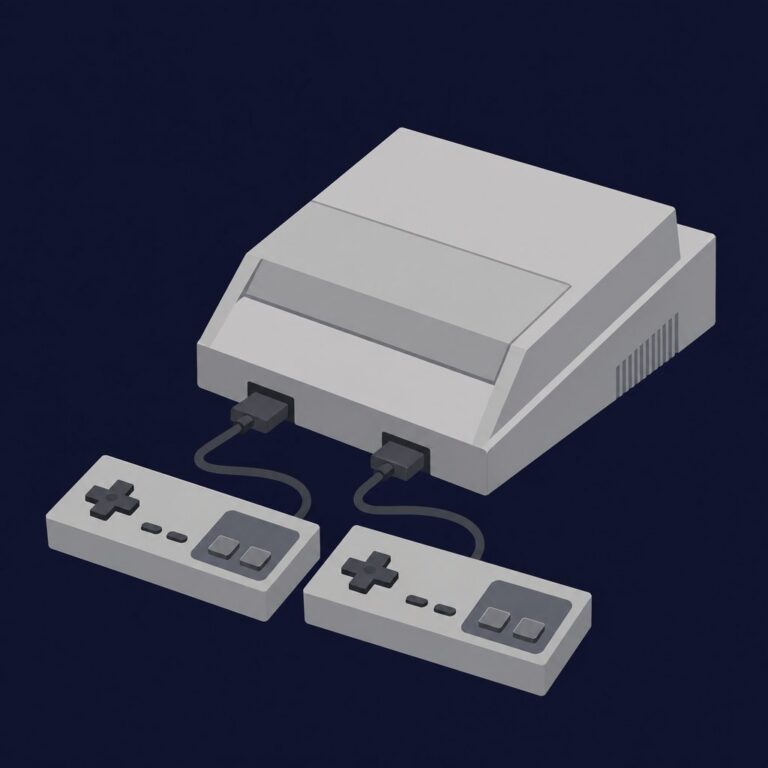
The Amstrad GX4000 is an 8-bit cartridge console made by Amstrad plc of the United Kingdom and launched in September 1990 in Europe at £99, including two controllers and the game Burnin’ Rubber. It shared its chip with the CPC Plus computers, and 27 games were released.
The Amstrad GX4000 was the home computer maker’s attempt to sell the Amstrad CPC range as a games console. Instead of a new design, it took the cartridge port and graphics chip of the new CPC 464+ and 6128+ computers and put them in a box without keyboard or drives. It arrived against the Sega Master System and the Nintendo Entertainment System with a £20 million advertising campaign behind the range, and it was discontinued in 1991.
Announcement and Launch
Amstrad Action reported in its September 1990 issue that the press had been briefed under embargo in June, with the lift in mid-August. The public announcement took place in August 1990 in Paris at the CNIT. The same issue presented the GX4000 together with the 464 Plus and 6128 Plus computers, noting that the CPC name was being dropped.
The UK price was £99, with two controllers and Ocean’s Burnin’ Rubber in the box. French listings give FRF 990. The magazine listed the Commodore C64GS at about £99 alongside it and said the £20 million advertising budget would run from October to Christmas 1990 across the console and the Plus computers. Sales were planned for the UK, France, Spain and Italy, and Europe was the only market.
Software for the console was manufactured and distributed by Amstrad alone on behalf of publishers. Amstrad Action in February 1992 blamed this arrangement for later delays.
Hardware
The GX4000 used a Zilog Z80A processor at 4 MHz and a custom chip called Arnold V, also known as the CPC Plus ASIC. The chip gave the machine 16 hardware sprites of 16 x 16 pixels, each with 16 colours (15 plus transparent) and magnification of two or four times. Sprite size was independent of the screen mode, which means about 32 colours could appear on screen at once. It also handled hardware smooth scrolling, programmable scanline interrupts and three DMA sound channels.
The console had 64 KB of RAM and 16 KB of video memory. The palette held 4,096 colours, with 16 colours per screen in mode 0 (160 x 200), four in mode 1 (320 x 200) and two in mode 2 (640 x 200). Sound came from a General Instrument AY-3-8912 chip, with stereo output through an Amstrad monitor. Video output went through RGB on an 8-pin DIN, composite or RF, and the machine worked on a TV or on an Amstrad monitor.
There were two digital controller ports and an analogue port, plus a light gun connector. Amstrad Action said a light gun in the style of the Phaser would appear around launch, and the Trojan Light Phazer was later used for Skeet Shoot and The Enforcer. Cartridges held one megabit (128 KB) at launch according to Amstrad Action, while later listings give up to 512 KB.
The Games
Twenty-seven games were released, and MAME’s software list holds 25 game cartridges plus BASIC and system cartridges. Burnin’ Rubber from Ocean was the pack-in and ran only on the GX4000. Other releases include Batman: The Movie, Operation Thunderbolt, Pang and Robocop 2 and Navy Seals from Ocean, Klax from Domark, Switchblade from Gremlin, Crazy Cars II from Titus, and Copter 271 and Panza Kick Boxing from Loriciel. Several titles were GX4000-only, including Robocop 2 and Burnin’ Rubber.
The MAME list also covers Barbarian II, Dick Tracy, Fire and Forget II, Mystical, No Exit, Pinball Magic, Plotting, Pro Tennis Tour, Tennis Cup II, Tintin on the Moon, Wild Streets and World of Sports. Publishers mentioned include Ocean, Titus, Loriciel, Infogrames, Trojan, Ubi Soft, Domark, Empire, Epyx, Coktel Vision and Gremlin. A game called Gazza II was cancelled. Cliff Lawson, who is credited as the designer, claimed the console was at least as good as the Super Nintendo, and early reviews in Computer and Video Games, ACE and Amstrad Action were positive.
Why It Ended
Amstrad Action’s February 1992 issue ran a piece with French publishers under the title “The French Connection”. Its verdict was blunt: “The console has flopped!” The French software houses blamed a price up to £30 above the Master System and NES, too few recruited publishers, software slippage that left few games at launch, and cartridge duplication taking months instead of weeks. Retailers including Dixons had dropped the console.
Price cuts followed. Listings put the price at £79.95 around March 1991 and £29.99 by July 1991, while a French publisher quoted in February 1992 said it was in some places down to about ten pounds. A “cartridge crisis” is reported for March 1991, and the Mega Drive reached Europe in November 1990. Amstrad did not move to 16-bit hardware. The console was quietly discontinued in 1991. It appears in the 1990s console overview.
Playing It Today
MAME emulates the system as gx4000, with no imperfect or not-working flags in its driver. The cartridge slot accepts .bin and .cpr files and the software list has 32 entries, including Locomotive BASIC with ParaDOS, a French BASIC cartridge with OS v3, and Burnin’ Rubber bundled with BASIC for France and Spain. The CPC 464+ and 6128+ share the chip and the cartridge port and run older CPC software, while only cartridges use the console’s special features. The Arnold V chip specification is published on cpctech.org.uk.
Frequently Asked Questions
How much did the Amstrad GX4000 cost?
It launched in the UK at £99 with two controllers and Burnin' Rubber. French listings give FRF 990, and prices were cut in 1991.
When was the GX4000 released?
It was announced in August 1990 and launched in Europe in September 1990, in the UK, France, Spain and Italy.
How many games were released for the GX4000?
Twenty-seven games were released. MAME's software list holds 25 game cartridges plus BASIC and system cartridges.
Why did the Amstrad GX4000 fail?
Amstrad Action in 1992 reported French publishers blaming the price, too few publishers, late software, slow cartridge duplication and retailers dropping the console.
What came in the GX4000 box?
Two controllers and Ocean's Burnin' Rubber came in the box.
Can the GX4000 be played today?
MAME emulates it as gx4000 with a software list of 32 entries, and the cartridge slot accepts .bin and .cpr files.