
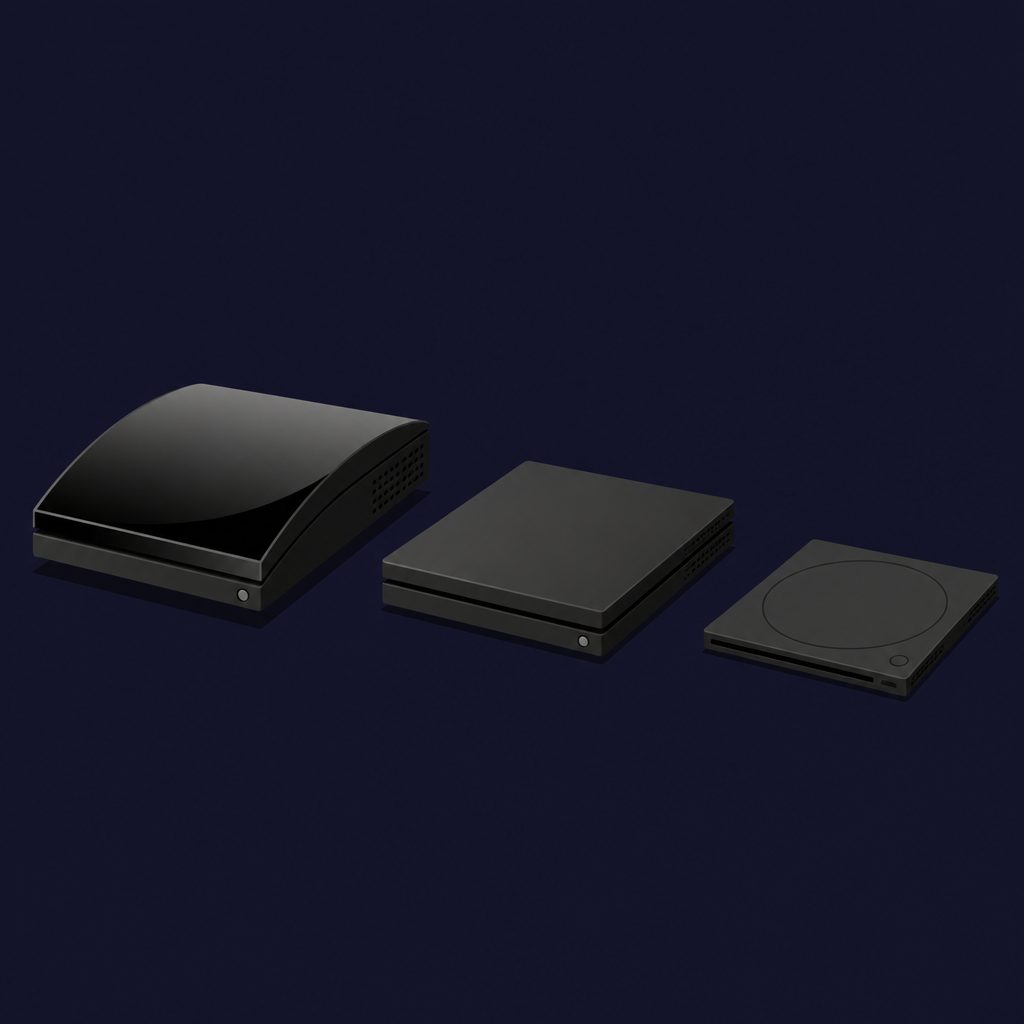
All PS3 models carry a model number that starts with CECH. The letters CECHA to CECHQ are the original “fat” consoles (November 2006 to 2009), CECH-20xx, 21xx, 25xx and 30xx are the PS3 Slim (from September 1, 2009), and CECH-40xx, 42xx and 43xx are the Super Slim (from September 25, 2012). Only the earliest fat consoles play PS2 discs on real PS2 hardware (CECHA and CECHB), two more use partial emulation (CECHC and CECHE), and every later model has no PS2 support at all.
The PlayStation 3 was revised many times during its life, and the PS3 models differ in weight, ports, storage and what discs they accept. A launch console weighs about 5 kg and has four USB ports and card readers. A Slim weighs 3.2 kg, and a Super Slim 2.1 kg with a top-loading disc drive. If a shelf of PS2 discs is part of the plan, the differences matter even more. The model number on the sticker answers most questions in a few seconds.
Reading the Sticker on Your PS3 Model
The label sits on the back of the console, near the bottom edge. It shows a model number such as CECHA01 or CECH-2501A. On the early fat consoles the letter after CECH names the hardware variant (A, B, C, E and so on), and the last two digits give the region: 00 is Japan, 01 is North America, 02 is Australasia, 03 is the UK, and 04 is Europe, the Middle East and Africa. A CECHA01 is therefore a North American 60 GB launch console.
Slim and Super Slim numbers add a hyphen and four digits. In published model tables the trailing letter follows storage size: A for 120 GB or 160 GB, B for 250 GB or 320 GB, and C for 500 GB on the Super Slim. Drives can be swapped by owners, so treat the letter as a hint about how the console left the factory. The comparable PS4 labels use a different prefix, and the PS4 model guide covers the CUH codes. If a number is hard to place, the model decoder matches it against the site’s revision database.
PS3 Models at a Glance
| Model | Model number | Release date (NA) | Launch price (USD) | Key change |
|---|---|---|---|---|
| Fat 20 GB | CECHB | November 17, 2006 | $499 | Hardware PS2 compatibility; four USB ports; no Wi-Fi or card readers |
| Fat 60 GB | CECHA | November 17, 2006 | $599 | Hardware PS2 compatibility; adds HDMI, Wi-Fi and card readers |
| Fat 80 GB | CECHE | August 6, 2007 | $599 ($499 from October 18, 2007) | PS2 games run through partial software emulation |
| Fat 40 GB | CECHG, CECHH, CECHJ | November 2, 2007 | $399 | No PS2 support, no SACD, no card readers, two USB ports |
| Fat 160 GB | CECHP, CECHQ | November 2008 | $499 | Largest drive of the fat generation |
| PS3 Slim | CECH-20xx, 21xx, 25xx, 30xx | September 1, 2009 | $299 | 120 GB drive in a smaller, lighter case |
| PS3 Super Slim | CECH-40xx, 42xx, 43xx | September 25, 2012 (250 GB bundle) | $269 (250 GB bundle); $299 (500 GB, October 30, 2012) | Top-loading disc drive |
The 20 GB console left the shelves in April 2007. The later 80 GB codes (CECHK, CECHL, CECHM) came in 2008 and, like the 40 GB models, dropped PS2 support.
What Is a Fat PS3?
“Fat PS3” is a collector nickname for the original design, the bulky glossy case that preceded the 2009 Slim. When people search for the PS3 fat release date, they are after November 17, 2006 in North America, the day the 20 GB and 60 GB consoles went on sale at $499 and $599.
The fat generation is not one console. Over about three years Sony changed features and costs in steps. The 20 GB model had no Wi-Fi and no card readers. The 60 GB model added both, plus HDMI. The early systems (20 GB, 60 GB and the North American 80 GB) have four USB ports at the front, while everything after has two. The 40 GB model and its successors dropped the card readers and SACD playback. Later revisions also moved the Cell processor from 90 nm to 65 nm.
PS2 Backwards Compatibility by Fat Model
This question sits behind most searches for the best fat PS3. The answer splits the line into three groups.
CECHA and CECHB have the PS2’s Emotion Engine and Graphics Synthesizer chips built in, so PS2 discs run on real PS2 silicon and compatibility is highest. CECHC and CECHE removed the Emotion Engine and emulate it in software on the Cell processor, while keeping the Graphics Synthesizer in hardware. Most games run, with lower compatibility. Starting with CECHG, no fat, Slim or Super Slim can play a PS2 disc, and no firmware update changes that.
The CECHC was a 60 GB model that reached the UK, Europe and Australia on March 23, 2007. A “60 GB” PS3 can therefore mean full hardware or partial emulation, depending on its letter. The sticker settles it faster than the capacity. The backwards compatibility database shows how each console generation handles older discs.
PS3 Slim: CECH-20xx, 21xx, 25xx and 30xx
Sony unveiled the Slim at Gamescom on August 18, 2009. It went on sale on September 1 in North America and Europe at $299 and €299 with a 120 GB drive, and Japan followed on September 3. The case measures 290 x 65 x 290 mm against the fat model’s 325 x 98 x 274 mm, and the weight fell from about 5 kg to 3.2 kg. The 45 nm Cell uses about 34% less power than the 65 nm version.
The Slim has no PS2 support, two USB ports and no card readers. The firmware it shipped with also removed the Install Other OS option that had let fat owners run Linux. A 250 GB Slim followed in North America on November 3, 2009, and the CECH-25xx and CECH-30xx revisions from 2010 on carried 160 GB and 320 GB drives.
PS3 Super Slim: CECH-40xx, 42xx and 43xx
The Super Slim was announced in September 2012. It measures 290 x 60 x 230 mm and weighs 2.1 kg, about 20% smaller and 25% lighter than the Slim, and it replaces the slot-loading drive with a top-loading one.
The 250 GB bundle reached North America on September 25, 2012 at $269, and the 500 GB version followed on October 30 at $299. A cheaper 12 GB flash-storage variant arrived in Europe in October 2012 and in North America in 2013. CECH-4200 and CECH-4300 are near-identical in hardware to the CECH-4000, and the 4200 limits analog video output for Blu-ray playback under copy-protection rules. CECH-4300 is the last revision.
The Yellow Light of Death
The PS3’s best-known fault is the yellow light of death (YLOD): the status light turns yellow and the console stops working. In September 2009 the BBC’s Watchdog program reported that affected consoles typically failed 18 to 24 months after purchase, outside the one-year warranty. Sony answered that its own data showed about 0.5% of consoles returned with YLOD symptoms. A 2009 SquareTrade study found a two-year failure rate of 10%, and Ars Technica judged the failure rate to be within the expected range for consumer electronics.
Repair guides blame heat and cracked solder joints on the main board. Collector references tie the problem most often to the oldest units, with the CECHA and CECHB consoles that offer full PS2 hardware at the top of the list. They are also the machines with the most years behind them.
Differences That Matter to a Buyer
Five things separate the PS3 models in practice.
PS2 discs. Only CECHA, CECHB, CECHC and CECHE play them. SACD and card readers. Gone after the early fat models. Size and noise. A fat console weighs about 5 kg and draws 170 to 200 W in use, and the Slim and Super Slim are lighter and use less power. USB ports. Four on the early fat models, two on the rest. Disc drive. Slot-loading up to the Slim, top-loading on the Super Slim.
All models play PS3 games and Blu-ray movies, and owners can upgrade the drive, so capacity should not drive the decision.
Which PS3 to Buy in 2026
If PS2 discs matter, a CECHE or CECHC offers emulation, and collector references report fewer long-term worries on these than on the older machines. A CECHA or CECHB gives the best compatibility at the cost of the highest age-related risk. Whichever letter it is, buy one that has been tested running a PS2 game. The PS3 console page has the collecting section for the hardware-compatible 60 GB model.
For everything else, a Slim or Super Slim is the sensible choice. The Super Slim (CECH-4000 and later) is the lightest and has no PS2 baggage. Look for a CECH-40xx or newer, check that the drive reads discs from several different games, and use the console age tool if the production year is unclear. A 12 GB Super Slim costs less up front, but its storage fills fast, so plan on a bigger drive.
Frequently Asked Questions
How do I tell which PS3 model I have?
Read the label on the back of the console, near the bottom edge. The model number starts with CECH. A letter after CECH (CECHA, CECHB, CECHC and so on) marks an original fat console, while a four-digit number such as CECH-2501A or CECH-4001C marks a Slim or Super Slim. The last two digits of fat model numbers give the region, for example 01 for North America.
What is a fat PS3?
Fat PS3 is the collector nickname for the original PlayStation 3 design that launched on November 17, 2006 in North America, before the Slim arrived on September 1, 2009. It covers the CECHA to CECHQ model numbers in 20 GB, 40 GB, 60 GB, 80 GB and 160 GB versions.
Which PS3 models play PS2 games?
Only four fat model families do. CECHA and CECHB have PS2 hardware built in, which gives full hardware compatibility. CECHC and CECHE emulate the PS2 processor in software and keep the graphics chip in hardware. From CECHG on, including every Slim and Super Slim, the PS3 cannot play PS2 discs.
What is the PS3 yellow light of death?
The yellow light of death (YLOD) is a hardware fault where the status light turns yellow and the console stops working. A September 2009 BBC Watchdog report said affected consoles typically failed 18 to 24 months after purchase, while Sony said about 0.5% of consoles were returned with YLOD symptoms. Repair guides point to heat and cracked solder joints on the main board.
What is the difference between the PS3 Slim and Super Slim?
The Slim (CECH-20xx to CECH-30xx) launched on September 1, 2009 at $299 and weighs 3.2 kg with a slot-loading disc drive. The Super Slim (CECH-40xx to CECH-43xx) arrived in September 2012, weighs 2.1 kg, is about 20% smaller and 25% lighter than the Slim, and uses a top-loading disc drive.
Which PS3 model should I buy in 2026?
A Super Slim (CECH-4000 or later) is the lightest option and has no PS2 support to think about. Buyers who want to play PS2 discs should look for a CECHE or CECHC for emulation, or a CECHA or CECHB for full hardware compatibility, and test the console with a PS2 game before paying.