
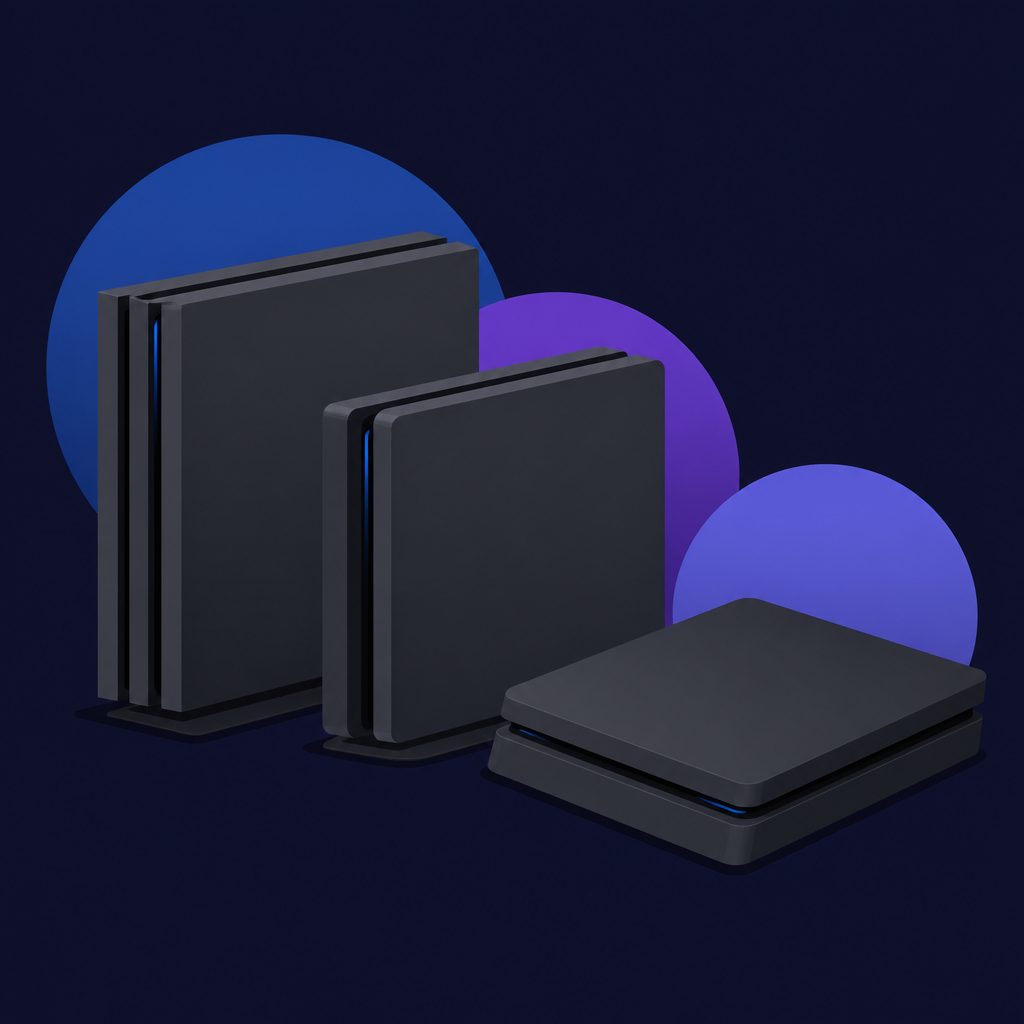
Every PS4 carries a model number starting with CUH-, and the first digit after that tells you the family: CUH-10xx/11xx/12xx is the original launch-era console, CUH-20xx/21xx/22xx is the PS4 Slim, and CUH-70xx/71xx/72xx is the PS4 Pro. Within each family, the last two digits mark a hardware revision, chasing smaller, cooler, and cheaper to build rather than more powerful, with the single exception of the Pro, which is a genuine performance step up built for 4K output.
The PlayStation 4 shipped for nearly eleven years, from November 2013 through Sony winding down production in 2024, and Sony revised the internal board more times than most owners realize. None of those revisions changed what games run or how they perform, except for the jump to the Pro. What they changed was weight, heat, noise, and manufacturing cost. If you’re buying secondhand or trying to figure out exactly what’s sitting under your TV, the sticker tells you everything.
Reading the Sticker
Flip the console over, or check the back panel on a Slim or Pro, and look for a rectangular label with a barcode. The model number reads something like CUH-1215B. Break that down as: CUH (the PS4 hardware prefix, replacing the CECH prefix Sony used on the PS3), a four-digit code where the first digit identifies the family and the remaining digits identify the revision, and a trailing letter that marks the regional and power-supply variant of that specific revision. Two units with the same four digits but different letters are the same internal hardware sold for different electrical standards and markets, not different consoles.
Original PS4: CUH-10xx, CUH-11xx, CUH-12xx
These are the pre-Slim consoles, the ones with the angled two-tone case that debuted in November 2013.
| Model | What changed |
|---|---|
| CUH-10xx | Launch board (SAA-001). Two-phase power circuit to the CPU, four-phase to the GPU. Heaviest of the three at roughly 2.75 kg. This is the revision most associated with early solder and RAM failures. |
| CUH-11xx | New SAB-001 board, about 50g lighter. Simplified power delivery (one-phase CPU, three-phase GPU), redesigned Wi-Fi antenna to cut electromagnetic noise, and revised internal fan fin angles for airflow. |
| CUH-12xx | Matte HDD bay cover instead of glossy, mechanical power/eject buttons instead of touch-sensitive, reordered rear ports (optical, AUX, HDMI, LAN instead of optical, HDMI, LAN, AUX), maximum power draw down from 250W to 230W, and weight down to about 2.5 kg. |
None of these changed a single teraflop of processing power. They’re the same AMD Jaguar CPU and GCN GPU throughout the original line.
PS4 Slim: CUH-20xx, CUH-21xx, CUH-22xx
Announced in September 2016, the Slim is a physical redesign, not a performance one. It uses the identical 8-core AMD Jaguar CPU at 1.6 GHz and the same 1.84 teraflop GCN GPU as the original PS4, with the same 8 GB of GDDR5 memory. What it changed: about 30% smaller footprint, roughly 16% lighter (2.1 kg versus 2.8 kg), quieter fans, and a lower 165W maximum power draw against the original’s 230W. Later revisions in the CUH-21xx and CUH-22xx range brought minor PCB optimizations and an updated 802.11ac Wi-Fi chipset, again without touching performance.
PS4 Pro: CUH-70xx, CUH-71xx, CUH-72xx
The Pro, released in November 2016, is the one revision in this family that actually changes what the console can do. It targets 4K output, higher-resolution textures, and boosted frame rates in games patched to support “Pro mode.” Physically it’s the largest PS4, with a distinctive three-tier stacked case. Across its own revisions, the later CUH-72xx boards are generally regarded as the quietest of the three Pro generations and use a different, more reliable power-connector style than the earlier CUH-70xx and CUH-71xx units, which is the main reason collectors and secondhand buyers tend to seek that revision out specifically.
Storage Capacity Isn’t Part of the Model Number
One common point of confusion: the CUH number identifies the hardware revision, not the hard drive size. Sony sold the original PS4 with 500 GB as standard, later offered a 1 TB option partway through the console’s life, and the Pro shipped with 1 TB standard and, in some regional bundles, 2 TB. Two consoles with the identical CUH-2216 code, for example, can carry different drive capacities depending on the specific retail SKU. If drive size matters to you, check the separate capacity line on the box or sticker, don’t assume it from the CUH number alone. It’s also worth knowing that every PS4 model accepts a standard 2.5-inch SATA drive as a user-installable upgrade, so a low-capacity unit isn’t a permanent limitation.
Known Issues by Revision
The most notorious PS4 fault is the so-called “blue light of death”: instead of turning solid white on power-up, the status light pulses blue and the console never fully boots. It surfaced almost immediately after the November 2013 launch and was concentrated in early CUH-10xx and early CUH-11xx units. Sony’s own diagnosis pointed to failed solder-ball connections beneath the APU and defective RAM chips generating excess heat, and the company put the overall failure rate at around 0.4% of shipped consoles, low in absolute terms but high enough to draw mainstream press coverage at the time. Later revisions, including every CUH-12xx unit and the entire Slim and Pro lines, are not associated with this specific failure pattern at anything like the same rate; general PS4 wear issues past that point are the ordinary kind, worn Blu-ray drive belts and thermal-paste degradation on higher-mileage units, rather than a design-specific fault.
Buying Used: A Short Checklist
A few checks are worth running before handing over cash for any secondhand PS4, regardless of which family it’s from. Power the console on and confirm the light bar turns solid white rather than flashing blue, ruling out the fault described above. Listen to the fan under load, ideally with a game running rather than sitting idle on the menu, since fan noise climbing sharply under load can point to dust buildup or aging thermal paste on higher-mileage units. Check the disc drive with a physical game if you’re not going all-digital, since drive belts and lasers wear with age across every revision. None of these checks differ by CUH family; they’re generic used-electronics diligence that happens to matter more on a console old enough that most units now have real hours on them.
Which One to Buy in 2026
If you’re shopping secondhand today, a later CUH-12xx original PS4 is fine for a budget disc-based system, but there’s little reason to prefer it over a Slim at a similar price, since the Slim runs cooler and quieter for identical performance. Between Slim and Pro, the decision comes down to whether 4K output and boosted frame-rate modes matter to you; if they do, look specifically for a CUH-72xx Pro, the quietest and most refined revision of the only PS4 model that’s actually more powerful than the one it replaced. For a deeper spec comparison against the console it competed with, see PS4 vs Xbox One.
Controllers and Accessories Across Models
All three families, original, Slim, and Pro, use the same DualShock 4 controller and the same accessory ecosystem; nothing about the CUH revision changes what peripherals work. What does vary slightly is the console’s own port layout, which shifted rear-panel positions between CUH-11xx and CUH-12xx as noted above, so a power or HDMI cable that routes cleanly behind one revision may need to be re-run behind another. None of that affects compatibility, only cable management. Original PS4 and Slim consoles also share the exact same controller charging and Bluetooth pairing behavior; the Pro doesn’t change that either, since its extra power goes entirely to the GPU rather than to I/O.
Frequently Asked Questions
Which PS4 model do I have?
Check the sticker on the underside or back of the console. It lists a model number starting with CUH- followed by four digits and a letter, for example CUH-1215B. The first digit after CUH tells you the form factor: 1 is the original launch-era PS4, 2 is the PS4 Slim, and 7 is the PS4 Pro.
What is the difference between CUH-1115A and CUH-1215A?
Both are original, pre-Slim PS4 consoles, but CUH-12xx is a later hardware revision than CUH-11xx, which is later than the launch CUH-10xx boards. Each revision made the console lighter and more power-efficient without changing performance: the move from CUH-11xx to CUH-12xx dropped maximum power draw from 250W to 230W and shed roughly 300 grams, while also changing the button style from touch-sensitive to mechanical and swapping the port order on the back panel.
Is the PS4 Slim or PS4 Pro better?
They serve different purposes rather than one being strictly better. The Slim (CUH-2000 series) has identical processing power to the original PS4, just in a smaller, cooler, quieter case. The Pro (CUH-7000 series) has a genuinely more powerful GPU built for 4K output and boosted frame rates in supported games. If 4K or higher, steadier frame rates matter, the Pro is the pick; if you just want a compact, reliable disc-based PS4, the Slim covers it.
Which PS4 model should I buy in 2026?
For a secondhand purchase today, a later-revision CUH-2200 Slim or CUH-7200 Pro is generally the safer buy. Later revisions in both lines carry minor reliability and thermal refinements over their earlier CUH-2000/2100 or CUH-7000/7100 counterparts, and the Pro specifically is worth seeking out if you still use a PS4 as a primary console, since it's the only PS4 model built for 4K and enhanced frame-rate modes.
What does the letter at the end of a PS4 model number mean?
The trailing letter identifies the specific regional/market variant of that hardware revision, which mainly affects power supply voltage, plug type, and bundled accessories rather than internal performance. Two consoles with the same four-digit number but different letters are the same hardware generation sold into different markets.
What was the PS4 'blue light of death'?
It was a launch-era hardware fault, most associated with original CUH-10xx and early CUH-11xx units, where the console's status light pulsed blue instead of turning solid white on power-up, and the system would not boot. Sony traced the failure to issues including solder-ball connections under the APU and faulty RAM, and put the overall failure rate at around 0.4% of units.