
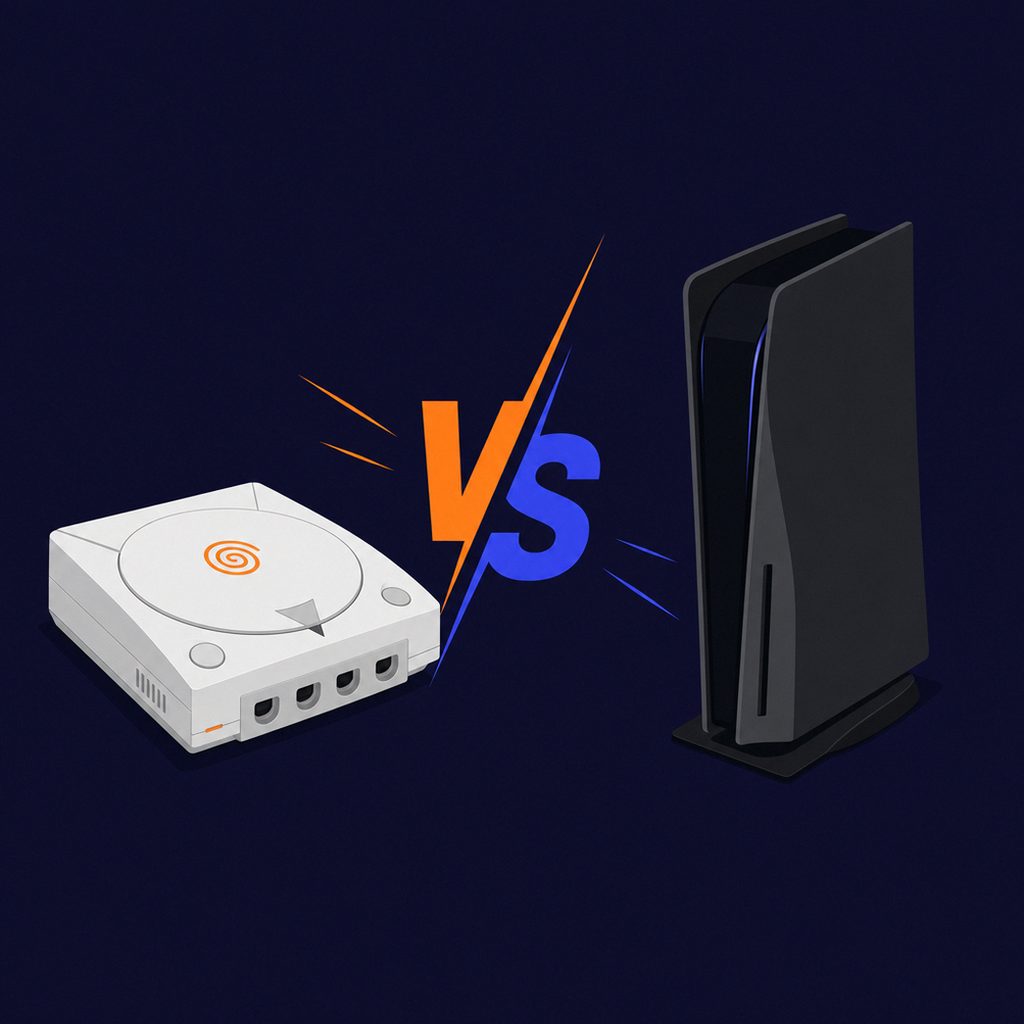
The Sega Dreamcast reached the sixth generation more than a year before the PlayStation 2, and for a brief moment it was the most advanced console on the market. The verdict, though, is bittersweet: the PS2 won decisively on sales and longevity, while the Dreamcast is remembered as a brilliant machine that arrived too early and ended Sega’s hardware era.
Hardware and Power
The Dreamcast launched in Japan on November 27, 1998 and in North America on September 9, 1999, built from off-the-shelf parts to keep costs down: a 200 MHz Hitachi SH-4 CPU and an NEC PowerVR2 GPU using efficient tile-based deferred rendering, paired with 16 MB of main memory. It was genuinely powerful for 1998 and produced clean, sharp visuals.
The PlayStation 2, released in Japan in March 2000 and in North America in October 2000, was more capable overall, led by its “Emotion Engine” CPU and 32 MB of memory, with strong geometry and effects performance. The most consequential hardware difference was the optical drive. The Dreamcast used a proprietary 1 GB GD-ROM and could not play DVDs; the PS2 included a full DVD drive that doubled as an affordable DVD movie player and gave it greater storage per disc — a decisive advantage as movies on DVD went mainstream.
The Dreamcast did include a forward-looking feature: a built-in modem for online play, making it the first console with online gaming out of the box, years before it became standard. Its VMU memory card with a small screen was another inventive touch.
Games and Library
For its short life the Dreamcast had an outstanding, distinctive library: Sonic Adventure, Soulcalibur (a landmark launch title), Shenmue, Jet Set Radio, Crazy Taxi, Skies of Arcadia, and Power Stone. Many of these are still celebrated, and the system is a favorite among collectors.
The PS2 went on to build the largest library of its generation, with Grand Theft Auto III, Metal Gear Solid 2 and 3, Final Fantasy X, God of War, and Shadow of the Colossus. Crucially, Sony’s heavy marketing and the anticipation around the PS2 — promoted long before its release — convinced many buyers to wait for it rather than commit to the Dreamcast, sapping Sega’s momentum at the worst possible time.
Legacy and Verdict
The outcome was stark. The Dreamcast sold roughly 9.13 million units before Sega discontinued it on March 31, 2001 and exited the hardware business to become a third-party publisher. The PlayStation 2 went on to sell over 155 million units — Sony has cited more than 160 million — the best-selling home console ever.
Weighing significance and library rather than raw specs, the PS2 is the clear winner on sales, library size, longevity, and lasting influence. Yet the Dreamcast’s verdict is one of the most respected in gaming: it pioneered built-in online play, delivered a remarkable run of original games, and was undone less by its own flaws than by the PS2’s DVD drive, Sony’s marketing reach, and Sega’s prior financial struggles. It came first, and it deserved better than it got.
See full specs on the Sega Dreamcast and PlayStation 2 pages, read more in the history of Sega consoles, or set up a matchup in the console comparison tool.
| Sega Dreamcast | Sony PlayStation 2 | |
|---|---|---|
| Released | 1998-Nov-27 | 2000-Mar-04 |
| Launch price | 199.99 USD | 299 USD |
| Units sold | 9.13 million | 155 million |
| Games released | 624 | 4489 |
| Generation | Console | Console |
| CPU | Hitachi SH-4 RISC | Emotion Engine |
| CPU speed | 200 MHz | 294.912 MHz |
| GPU | NEC PowerVR2 (CLX2) | Graphics Synthesizer at 147.456 MHz |
| RAM | 16 MB main + 8 MB video + 2 MB sound | 32 MB RDRAM + 4 MB VRAM |
| Media | GD-ROM (proprietary) | DVD-ROM, CD-ROM |
| Graphics | 9/10 | 7/10 |
| Game Library | 9/10 | 10/10 |
| Controllers | 8/10 | 8/10 |
| Gamer Value | 9/10 | 10/10 |
| Collector Value | 9/10 | 7/10 |
| Overall rating | 8.2/10 | 8.1/10 |
Open this matchup in the interactive comparison tool →
Frequently Asked Questions
Did the Dreamcast come out before the PS2?
Yes. The Sega Dreamcast launched in Japan on November 27, 1998, and in North America on September 9, 1999, more than a year before the PlayStation 2, which arrived in Japan in March 2000 and in North America in October 2000. For a brief period the Dreamcast was the most advanced console on the market.
Which sold more, the Dreamcast or the PS2?
The PS2 sold far more. The Dreamcast sold roughly 9.13 million units before Sega discontinued it in 2001, while the PlayStation 2 sold over 155 million units, with Sony citing more than 160 million, making it the best-selling home console of all time.
Why did the Dreamcast fail against the PS2?
Several factors combined. The PS2 included a DVD drive that doubled as an affordable movie player and offered more storage per disc, while the Dreamcast used proprietary GD-ROMs and could not play DVDs. Sony's heavy marketing led many buyers to wait for the PS2 rather than commit to the Dreamcast, and Sega's prior financial struggles limited its ability to compete. Sega exited the hardware business in 2001.
Was the Dreamcast the first console with online play?
It was the first home console to include online gaming out of the box, thanks to a built-in modem. This came years before online play became standard on consoles, and titles like Phantasy Star Online demonstrated the concept early. It was one of the Dreamcast's most forward-looking features.
Was the Dreamcast or PS2 more powerful?
The PS2 was more capable overall, led by its Emotion Engine CPU and 32 MB of memory. The Dreamcast, with a 200 MHz SH-4 CPU, a PowerVR2 GPU, and 16 MB of memory, was genuinely powerful for its 1998 launch and produced clean, sharp visuals, but the later PS2 had stronger overall performance and the major advantage of a DVD drive.