The PlayStation 2 is the best-selling video game console ever made. That statement requires no qualifiers, no asterisks, no caveats. With 155 million units sold between its March 2000 Japanese launch and its final production run in 2013, the PS2 spent 13 years in active manufacturing and amassed a library of 4,489 games — numbers that no console before or since has matched. It wasn’t just dominant; it was an era unto itself.
History & Development
Sony entered the 2000s riding the momentum of the original PlayStation, which had dethroned Nintendo and marginalized Sega in the 5th generation. The PS2’s development, led by Ken Kutaragi (often called the “Father of the PlayStation”), aimed for nothing less than making the console the center of home entertainment. The machine wouldn’t just play games — it would play DVDs, and at a time when standalone DVD players cost $300-500, this was a strategy of devastating effectiveness.
The Japanese launch on March 4, 2000 was chaotic. Sony shipped 980,000 units against pre-orders exceeding a million. Stores were overwhelmed, scalpers thrived, and the limited launch library (only 10 games in Japan) didn’t matter. People were buying a DVD player that also happened to play games — and could play their entire PS1 library through full backward compatibility. The North American launch on October 26, 2000 at $299 USD followed the same pattern: insufficient supply, massive demand.
The PS2’s market timing was impeccable. It launched 18 months before the GameCube and Xbox, building an installed base that created a gravitational pull for developers. By the time competitors arrived, the PS2’s library was already deep, its price was dropping, and its DVD functionality had helped it penetrate households that might not have purchased a dedicated game console. Third-party publishers treated the PS2 as their default platform — if a game was going to be on one console, it was going to be on the PS2.
Hardware & Technical Specifications
The PS2’s custom Emotion Engine CPU ran at 294.912 MHz and was built around a MIPS R5900 core with dedicated vector processing units (VU0 and VU1) for geometry calculations. Sony marketed it with typically grandiose claims about the chip’s capabilities, but the reality was impressive enough: the Emotion Engine could push geometry data to the GPU at rates that, when properly utilized, produced visuals competitive with its younger rivals.
The Graphics Synthesizer GPU, clocked at 147.456 MHz, featured 4 MB of embedded VRAM with an enormous internal bandwidth of 48 GB/s. This bandwidth gave the GS its primary advantage: it could fill the screen with textured, filtered pixels extremely quickly. The trade-off was limited on-chip memory, which constrained texture resolution and required developers to carefully manage data flow from the system’s 32 MB of main RDRAM.
The PS2 was notoriously difficult to develop for. Its architecture was powerful but idiosyncratic, with multiple processors (Emotion Engine, Graphics Synthesizer, and the original PlayStation’s CPU reused as an I/O processor) that required careful coordination. Early PS2 games often looked rough — jagged, with shimmering textures and visible aliasing. But developers who mastered the hardware produced remarkable results. Games like God of War II, Shadow of the Colossus, and Gran Turismo 4, all released late in the console’s life, demonstrated capabilities that seemed to exceed the hardware’s specifications.
The DualShock 2 controller refined the DualShock’s design with pressure-sensitive face buttons and analog sticks. Every button except Start, Select, and L3/R3 registered 256 levels of pressure, though relatively few games utilized this feature meaningfully. The controller’s overall ergonomics and layout became the template for PlayStation controllers through the PS4 era.
Game Library & Legacy
The PS2’s library of 4,489 games is so large that attempting a comprehensive survey is futile. Instead, consider the breadth: the console was home to definitive entries in virtually every genre.
Grand Theft Auto III (2001) invented the open-world action genre as we know it, and its sequels Vice City and San Andreas each raised the bar. Metal Gear Solid 2 and 3 pushed cinematic storytelling. Final Fantasy X brought voice acting and fully 3D environments to the series. Kingdom Hearts combined Disney and Square in a partnership that shouldn’t have worked and became a phenomenon. Shadow of the Colossus proved games could be art in a way that silenced skeptics. Ico did the same, more quietly.
Gran Turismo 3 and 4 were system sellers for driving enthusiasts. God of War defined hack-and-slash spectacle. Devil May Cry created the character action genre. Ratchet & Clank and Jak and Daxter carried the platformer torch. Guitar Hero launched the rhythm game craze. Katamari Damacy was unlike anything before or since. The sports genre had its golden age on PS2, with NFL 2K5, SSX Tricky, MVP Baseball, and annual iterations of EA’s franchises all at their peak.
Online play arrived via a Network Adapter accessory that added an Ethernet port (and modem in the original “fat” version). While online gaming was more limited than Xbox Live, titles like SOCOM: U.S. Navy SEALs, Final Fantasy XI, and Tony Hawk’s Pro Skater 3 offered online multiplayer. The service was free, foreshadowing a debate about paid online that would intensify in subsequent generations.
Models & Variants
The PS2 went through two major hardware revisions. The original “fat” model (SCPH-30000 through 50000 series) featured the iconic vertical-standing tower design. It included an expansion bay for the hard drive adapter (used primarily by Final Fantasy XI and a handful of other games) and the network adapter. Build quality varied across revisions — early models were known for Disc Read Errors (DREs) caused by a laser alignment issue, which became the subject of a class-action lawsuit.
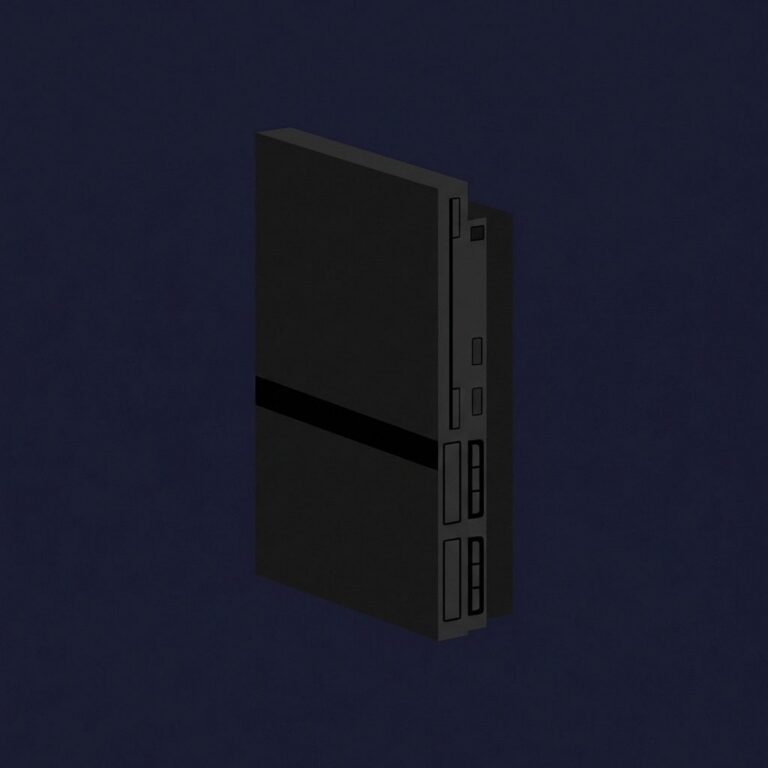
In 2004, Sony introduced the PS2 Slim (SCPH-70000 series), a dramatically redesigned model that was roughly 75% smaller and lighter than the original. The slim removed the expansion bay but integrated the Ethernet port directly into the unit and added an infrared receiver for the DVD remote. Later slim revisions (SCPH-90000) further reduced the size. The slim’s internal power supply eliminated the external adapter, and its revised laser assembly largely solved the DRE issues that plagued early fat models.
Color options expanded over the console’s life. The standard black was joined by silver, satin silver, ceramic white, ocean blue, pink, and various regional exclusives. Japan received the most color variety. Special edition bundles tied to major game releases (Final Fantasy X, Gran Turismo, etc.) were produced in limited quantities and are now collectible.
Collecting & Value Today
The PS2’s enormous production run makes hardware readily available and affordable. Working fat models sell for $40-70 USD, slims for $50-80, both with cables and controller. Special colors command modest premiums. The sheer volume of units produced means supply continues to outpace collector demand for hardware.
The game library is where value diverges sharply. The vast majority of PS2 games can be found for $5-15, making it one of the most affordable platforms to collect for. But select titles have reached remarkable prices. Rule of Rose (a controversial survival horror title with limited production) sells for $300-500+ complete. Kuon, .hack//Quarantine, and Haunting Ground regularly exceed $200. The Shin Megami Tensei series (Nocturne, Digital Devil Saga, Persona 3 and 4) have seen significant appreciation.
Practically, the PS2 is an excellent platform for budget-conscious retro gaming. The library is deep enough to provide years of discovery, most games are cheap, and the hardware is plentiful. For buyers, the primary concern is laser health — always test disc reading with both CD-based games (typically blue-bottomed discs) and DVD-based games (silver-bottomed) to verify both lasers function. Fat models should be tested in both horizontal and vertical orientations, as laser alignment issues sometimes only manifest in one position.