
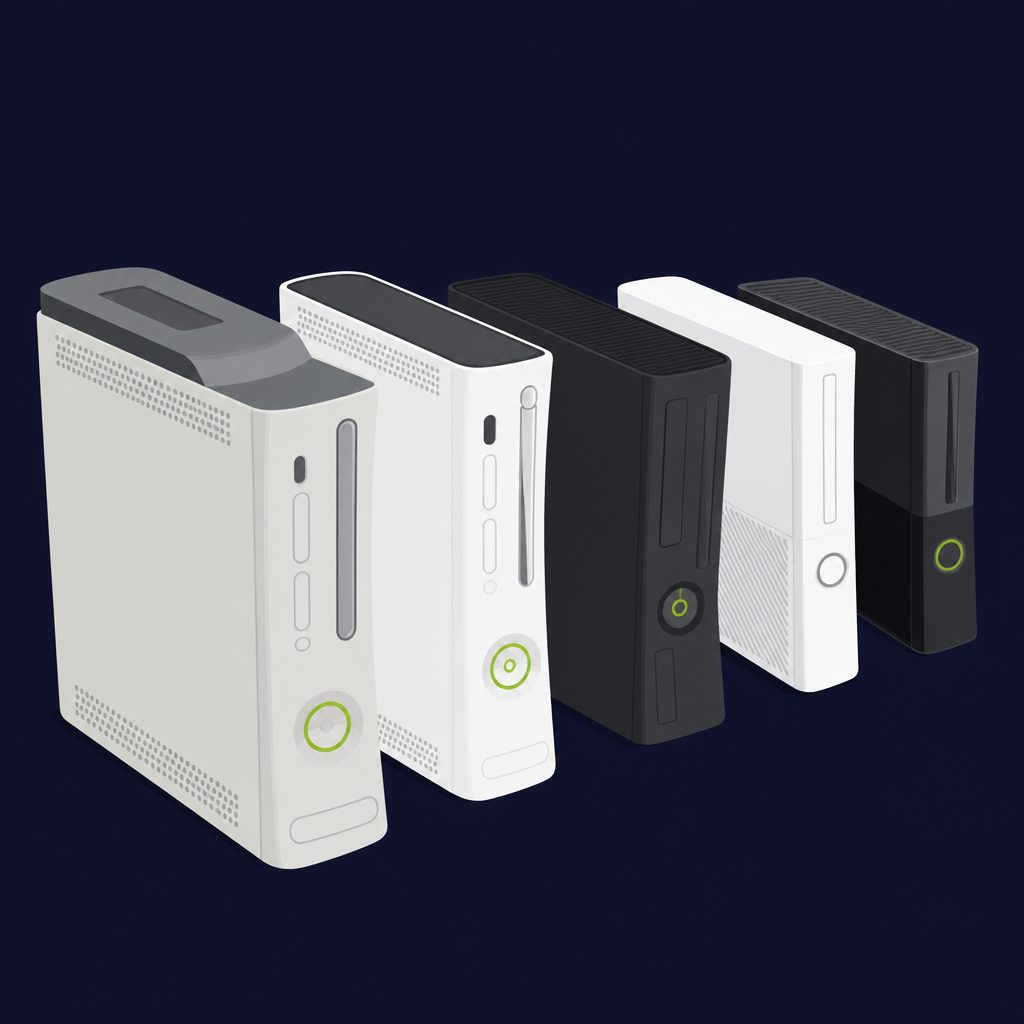
The Xbox 360 went through eight distinct motherboard revisions across its 2005-2016 production run, known internally by codenames: Xenon, Zephyr, Falcon, Opus, Jasper, Trinity, Corona, and Winchester. Each shrank the chips, cut power draw, and reduced heat, which matters directly for reliability, since Xbox 360’s defining hardware failure, the red ring of death, was fundamentally a heat problem on the earliest boards. The short version: anything built after 2010, meaning the Xbox 360 S or E, is dramatically more reliable than the original boxy-case consoles from 2005-2010.
Microsoft never marketed these codenames; console owners and repair technicians reverse-engineered them from what was printed on the boards themselves. That makes them genuinely useful for buyers, because the case shape alone doesn’t tell you everything, two consoles that look identical on the outside can carry meaningfully different internals depending on when they rolled off the line.
Original Case Revisions (2005-2010)
Every console below shares the same external “fat” Xbox 360 shape, the boxy white or black case sold from launch through 2010.
| Codename | Introduced | Process | Notes |
|---|---|---|---|
| Xenon | 2005 (launch) | 90nm CPU, 90nm GPU | The original board. Highest RROD risk of any revision. |
| Zephyr | 2005-2006 | 90nm / 90nm | Nearly identical to Xenon internally; added HDMI output. Same heat profile, same elevated RROD risk. |
| Falcon | 2007 | 65nm CPU, 80nm GPU | First real thermal improvement. Shipped with a 175W power supply, down from Xenon/Zephyr’s heavier draw. |
| Opus | 2007-2008 | 65nm / 80nm | Essentially a Falcon board used as an out-of-warranty repair replacement. Lacks HDMI, which is the giveaway you’re holding an Opus rather than a retail Falcon. |
| Jasper | 2008 | 65nm CPU, 65nm GPU | Both chips finally shrunk together. Power supply dropped to 150W. Generally regarded as the most reliable of the original-case boards. |
The Xenon and Zephyr boards are the source of the Xbox 360’s reputation. The 90-nanometer CPU and GPU ran hot enough that solder joints beneath the GPU package would crack under repeated heat cycling, letting the chip warp fractionally away from the board and break its electrical connections, at which point the console flashed three red lights on the ring around the power button and refused to boot properly. Microsoft extended the warranty on affected consoles to three years in 2007 after the failure became a public, well-documented problem. Falcon reduced the risk meaningfully by shrinking the CPU; Jasper reduced it further by shrinking the GPU too. Neither eliminated RROD entirely, but by Jasper, it stopped being the defining risk of ownership.
Xbox 360 S (Slim): Trinity, 2010
The Trinity motherboard shipped in the redesigned Xbox 360 S, announced at E3 2010. This is a bigger architectural jump than any revision before it: Trinity combines the CPU and GPU onto a single die, rather than two separate chips on the same board, which cuts heat output and power draw substantially compared to even Jasper. The Slim case is smaller, glossier, and adds a built-in Wi-Fi radio that earlier revisions required a USB dongle for. It shipped with HDMI, three USB ports, an optical audio port, and a polarized (keyed) power connector. RROD is not a meaningful risk on Trinity units; by this point Microsoft had solved the underlying thermal problem rather than just mitigating it.
Xbox 360 E (Super Slim): Corona and Winchester, 2013-2016
The Xbox 360 E, released in 2013, shrank the case again and adopted the two-tone matte-and-gloss look that matched the newly launched Xbox One. Two motherboards shipped inside this case over its production run.
Corona boards, used from the 2013 launch through roughly mid-2014, kept an integrated heat spreader (IHS) over the CPU. Winchester boards replaced Corona in production during the second half of 2014, identifiable partly by manufacture date (units stamped July 2014 or later are typically Winchester) and partly by the missing IHS over the CPU die. Functionally, both are stable, low-heat boards descended from the same single-chip design philosophy as Trinity. Compared with the 360 S, the E dropped the optical audio output and switched from a polarized power connector to a standard barrel plug; it’s a marginally more refined console but slightly less flexible for home-theater setups still relying on optical audio.
Kinect and the 360 S’s Extra Port
One physical tell that’s specific to the 360 S is a dedicated Kinect port on the back panel, added because the Kinect sensor, launched alongside the S in November 2010, needed more power than a standard USB port could supply on its own. Earlier revisions can run Kinect too, but only via an external power adapter bundled with the sensor for that purpose. It’s a small detail, but it’s a fast, unambiguous way to confirm you’re holding a 360 S rather than an original-case Jasper unit if the case has been swapped or damaged and the usual shape cues aren’t reliable.
Storage: A Separate Headache from RROD
Xbox 360 storage is its own small minefield, unrelated to the motherboard codename. Original-case consoles used a proprietary hard drive that slid into a top-mounted caddy, available over the years in 20 GB, 60 GB, 120 GB, and 250 GB capacities depending on the bundle. The 360 S moved to an internal, non-removable drive on some SKUs while still offering a version with the old removable caddy, and the 360 E standardized on an internal 250 GB or 500 GB drive with no external caddy slot at all. Because the proprietary connector changed between generations, a hard drive pulled from an original-case Xbox 360 will not simply slot into a 360 E, and vice versa; capacity and drive type need checking independently of which motherboard revision you’re evaluating.
Identifying What You Have
Start with the case. The original boxy shape narrows things to Xenon, Zephyr, Falcon, Opus, or Jasper. The 2010 slim case is Trinity. The smaller 2013-onward case is Corona or Winchester. From there, the sticker on the bottom of the console lists a manufacture date and serial number; repair-community reference charts cross-reference that serial format against known production windows for each codename, since Microsoft didn’t print the codename itself on the outside of the box. For original-case consoles specifically, the presence or absence of an HDMI port is a fast partial check: Xenon shipped without one, Zephyr onward included it, and Opus units, despite dating from the Falcon era, lack HDMI because they were built specifically as internal repair-replacement boards rather than retail units.
Which to Buy for Reliability in 2026
If reliability is the only criterion, skip the entire original-case line and go straight to a 360 S or 360 E. Between those two, it’s a coin flip weighted by what you’re connecting it to: the S if you want optical audio output, the E if you don’t care and prefer the smaller footprint. Within the original-case generation, a late Jasper unit is the reasonable floor if a slim or super-slim model isn’t available, since it carries the lowest RROD risk of any board built before Trinity. Xenon and Zephyr units are the ones to be wary of buying untested, given their well-documented thermal history, though plenty have survived two decades without failing. For how the 360 stacked up against its main rival at the time, see PS3 vs Xbox 360, and for the console line’s full retail history, the Xbox 360 page covers specs and release details.
Frequently Asked Questions
What causes the Xbox 360 red ring of death?
The red ring of death (RROD) was primarily a heat problem on early motherboards. The original Xenon board used a 90-nanometer CPU and GPU that ran hot enough to cause solder joints under the GPU to crack and the chip to warp slightly away from the board, breaking connections. It was most common on Xenon and Zephyr units and became progressively rarer as Microsoft shrank the chips on later Falcon and Jasper boards.
How do I know which Xbox 360 motherboard I have?
Check the manufacture date and serial number printed on the bottom sticker, along with the case style. A boxy original-shape console (2005-2010) is one of Xenon, Zephyr, Falcon, Opus, or Jasper; the 2010 slim case is Trinity; the smaller 2013 Super Slim case is Corona or Winchester. The motherboard codename itself is usually printed near the serial number inside these date ranges, and detailed lookup guides cross-reference the serial number format to the exact revision.
What is the difference between Falcon and Jasper Xbox 360 boards?
Falcon (2007) shrank the CPU to 65nm but kept a larger 80nm GPU, shipping with a 175W power supply. Jasper (2008) shrank both the CPU and GPU to 65nm and dropped the power supply rating to 150W, making it run cooler and draw less power than Falcon, and it's generally considered the most reliable of the original boxy-case revisions.
Which Xbox 360 model is most reliable?
The Xbox 360 S (2010, Trinity motherboard) and Xbox 360 E (2013, Corona/Winchester motherboards) are the most reliable Xbox 360 models. Both moved to a single combined CPU/GPU chip, which runs far cooler than the separate-chip designs in every original-case revision, and neither is associated with widespread RROD failures the way Xenon and Zephyr are.
What's the difference between the Xbox 360 S and Xbox 360 E?
The 360 S (2010) has a glossy black finish, HDMI output, three USB ports, an optical audio port, and a polarized power connector. The 360 E (2013) uses a matte-and-gloss two-tone finish matching the Xbox One's design language, drops the optical audio port, and switches to a standard barrel power connector. Both are considered reliable; the S is more flexible for setups needing optical audio out.
Can Xbox 360 Corona and Winchester motherboards be modded?
Corona boards, used in early 360 E consoles, can generally still be modded through existing hardware and software exploits. Winchester boards, which replaced Corona in production during the second half of 2014 and removed the integrated heat spreader over the CPU, are considerably harder to mod and are typically only accessible through a software-only exploit rather than a hardware method.