
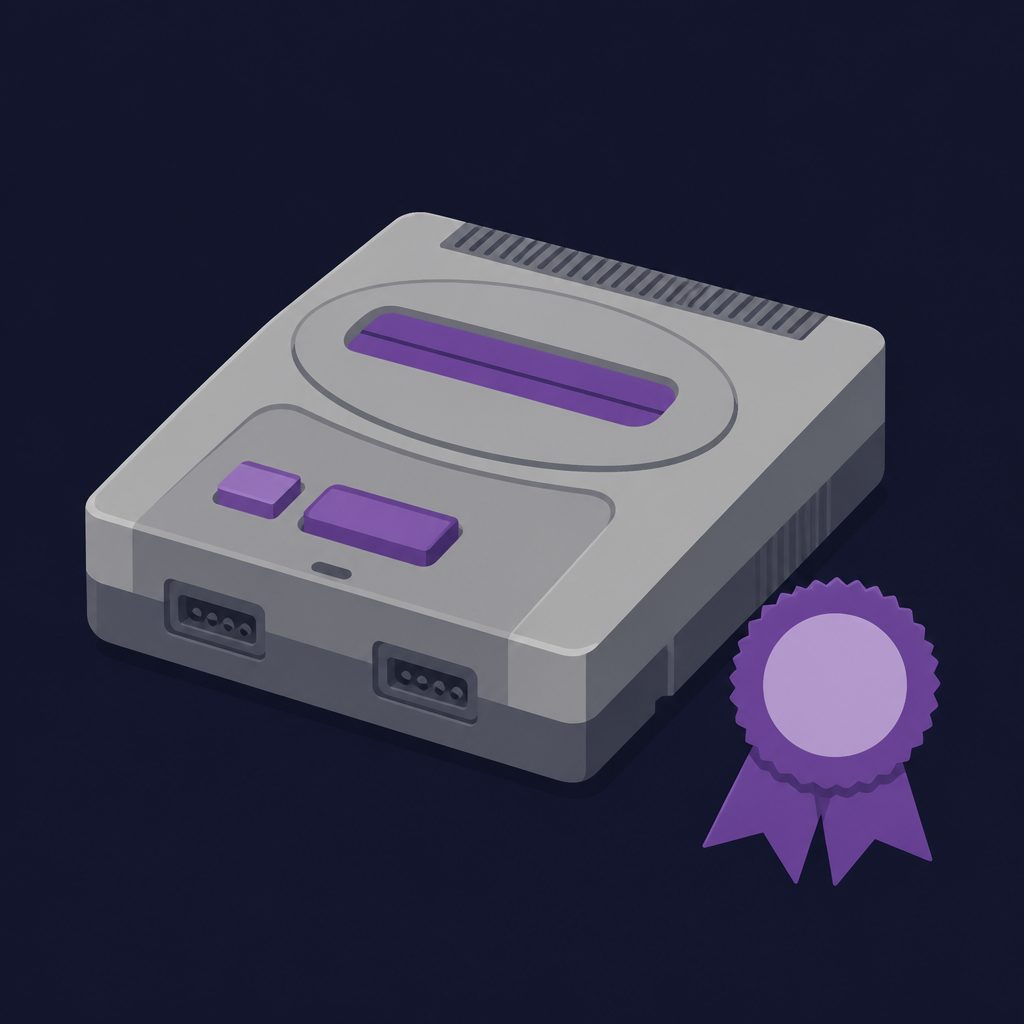
The Super Nintendo Entertainment System launched in North America on August 23, 1991, at $199, bundled with Super Mario World. That’s the headline fact, and it’s thirty-five years old this month. What the headline leaves out is the position Nintendo was actually launching from: two years behind a rival that had already claimed the “next generation” story in the American press, with a chunk of the teenage audience already telling their friends Sega was the cooler brand. The SNES didn’t launch into an open market. It launched into a fight that was already underway, on terms Sega had spent two years defining.
The Two-Year Problem
Do the math on the calendar and the gap is stark. Sega’s Genesis had been on American shelves since August 1989. By the time the SNES arrived in August 1991, the Genesis had a two-year head start, an established library, and a marketing campaign, “Genesis does what Nintendon’t,” built specifically to make Nintendo look like the establishment choice for kids who’d outgrown Mario. Nintendo wasn’t just launching a new console. It was launching a rebuttal to an argument Sega had already made in public for two full years.
Making matters slightly stranger, the SNES itself had already been out for nine months, just not in America. The Super Famicom launched in Japan on November 21, 1990, and the gap between that release and the August 1991 US debut was long enough that a real import scene developed around it in the meantime. American enthusiasts with the money and the patience imported Japanese units, stepped-down power converters, and region-modified cartridges rather than wait for Nintendo’s own timetable. It’s an easy detail to skip over in a launch-day recap, but it says something about how starved for the hardware serious players already were before Nintendo officially sold a single unit domestically.
The Price and the Pack-In
Nintendo priced the SNES at $199, ten dollars above the Genesis’s original $189, and packed it with Super Mario World rather than selling the game separately at retail. That single decision did a lot of work on its own. Super Mario World wasn’t a tech demo or a simple platformer. It was, by most measures at the time, the most sophisticated Mario game yet made, built specifically to show off what the new hardware could do with scrolling, sprite work, and level design at a scale the NES simply couldn’t manage. Bundling it instead of charging separately meant every SNES buyer walked out of the store already holding proof the console was worth the premium over an older Nintendo machine.
The rest of the North American launch lineup was thin by later standards but strategically chosen rather than padded. F-Zero and Pilotwings both leaned hard on the console’s signature graphical trick, and SimCity gave the machine a foothold with an audience that had nothing to do with platformers at all. None of these titles were filler. Each one existed to demonstrate a specific hardware capability that the Genesis simply couldn’t replicate.
Mode 7: The Trick Everyone Remembers
Ask a collector what made the SNES feel different from the Genesis in 1991, and most will say Mode 7 before they say anything about the CPU. Mode 7 was a background-layer effect that let a single flat plane of graphics rotate, scale, and warp in real time: the pseudo-3D swoop under the ship in F-Zero, the tilting racetrack in Super Mario Kart a year later, the globe-spinning intro sequences that turned up across the library for the rest of the generation. It wasn’t true 3D, and it wasn’t even applied to more than one background layer at a time on most titles. But nothing on the Genesis could touch it, and Nintendo knew it. That’s exactly why F-Zero, a game built almost entirely around showing off this one trick, sat in the launch lineup instead of somewhere further down the release schedule.
Notice that Mode 7 games skew heavily toward racing or flight titles rather than platformers. That’s not an accident of taste. The effect works on a single flat plane, and a flat plane reads naturally to the eye as ground or sky, not as a side-scrolling level full of obstacles. Nintendo’s own internal teams spent the better part of two years finding new excuses to put a rotating floor under something, and the trick shows up in some form in dozens of the system’s biggest titles.
An Unlikely Engineer in the Sound Chip
Here’s a detail worth pulling out on its own, since it connects directly to a console this site has already covered as a rival: the SNES’s sound processor, an 8-bit chip built around a Sony-designed core, was developed with direct involvement from a young Sony engineer named Ken Kutaragi. Kutaragi worked on the SNES audio hardware in the late 1980s specifically as a Sony liaison to Nintendo, years before he became the driving force behind Sony’s own PlayStation project. The two consoles that would go on to define opposite sides of the 16-bit and 32-bit console wars shared, for a brief window, the same engineer’s fingerprints on their audio hardware. Nintendo and Sony’s relationship famously fell apart shortly afterward over a disputed CD-ROM add-on deal, the same collapse that eventually pushed Sony to build the PlayStation on its own. Readers who want the fuller PlayStation side of that story can find it on the PlayStation page.
The Console War Nobody Actually Won Quickly
Here’s where a tidy narrative would like to declare a winner and move on. The real story is messier than that. In North America specifically, the Genesis-versus-SNES race stayed close for years. Some retail tallies had Sega ahead through much of the early 1990s, and Sega’s aggressive pricing and edgier marketing kept it competitive with an audience Nintendo had trouble winning back quickly, no matter how strong the SNES library got. It wasn’t until the generation’s final numbers were tallied worldwide that the picture actually clarified: the SNES finished at 49.1 million units sold globally against the Genesis’s 30.75 million, a decisive win once Japan and Europe, markets where Nintendo’s brand strength ran much deeper than Sega’s, are counted alongside North America.
So the honest verdict is this. Sega won the opening years of the fight it picked, at least in the US specifically. Nintendo won the war once the full sales ledger closed, and it won by a wide margin once every region was counted. Both of those things are true at the same time, and neither one cancels the other out. Anyone claiming the SNES “crushed” the Genesis from day one in America is skipping the part of the story where that simply wasn’t what happened on the ground.
What the SNES Left Behind
Thirty-five years on, the SNES’s reputation rests less on its sales figures than on the back half of its library, the years after 1991 when Nintendo’s first-party teams and a handful of third-party studios (Square, most famously, with Chrono Trigger and Final Fantasy VI) turned the hardware into something closer to an art form than a launch-window spec sheet would ever have suggested. None of that was visible on August 23, 1991. What was visible that day was a $199 console, a bundled Mario game, a rotating racetrack, and a Sega-shaped problem Nintendo hadn’t fully solved yet. Solving it took years, not a single strong launch weekend. Full specs, library, and pricing history for the console sit on the SNES page, and its place inside the broader 16-bit generation is covered on the 1990s console guide.
One detail that rarely makes the anniversary pieces: the console in most Americans’ memory isn’t quite the console Japan actually got. The Super Famicom shipped there with purple-and-gray curved edges and four distinctly colored face buttons. The North American SNES that launched on August 23, 1991 flattened that palette into a more uniform gray case with plain gray buttons. Same hardware inside both units. If the console you remember from a childhood living room looked plain and gray, that memory is accurate. It’s simply not what Japan got.
Frequently Asked Questions
When did the SNES launch in North America?
August 23, 1991, at $199, bundled with Super Mario World.
How much of a head start did the Genesis have over the SNES?
About two years. The Genesis test-launched in the US in August 1989, while the SNES didn't arrive until August 1991, giving Sega significant time to establish its library and 'Genesis does what Nintendon't' marketing before Nintendo responded.
What was Mode 7?
A hardware graphics effect that let a single background layer rotate, scale, and warp in real time, creating a pseudo-3D look. It powered the visual signature of launch title F-Zero and later Super Mario Kart, and had no direct equivalent on the Genesis.
Did the SNES or the Genesis sell more units?
The SNES sold more worldwide — 49.1 million units against the Genesis's 30.75 million — though the North American race specifically stayed close for years, with the Genesis competitive or ahead through much of the early 1990s in that region alone.
What launch titles did the SNES ship with in the US?
Super Mario World came packed in with the console itself. F-Zero, Pilotwings, and SimCity were among the other titles available at launch.
How does the North American SNES differ from the Japanese Super Famicom?
The Super Famicom, which launched in Japan on November 21, 1990, used a purple-and-gray case with four distinctly colored face buttons. The North American SNES flattened this into a more uniform gray case with plain gray buttons, though the internal hardware was the same.