
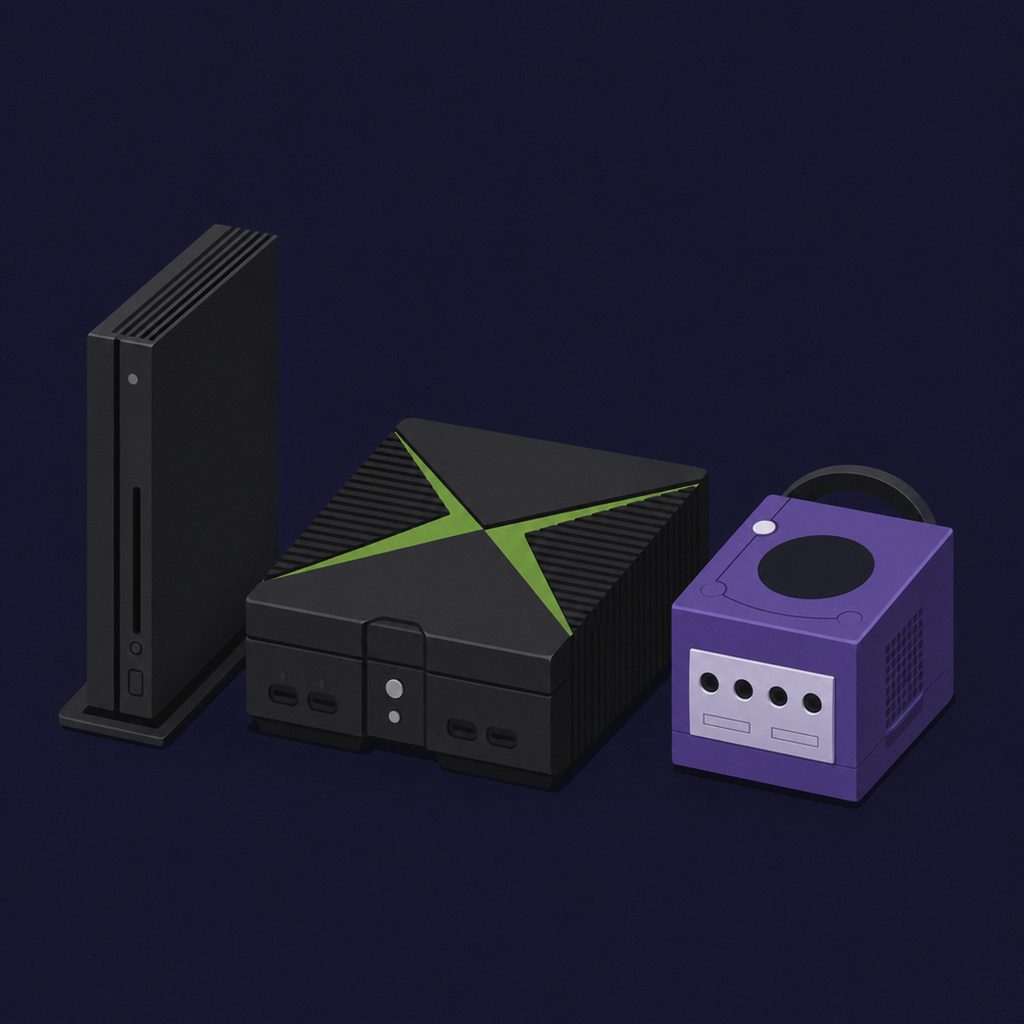
The sixth console generation pitted Sony’s PlayStation 2 against newcomer Microsoft’s Xbox and Nintendo’s GameCube. The verdict was never really in doubt commercially — the PS2 won by an enormous margin — but the Xbox was the technical powerhouse and the GameCube delivered some of the era’s most enduring first-party games.
Hardware and Power
The three consoles ranked clearly on raw specifications, with the order inverse to their sales. The Xbox was the most powerful: a 733 MHz Intel Pentium III-class CPU, an Nvidia-based GPU, 64 MB of unified memory, and — uniquely for the generation — a built-in 8 GB hard drive that enabled custom soundtracks and faster loading.
The GameCube sat in the middle with a 485 MHz IBM PowerPC “Gekko” CPU, an ATI-designed “Flipper” GPU, and roughly 43 MB of memory. It was an efficient, well-balanced machine that punched above its raw numbers, but it used small proprietary 1.5 GB mini-DVDs and, unlike its rivals, could not play standard DVD movies.
The PlayStation 2 was the least powerful on paper, with its “Emotion Engine” CPU and just 32 MB of main memory, which forced reduced textures in many cross-platform games. Its decisive features were elsewhere: a DVD drive that doubled as an affordable DVD movie player, and backward compatibility with the vast PlayStation 1 library.
Games and Library
The PS2 amassed the largest game library of any console of its era, anchored by Grand Theft Auto III and its sequels, Metal Gear Solid 2 and 3, Final Fantasy X, God of War, Gran Turismo 3, and Shadow of the Colossus. Its sheer breadth made it the default platform for both blockbusters and niche titles.
The GameCube’s strength was Nintendo’s first-party quality: Super Smash Bros. Melee, The Legend of Zelda: The Wind Waker, Metroid Prime, Super Mario Sunshine, and Resident Evil 4 (initially a GameCube exclusive). The Xbox built its identity around Halo: Combat Evolved and Halo 2, alongside Fable and a strong online service in Xbox Live, which introduced many players to console online gaming.
Strategy and Identity
Each console reflected a different strategy. Sony leveraged the PS2’s DVD playback and PS1 momentum to reach a mass audience well beyond traditional gamers. Microsoft entered the console market for the first time with a PC-derived powerhouse, betting on graphics, a hard drive, and online play — a beachhead that set up the Xbox 360. Nintendo focused on its own franchises and younger players, but the GameCube’s lack of DVD playback and its mini-disc format limited its appeal against rivals that doubled as home-theater devices.
Legacy and Verdict
Commercially the result was lopsided. The PlayStation 2 sold over 155 million units — Sony has cited more than 160 million — making it the best-selling home console of all time. The Xbox sold roughly 24 million units and the GameCube roughly 21.7 million, leaving them in a distant battle for second place that the Xbox narrowly won.
Judged on significance and library rather than specs alone, the PS2 is the clear overall winner on sales, library size, and cultural reach. But the verdict is layered: the Xbox won on hardware and laid the groundwork for Microsoft’s lasting place in the industry, while the GameCube won on first-party craft, producing a small but exceptional catalog that collectors prize today. All three shaped the modern console landscape.
See full specs on the PlayStation 2, Xbox, and GameCube pages, explore the 2000s game consoles overview, or pit all three against each other in the console comparison tool.
| Sony PlayStation 2 | Microsoft Xbox | Nintendo GameCube | |
|---|---|---|---|
| Released | 2000-Mar-04 | 2001-Nov-15 | 2001-Sep-14 |
| Launch price | 299 USD | 299 USD | 199 USD |
| Units sold | 155 million | 24 million | 21.74 million |
| Games released | 4489 | 968 | 653 |
| Generation | Console | Console | Console |
| CPU | Emotion Engine | Intel Custom Pentium III (Coppermine) | IBM PowerPC Gekko |
| CPU speed | 294.912 MHz | 733 MHz | 485 MHz |
| GPU | Graphics Synthesizer at 147.456 MHz | NVIDIA NV2A (custom GeForce 3) | ATI/ArtX Flipper at 162 MHz |
| RAM | 32 MB RDRAM + 4 MB VRAM | 64 MB DDR unified | 24 MB 1T-SRAM + 16 MB DRAM |
| Media | DVD-ROM, CD-ROM | DVD-ROM | miniDVD (proprietary 8 cm disc) |
| Graphics | 7/10 | 9/10 | 8/10 |
| Game Library | 10/10 | 9/10 | 8/10 |
| Controllers | 8/10 | 7/10 | 9/10 |
| Gamer Value | 10/10 | 8/10 | 9/10 |
| Collector Value | 7/10 | 7/10 | 9/10 |
| Overall rating | 8.1/10 | 7.9/10 | 8.3/10 |
Open this matchup in the interactive comparison tool →
Frequently Asked Questions
Which sold more, the PS2, Xbox, or GameCube?
The PlayStation 2 dominated, selling over 155 million units, with Sony citing more than 160 million, making it the best-selling home console of all time. The original Xbox sold roughly 24 million units and the GameCube roughly 21.7 million, leaving them in a distant contest for second place that the Xbox narrowly won.
Which was the most powerful sixth-generation console?
The Xbox was the most powerful. It had a 733 MHz Pentium III-class CPU, an Nvidia-based GPU, 64 MB of unified memory, and a built-in hard drive. The GameCube was the mid-range option, and the PS2 was the least powerful on paper with just 32 MB of main memory. The sales order was the inverse of the power order.
Why did the PS2 outsell the Xbox and GameCube so heavily?
Several factors combined. The PS2 had a built-in DVD drive that doubled as an affordable DVD movie player at a time when standalone players were expensive, it was backward compatible with the huge PlayStation 1 library, and it built the largest game catalog of the era. That mass-market appeal pushed it far beyond a traditional gaming audience.
Could the GameCube play DVDs?
No. The GameCube used small proprietary 1.5 GB mini-DVDs and could not play standard DVD movies, unlike the PS2 and Xbox, which both doubled as DVD players. This was a notable disadvantage when rivals were positioned as home-theater devices as well as game consoles.
Which console has the best exclusives from the sixth generation?
It depends on taste. The PS2 had the largest library, including Grand Theft Auto III, Metal Gear Solid 2 and 3, and God of War. The GameCube is prized for first-party quality such as Super Smash Bros. Melee, Metroid Prime, and Resident Evil 4. The Xbox is defined by Halo: Combat Evolved and Halo 2, plus the introduction of Xbox Live.