NUON was a media processor from VM Labs of California that added games and video effects to DVD players. The first players from Samsung and Toshiba reached North America in 2000, priced from $249 to $499 depending on the model and date. Eight NUON games were released before VM Labs went bankrupt.
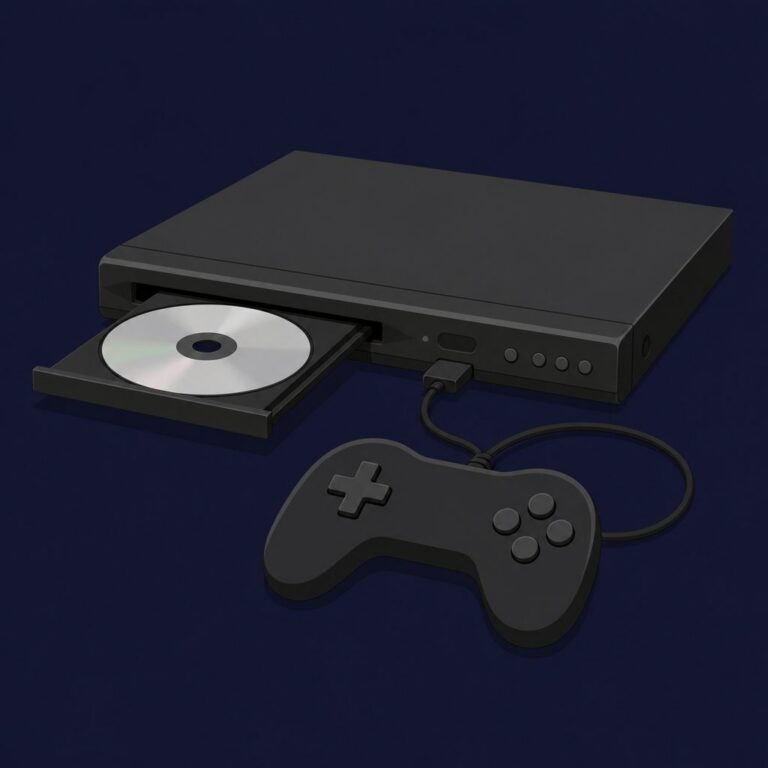
NUON is a console that never had a console of its own. VM Labs designed a chip and a software platform, then licensed them to consumer electronics makers who put them inside ordinary DVD players. Buyers got a movie player with a second life as a game machine, and the games ran from DVD-based discs in the same drive. NUON players also played standard DVDs and CDs. The first players reached shops in the year of the PlayStation 2, which did both jobs from a single box.
VM Labs and the Idea
VM Labs Inc. was founded in 1995 by Richard Miller, a former Atari vice president, in California (Mountain View and Los Altos are both given as its base). The company licensed a media-processor design from Motorola. The first design went to Motorola for layout in 1996, and prototype silicon followed in 1997.
In early 1998 the project was presented in the gaming press as “Project X”, a console. It reached shops as a feature of DVD players instead. The chip went through three generations: Aries-1 in production by 1999, Aries-2 in 2000 and Aries-3 in 2001, made by TSMC.
The Players
Samsung, which marketed the N2000 as an Extiva, announced the DVD-N2000 on 10 December 1999 at a list price of $499 for the first quarter of 2000, and the player slipped into the year. Raite announced an RDP-741 at CES in January 2000 at $299, and Toshiba announced its first NUON player in March 2000 for the third quarter. Toshiba’s SD2300 shipped in September 2000 at $399.99. Samsung’s DVD-N501 followed in early 2001 at $249 on its spec sheet and $229 in one review. Orient Power Multimedia, selling under the Oritron name, set a target below $200 for its DVD900 in mid-2001.
| Maker | Models | Notes |
|---|---|---|
| Samsung | DVD-N2000, DVD-N501, DVD-N504, DVD-N505, DVD-N591 | N504 and N505 for Europe, N591 for Korea |
| Toshiba | SD-2300 | Shipped September 2000 at $399.99 |
| RCA (Thomson) | DRC300N, DRC480N | Run homebrew, like Samsung’s N501, N504 and N505 |
| Motorola | Streamaster 5000 | Set-top box |
Raite, Oritron and LGE were announced as partners, but no shipping product from them is confirmed.
Hardware
The chip was marketed as the NUON Media Processor, a 128-bit design. Descriptions of its internals give four 128-bit VLIW processors running at 54 or 108 MHz, with 32 MB of main memory and 8 MB of video RAM. The Toshiba SD2300 offered ColorStream component, S-Video and composite video outputs in parallel, with a 10-bit 27 MHz converter, and audio at up to 24 bits and 96 kHz. The Samsung N501 added an HDCD decoder and a digital output compatible with DTS.
Two joystick and peripheral ports sat on the front panel. Controllers came from Logitech, Pro-elite, AirPlay, Stealth and Warrior, and an Aries64 adapter let an N64 pad connect. A memory card was announced in 2001 and never released.
Games and Movies
Eight NUON games shipped, seven of them in the West. Crayon Shin-chan 3 appeared in Korea only. The 2000 releases ran as follows.
- Iron Soldier 3 (Eclipse Software) and Space Invaders XL (Matahari Studios, Taito) in June 2000
- Ballistic (Mitchell, Infogrames) in July 2000, bundled with Samsung players
- The Next Tetris (Blue Planet Software) in November 2000, bundled with Toshiba players
- Freefall 3050 A.D. (TAKS) and Merlin Racing (Miracle Designs) in December 2000
Tempest 3000, a Jeff Minter game published under the Atari and Hasbro banner, followed in January 2001. Minter also designed the Virtual Light Machine visualizer. Iron Soldier 3 was later recalled because it did not work on every player. Forty further titles were planned but never released, among them Dragon’s Lair, Myst and Madden NFL.
NUON also enhanced movies. The first enhanced DVD, a special edition of Bedazzled, was scheduled for March 2001, and four enhanced films were released in total.
Why It Ended
Funding collapsed after September 2001, and VM Labs filed for Chapter 11 in December 2001. On 5 March 2002 Genesis Microchip won the bankruptcy auction for the company’s patents, trademarks and other intellectual property with a cash bid of $13.6 million. In an interview with Time Extension, Bill Rehbock names several causes: the memory card never shipped, so games stayed simple; partners including Thomson (RCA) wanted equity on onerous terms; and the PlayStation 2, released in March 2000, was a console and a DVD player in one. See the PlayStation 2 page for that rival. By November 2004 no NUON players were shipping and no new titles were coming.
Preservation Today
A homebrew SDK was released in late 2001, and the Samsung N501, N504 and N505 plus the RCA DRC300N and DRC480N can run homebrew. The NuanceResurrection emulator, based on code written between 2002 and 2007 and released as source after its author’s death in 2007, continues to be developed and now has a libretro core. Tempest 3000 and Merlin Racing are playable in it, while the emulator still has known bugs and missing BIOS functions. Nuon-Dome.com, run by Kevin Manne, hosts community resources, including a manual for the Samsung N2000. Time Extension reports collector prices of about $330 for Tempest 3000 and above $600 for The Next Tetris.
NUON belongs with the other short-lived platforms listed in the cancelled consoles database, and with the multimedia hardware of the 2000s.
Frequently Asked Questions
What is NUON?
NUON is a media processor and software platform from VM Labs that added games and video effects to DVD players made by Samsung, Toshiba, RCA and others.
How much did a NUON player cost?
Prices ran from about $249 to $499. The Samsung DVD-N2000 was announced at $499, the Toshiba SD2300 shipped at $399.99 and the Samsung DVD-N501 sold for $229 to $249.
How many NUON games were released?
Eight, seven of them in the West. Crayon Shin-chan 3 was released in Korea only.
Which players support NUON?
Samsung's DVD-N2000, N501, N504, N505 and N591, Toshiba's SD-2300, RCA's DRC300N and DRC480N, and the Motorola Streamaster 5000 set-top box.
Why did NUON fail?
VM Labs lost its funding after September 2001. The memory card never shipped, partners wanted equity on difficult terms and the PlayStation 2 combined a console with a DVD player.
Who bought VM Labs?
Genesis Microchip won the bankruptcy auction for the patents, trademarks and other intellectual property with a $13.6 million cash bid, reported on 5 March 2002.