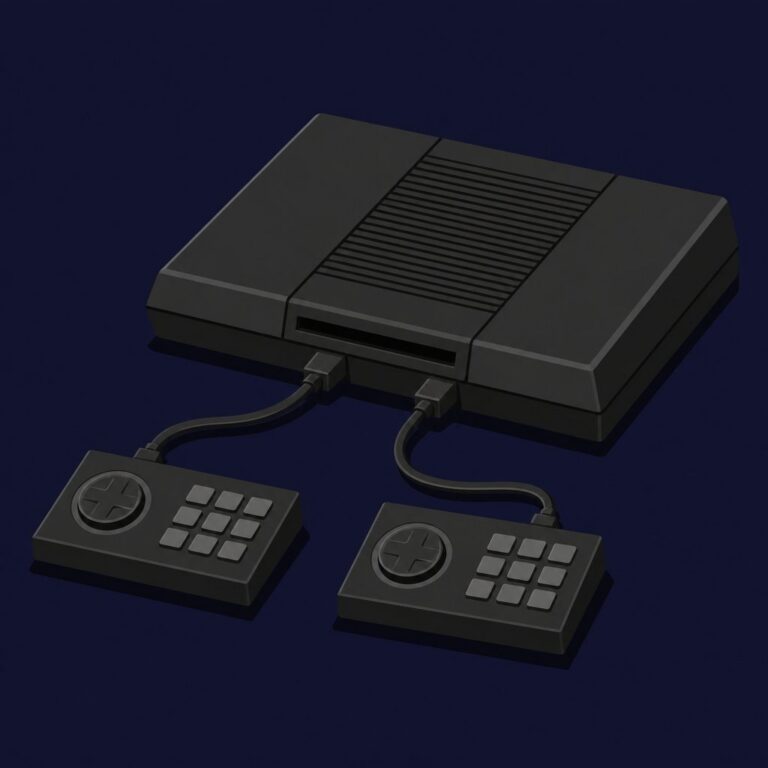
The Emerson Arcadia 2001 is a second-generation cartridge console sold by Emerson Radio Corp. in the United States from about May 1982, with a list price of roughly $200 that stores often halved. It ran on a Signetics 2650 processor and was rebadged by dozens of companies around the world.
The Arcadia 2001 is best known for what happened to its design after Emerson released it. Companies in Japan, the United Kingdom, Germany, France, Italy, Canada, Australia, New Zealand and elsewhere sold the same hardware under their own names, so a collector can find the console as the Bandai Arcadia, the Hanimex Home Arcade Centre, the Tchibo Tele-Fever or the GiG Leonardo. The family it started covers more than thirty names.
Release and Price
Sources disagree on the month of the American launch. The common date is May 1982, while Emerson’s trademark filing claims first use on 26 March 1982, and in September 1982 the company said the console would be in stores in time for the holiday gift-giving season. Emerson did not design the machine itself and only licensed it. The Digital Press FAQ names UA Limited, possibly based in Hong Kong, as the likely original developer.
The planned launch library was 19 or 20 cartridges, with 30 by the end of 1982 and 20 more in 1983. The console was shown at the summer 1982 Consumer Electronics Show, where Danny Goodman wrote in Creative Computing that its graphics were similar to the Atari VCS and that it was priced in the Atari VCS range. Emerson expected about $15 million in revenue for the second half of 1982. The list price was about $200, and a contemporary review quoted by Digital Press says stores sold it for around half that.
In the United Kingdom, Computer and Video Games reported in June 1982 that Hanimex would launch the console there with 17 cartridges at about £89. In Japan, Bandai released its version in 1982 at ¥19,800 and added four games of its own.
Hardware
The console used a Signetics (Philips) 2650A processor, running at 3.58 MHz on NTSC machines according to MAME’s documentation, together with a Signetics 2637 video chip. Video output was 128 x 208 pixels, built from a 16 x 26 background of 8 x 8 two-colour characters plus four 8 x 8 sprites, with eight colours available. Digital Press counts nine colours, and MAME’s figure is the more detailed one.
Memory was modest. The board carries 1 KB of RAM, of which only 512 bytes are available to programs, although advertising suggested more. Sound came from a single-channel beeper.
The two controllers were hardwired to the console. Each had a 12-key keypad and a direction pad that Creative Computing said could be used as either a disc or a joystick. Five console buttons handled power, start, reset, option and select. The power supply was 12 V DC at 0.5 A, and games came on ROM cartridges of 2 KB to 8 KB.
A Console With Many Names
The Arcadia 2001 family is ROM-compatible, but the cartridges are not slot-compatible across brands. Emerson-family cartridges are black plastic in two lengths, while the MPT-03 family used brown plastic cartridges like those of the SNES, according to the Museum of Obsolete Media. MAME’s driver lists the following among the many machines it supports.
| Name | Country |
|---|---|
| Bandai Arcadia | Japan (1982) |
| Dynavision (Yamagiwa) | Japan |
| Hanimex Home Arcade Centre | United Kingdom |
| Rowtron 2000 | United Kingdom |
| Hanimex HMG-2650 | Germany |
| Palladium (Neckermann) | Germany |
| Tchibo Tele-Fever | Germany |
| Advision Home Arcade | France |
| GiG Leonardo | Italy |
| Ormatu 2001 | Netherlands |
| Leisure-Vision (Leisure-Dynamics) | Canada |
| Sheen Home Video Centre | Australia |
| Tunix Home Arcade (Monaco Leisure) | New Zealand |
Longer listings reach 38 names once smaller sellers in India, Israel and South Africa are counted. The Interton VC-4000 belongs to a separate, earlier and incompatible group of machines. It is covered on the 1292 APVS VC-4000 page.
Games
Counts of the library range from 35 to 58, depending on whether clones, Japan-only releases and homebrew are included. The most detailed list, the Arcadia 2001 Gaming Guide, names 58 non-homebrew titles. Digital Press puts the number of known ROM images at about 50.
Many titles were arcade-style clones. Space Vultures follows Phoenix, Alien Invaders follows Space Invaders, and Missile War follows Missile Command. Cat Trax belongs to the Pac-Man family. Other titles include Jungler, Route 16, Jump Bug, Pleiades, Star Chess, Tanks a Lot, Breakaway, Hobo, Escape and Funky Fish. Bandai’s Japanese releases added Doraemon, Dr. Slump, Mobile Soldier Gundam and Macross. Homebrew developers have since produced conversions of Frogger, JTron and Tetris.
Atari’s exclusivity claims on arcade titles such as Pac-Man blocked Emerson from making its own conversions. A lawsuit between Atari and North American Philips over Munchkin was reported in Electronic Games in July 1982. Games that did reach the console were competing in the same price range as the Atari 2600.
Why It Ended
Emerson decided to leave the games hardware business in or around 1983, according to Digital Press. The decision came as the video game crash of 1983 hit the market. The clone makers sold on into 1983, and Mr. Altus’s Tele Brain from Germany dates from that year.
Playing and Collecting Today
MAME emulates the console through its arcadia driver, though sound is imperfect on every variant and four of the clone machines, the Mr. Altus, Palladium, Polybrain and Trakton models, are flagged as not working. The libretro AmiArcadia core covers the Arcadia 2001 and compatible machines. The first emulator was written by Paul Robson and later added to MESS by PeT. MAME’s own notes list unfinished work, including the front-panel reset key and a dump of the character ROM.
Service manuals are still sold, according to Digital Press. Google Arts & Culture carries an Arcadia 2001 object entry. For the wider picture of the period, see the 1980s console overview.
Frequently Asked Questions
How much did the Emerson Arcadia 2001 cost?
List price was about $200 in the United States, and a contemporary review says stores sold it for around half that. In Japan, Bandai's version cost ¥19,800 and in the UK Hanimex planned about £89.
When was the Arcadia 2001 released?
The common date for the US launch is May 1982, though Emerson claimed first use of the name on 26 March 1982. Hanimex scheduled a UK launch for June 1982.
How many games did the Arcadia 2001 have?
Counts run from 35 to 58 depending on whether clones, Japan-only releases and homebrew are included. The Arcadia 2001 Gaming Guide lists 58 non-homebrew titles.
What are the Tele-Fever, Leonardo and Hanimex consoles?
They are rebadged Arcadia 2001 machines sold by Tchibo in Germany, GiG in Italy and Hanimex in the UK and Germany.
Are Arcadia cartridges compatible across clones?
Games are ROM-compatible within families such as Emerson, MPT-03, Palladium and Ormatu, but the cartridges are not slot-compatible across brands.
Can the Arcadia 2001 be played today?
MAME has an arcadia driver with imperfect sound, and the libretro AmiArcadia core covers the Arcadia 2001 and compatible machines.