
Basic strategy is a fixed table of the mathematically correct move, hit, stand, double or split, for every hand a player can hold against every card a dealer can show. Under common rules (six decks, dealer stands on soft 17), playing it perfectly holds the house edge to roughly 0.5%, the lowest of any widely offered casino game. It is not a system and it does not need to track previous hands to work.
Every blackjack decision reduces to one question: given this hand and that dealer upcard, which action loses the least money on average over a very large number of repetitions? Computer simulation answered that question decades ago, and the answer doesn’t change from table to table as long as the rules stay the same.
Why blackjack has a chart at all
Most casino games don’t give a decision tree anything to work with the way blackjack does. A roulette wheel doesn’t care what number a player bet last spin, and a slot’s reels don’t respond to anything the player does mid-round. Blackjack is different because the player acts first, with information the dealer’s own hand doesn’t yet reveal, and because the dealer is bound by fixed rules (stand on hard 17 or higher, hit anything lower) that a computer can simulate exhaustively. That combination, player choice plus a fixed, simulate-able dealer, is what makes an optimal chart possible in the first place, and it’s also why no comparable chart exists for a fixed-odds game like the ones described in Roulette Bets Explained.
Hard totals and the dealer upcard
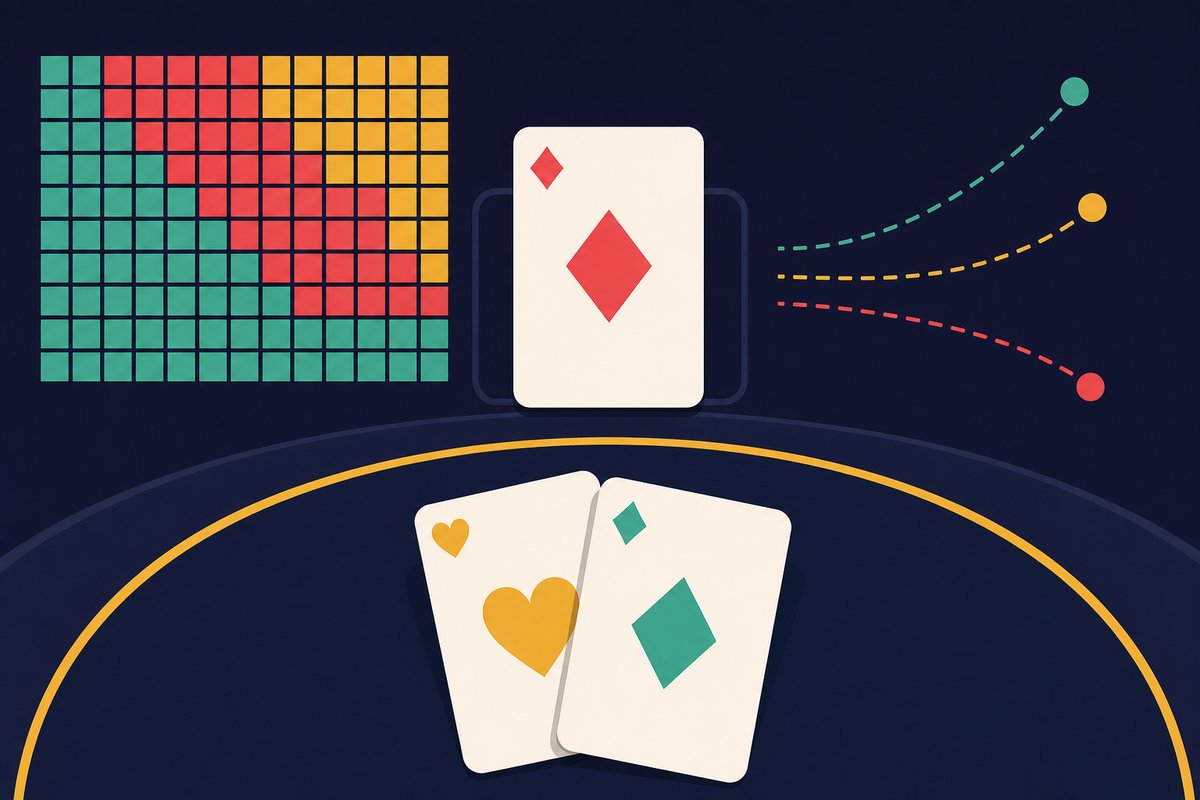
A hard total is any hand with no ace, or with an ace counted as 1 because counting it as 11 would bust. The core logic: a dealer upcard of 2 through 6 gives the dealer a materially higher chance of busting, so basic strategy leans toward standing on marginal totals like 12 through 16 against those cards. A dealer upcard of 7 through Ace lowers that bust risk, so the same marginal totals usually call for hitting instead, since the dealer is less likely to break on their own.
The upcards 2 through 6 are sometimes grouped informally as the dealer’s “bust cards,” and the intuition behind that label holds up under simulation: a dealer showing a 5 or 6 busts noticeably more often than a dealer showing a 9 or 10, because the hidden card and every subsequent hit carry real risk of pushing a weak starting total over 21. Standing on a mediocre hand against a bust card isn’t passive play, it’s the option that lets the dealer’s own rules do the losing.
Soft totals
A soft total includes an ace counted as 11, soft 18 is A-7, for instance. Because the ace can silently become a 1 if a high card lands, soft hands can be hit without any bust risk on that turn, which basic strategy uses to be more aggressive with doubling and hitting on soft totals than the equivalent hard total would allow.
This is precisely why a hand that sounds strong, soft 18, still gets hit against a dealer 9, 10 or Ace despite already totalling a respectable number. A hard 18 in the same spot is an easy stand; a soft 18 has room to improve to 19, 20 or 21 with zero downside if the extra card doesn’t help, since the ace simply reverts to counting as 1. The flexibility built into an ace is the entire reason soft-hand strategy diverges from hard-hand strategy at nearly every matching total.
Pairs and when to split
Splitting turns one hand into two, each played and bet separately. A pair of Aces is split essentially always, two hands starting at 11 beats one hand starting at a soft 12. A pair of 8s is split against almost any dealer upcard, since a hard 16 is one of the worst totals in the game to keep intact. A pair of 5s is effectively never split, because two hands starting at 5 are worse than one hand starting at 10, which doubles well. A pair of 10-value cards is likewise never split under basic strategy, despite the temptation, a made 20 is too strong to break apart.
Splitting also isn’t a one-and-done decision at some tables: rules on resplitting (splitting again if a third matching card appears) and on doubling after a split vary by casino, and both change the value of a marginal split slightly. Where a table allows doubling after a split, a handful of borderline splits, 6s and 7s against certain upcards, for instance, become correct that wouldn’t be under stricter rules. This is one of the clearer examples of how house rules, not just cards, shape the correct decision.
Example decisions
None of these require memorizing an entire chart at once; they illustrate the underlying logic described above.
- Hard 16 against a dealer 10: hit. Standing loses more often than the bust risk from hitting does.
- Hard 12 against a dealer 4: stand. The dealer’s bust risk on a weak upcard outweighs the modest chance of improving 12.
- Soft 18 (A-7) against a dealer 9: hit. Against a strong upcard, soft 18 is not safely ahead.
- Pair of 8s against a dealer 10: split. A hard 16 is bad enough that splitting into two hands, even against a strong card, still beats keeping it.
- Pair of Aces against any upcard: split, without exception under basic strategy.
- Hard 11 against a dealer 6: double down. Few dealer upcards are weaker, and few player totals are better positioned to capitalize on one card.
- Soft 13 (A-2) against a dealer 5: double down where allowed, otherwise hit.
- Hard 16 against a dealer 7: hit, for the same reason as against a 10, standing is the weaker option here too.
Six decks, dealer stands on soft 17, double after split allowed, late surrender available.
Press Deal to start. Each decision is graded against basic strategy for the rules above.
Why the edge sits near 0.5%, and why rules move it
Basic strategy minimizes the house’s advantage but cannot erase it, chiefly because the dealer acts last: if the player busts, the hand is lost immediately regardless of what the dealer’s own cards would have done. Under a common rule set, six decks, dealer stands on soft 17, perfect basic strategy play holds that structural edge to roughly 0.5%. Change one rule and the number moves: a dealer who hits soft 17 instead of standing adds back a small amount of edge, and restrictions on doubling or splitting after a split do the same. Deck count matters too, but less than the rule variations do. Blackjack’s 0.5% sits at the low end of every widely offered game, a comparison laid out fully on the House Edge Explorer.
Where players deviate from the chart, even knowing it
Two decisions account for a disproportionate share of basic-strategy mistakes, and both come from the same instinct: hard 16 against a dealer 10, and splitting 10-value cards. Standing on hard 16 feels safer than hitting into a likely bust, but the chart already accounts for the bust risk and still finds hitting the lower-cost option against a strong dealer card. Splitting a pair of 10s feels like turning one strong hand into two, but a made 20 already beats most outcomes outright, and breaking it apart trades a near-certain win for two uncertain ones. Both are cases where the correct play feels counterintuitive precisely because it’s optimizing for the long run, not for how any single hand is likely to feel in the moment.
A note on card counting
Basic strategy ignores everything except the current hand and upcard. Card counting is a different discipline entirely, tracking the ratio of high to low cards remaining in the shoe to estimate when the remaining deck favors the player, then adjusting bets accordingly. Edward Thorp’s 1962 book Beat the Dealer is usually credited with bringing the math of counting to a general audience, and it changed how casinos shuffle and monitor tables to this day. Basic strategy needs none of that infrastructure; it works from a single static chart, hand after hand, the same chart the Blackjack Strategy Trainer grades a player’s own decisions against, hand by hand.
Insurance and the side bets basic strategy skips
One decision deliberately isn’t covered by the example list above: insurance, offered when the dealer shows an Ace, which lets a player bet separately that the dealer holds a ten-value card underneath for blackjack. Basic strategy’s answer is simple and consistent regardless of the player’s own hand: decline it. The bet pays 2:1 but wins less than a third of the time in a full, unpredicted shoe, making it a worse proposition on its own terms than almost any main-hand decision on this page, insurance for a player’s own blackjack included. Side bets with flashy payouts, perfect pairs, 21+3 and similar, generally carry a much higher house edge than the main game and sit outside basic strategy entirely, since they don’t respond to hand-by-hand decisions the way the core game does.
The chart doesn’t care whether the stakes are five dollars or five hundred. What changes is only how expensive it gets to ignore it. Readers wanting the licensing and testing context behind the tables this chart applies to can start with How Online Casinos Work.
Frequently Asked Questions
What is blackjack basic strategy?
It is the set of mathematically correct decisions, hit, stand, double or split, for every possible combination of a player's hand and the dealer's upcard, derived from computer simulation of millions of hands. It is a fixed chart, not a betting system, and it does not depend on what has been dealt earlier in the shoe.
Why does the dealer's upcard change the correct decision?
Because it changes the dealer's probability of busting. Upcards of 2 through 6 give the dealer a meaningfully higher bust chance, so basic strategy often favors standing on marginal totals against them. Upcards of 7 through Ace lower that bust chance, so the same marginal totals often call for hitting instead.
Why is the house edge around 0.5% and not 0%?
Basic strategy minimizes the house edge but does not eliminate it, mainly because the dealer acts last and wins automatically if the player busts first, regardless of what the dealer's own hand would have done. Under common six-deck rules with the dealer standing on soft 17, that structural edge works out to roughly 0.5% with perfect play.
Does basic strategy change with the number of decks?
Slightly. More decks in play generally push the house edge up a small amount and shift a handful of borderline decisions, though the core logic of the chart stays the same. Rule variations, like whether the dealer hits or stands on soft 17, move the edge more than deck count does.
Is basic strategy the same as card counting?
No. Basic strategy is a fixed set of decisions that ignores what's already been dealt. Card counting tracks the ratio of high to low cards remaining in the shoe and adjusts bets and, in some systems, decisions accordingly, a different, more involved approach with a longer and more contested history at the table.
Can I use basic strategy at any blackjack table?
The chart is built around a specific rule set, commonly six decks, dealer stands on soft 17. Tables with different rules, such as the dealer hitting soft 17 or restricted doubling, shift a small number of the closer decisions, so the optimal play for one rule set is not always identical for another.