
Roulette bets fall into two families, inside bets on or between specific numbers, and outside bets on broader groups like colour or parity, and every one of them pays slightly less than its true mathematical odds. That gap is the house edge: 2.70% on a European wheel with a single zero, 5.26% on an American wheel with a zero and a double zero, for otherwise identical bets.
A roulette wheel doesn’t care which bet is placed on it; every pocket has an equal chance of coming up regardless. What changes from bet to bet is only the payout offered relative to how often that outcome actually wins, and that relationship is where every roulette bet’s edge comes from.
That’s a different claim from most casino games, where the house edge can shift with skill, rule variations or which specific side bet a player picks, blackjack is the clearest counterexample. On a standard roulette wheel, with one exception covered further down, the edge is close to identical across nearly every bet on the layout. Choosing which bet to place is really a choice about variance and payout size, not about finding a better edge hiding somewhere on the felt, as the full comparison on the House Edge Explorer shows.
The wheel and the table are two separate objects
It helps to keep two physical layouts straight, because they don’t match each other. The wheel arranges numbers in a sequence designed to alternate red and black and roughly balance high and low numbers around its circumference, not in numerical order. The betting table, by contrast, lays numbers out in a simple numerical grid, three columns wide, purely for convenience of placing chips. A player reading the table sees 1 next to 2 next to 3; the wheel itself puts those same numbers nowhere near each other. Called bets, covered further down this page, only make sense once that distinction is clear, since they group numbers by wheel position rather than table position.
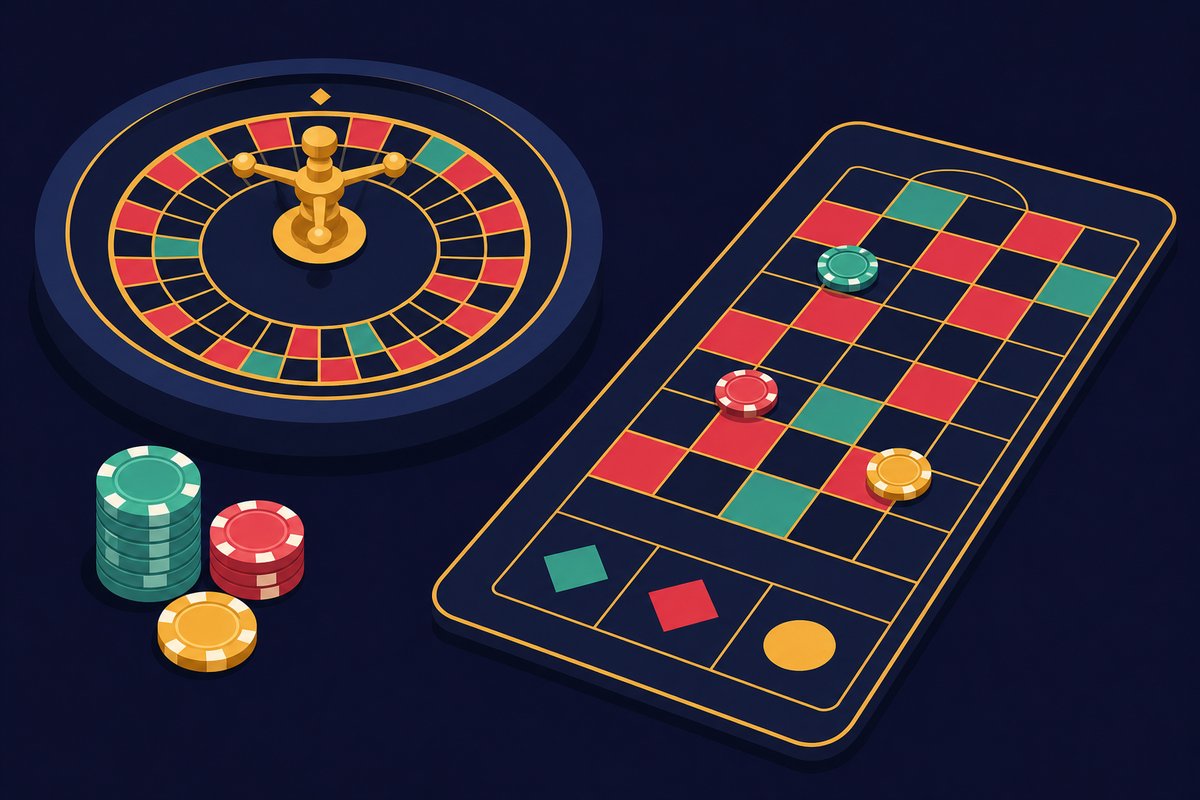
Inside bets
Inside bets sit on the numbered grid itself. A straight-up bet covers a single number. A split covers two adjacent numbers by placing a chip on the line between them. A street covers a row of three numbers. A corner covers four numbers meeting at a point. A six line, sometimes called a double street, covers two adjacent rows of three. Each pays more the fewer numbers it covers, because the odds against winning get longer the narrower the bet.
Placement on the felt is what determines which bet a chip represents, not the player’s intent, which is why dealers are strict about exact positioning. A chip sitting squarely inside one number’s box is a straight-up bet; nudged onto the shared line between two boxes, the same chip becomes a split; centred on the intersecting corner of four boxes, it becomes a corner bet instead. This is a detail worth knowing before playing at a physical table, since a chip placed slightly off from where a player intended can change what they’ve actually wagered.
Outside bets
Outside bets sit around the edge of the grid and cover much larger groups. Red/black, odd/even and high/low (1-18 or 19-36) each cover 18 of the wheel’s numbered pockets and pay even money. Dozens (1-12, 13-24, 25-36) and columns each cover 12 numbers and pay 2:1. None of these outside bets cover the zero or (on an American wheel) the double zero, which is exactly where the house edge lives on every one of them.
A commonly misunderstood point: a dozen bet and a column bet cover the same number of pockets (12) and pay the same odds (2:1), but they group numbers completely differently. A dozen is a straightforward block, 1 through 12, 13 through 24, or 25 through 36. A column runs vertically down the betting grid instead, picking up every third number across the full range. Mathematically the two are identical in edge; the only real difference is which specific numbers a win requires. The Roulette Bet Visualizer shows both groupings highlighted against the layout, which makes the difference obvious in a way a written description can’t quite manage.
Payouts and true odds, wheel by wheel
| Bet | Numbers covered | Payout | European true odds (single zero) | American true odds (double zero) |
|---|---|---|---|---|
| Straight up | 1 | 35:1 | 36:1 | 37:1 |
| Split | 2 | 17:1 | 17.5:1 | 18:1 |
| Street | 3 | 11:1 | ~11.3:1 | ~11.7:1 |
| Corner | 4 | 8:1 | 8.25:1 | 8.5:1 |
| Six line | 6 | 5:1 | ~5.17:1 | ~5.33:1 |
| Dozen / column | 12 | 2:1 | ~2.08:1 | ~2.17:1 |
| Even money (red/black, odd/even, high/low) | 18 | 1:1 | ~1.06:1 | ~1.11:1 |
In every row, the payout falls slightly short of the true odds. That constant shortfall works out to a 2.70% house edge across nearly all standard bets on a European wheel, and 5.26% on an American wheel, for the reason described below.
Pick a wheel and a bet to see the numbers it covers, the payout, the true odds and the house edge.
Called bets: a wheel-position tradition
Alongside the grid-based bets above, European tables often offer called (or announced) bets, grouped not by their position on the betting layout but by their physical position on the wheel itself. Voisins du Zéro (“neighbours of zero”) covers a cluster of numbers around the zero pocket; Tiers du Cylindre covers the third of the wheel roughly opposite it; Orphelins (“orphans”) covers the numbers left over between the two. These groupings trace back to the wheel layout used in French casinos and remain a distinctly European convention, American tables generally don’t offer them, since American wheels don’t share the same historical numbering sequence.
A fourth grouping, Jeu Zéro (“zero game”), covers a tight cluster of just seven numbers immediately surrounding the zero pocket on the wheel and is sometimes offered as its own called bet or as a variant folded into Voisins du Zéro depending on the table. None of these called bets change the underlying math of the individual straight-up and split bets that make them up, they’re a convenience for placing several related chips in one action, not a separate category of odds.
Why the European wheel is the better bet, mathematically
The entire gap between 2.70% and 5.26% comes down to one extra pocket. A European wheel has 37 slots (1-36 plus a single 0); an American wheel has 38 (1-36 plus 0 and 00). The payouts on nearly every bet are identical across both wheel types, so the only thing that changes is how many losing pockets there are to divide the same payout against. Some European tables go a step further with a rule called la partage, which returns half of an even-money bet if the ball lands on zero, cutting the effective edge on those specific bets to roughly 1.35% where it applies.
A closely related rule, en prison, appears mainly at some French-style tables and works slightly differently: rather than returning half the stake outright, a losing even-money bet on zero is “imprisoned” for one more spin, and only lost outright if that following spin also loses. Both rules exist for the same reason, to soften the house’s edge specifically on the simplest, most commonly placed bets, and neither is universal. A reader should treat 2.70% as the baseline European figure and these reduced numbers as table-specific improvements on it, not the default. Both rules apply narrowly to even-money bets only, the licensing and testing that confirm a table’s published rules are covered generally in How Online Casinos Work.
The bet that breaks the pattern
Not every bet on an American wheel follows the same 5.26% rule. The five-number bet, covering 0, 00, 1, 2 and 3 in one wager at 6:1, has no equivalent on a single-zero wheel and carries a noticeably worse house edge, close to 7.9%, than every other standard bet on that same table. It’s the one line on the American betting grid where the house edge isn’t 5.26%, it’s worse, and it’s the only bet where the wheel type itself makes an exception to its own rule.
Betting systems don’t change any of this
Martingale, Fibonacci and other progressive betting systems, doubling or scaling a bet after a loss, in various patterns, are sometimes presented as ways to beat roulette’s edge. None of them do. Every spin is independent of the last, which means no sequence of bets, however cleverly staked, changes the 2.70% or 5.26% edge baked into the wheel itself. What these systems actually do is reshape the distribution of outcomes: smaller, more frequent wins against the occasional large loss, or the reverse, depending on the system. The long-run expected result stays exactly where the house edge puts it, regardless of staking pattern.
Anyone who has ever watched a wheel land on the same colour six times running and felt the next spin was “due” has run into the same misconception from a different angle: the wheel has no memory, on either side of that bet.
Frequently Asked Questions
What's the difference between a European and an American roulette wheel?
A European wheel has 37 pockets, numbered 0 through 36. An American wheel adds a second zero, 00, for 38 pockets total. That single extra pocket raises the house edge from 2.70% on the European wheel to 5.26% on the American one, for the same bets at the same payouts.
What is the difference between inside and outside bets?
Inside bets are placed directly on or between numbers on the betting grid, straight up, split, street and corner bets among them, and pay higher odds for a lower chance of winning. Outside bets cover broader groups such as red/black, odd/even, dozens and columns, paying lower odds for a higher chance of winning.
Why do straight-up bets pay 35:1 when the true odds are different?
A straight-up bet's true odds are 36:1 on a European wheel (1 winning number out of 37) and 37:1 on an American wheel (1 out of 38), but the payout is fixed at 35:1 on both. That gap between the payout and the true odds is exactly what generates the house's edge.
What are called bets?
Called bets, sometimes announced bets, are groupings of inside bets based on the numbers' physical position on a European wheel rather than on the betting grid, Voisins du Zéro, Tiers du Cylindre and Orphelins are traditional French names for some of them. They are a way of covering a wheel sector in one action rather than several separate chips.
Which roulette bet has the worst odds?
On an American wheel, the five-number bet covering 0, 00, 1, 2 and 3 carries a higher house edge, close to 7.9%, than any other standard bet on that wheel, because its 6:1 payout is a poor match for its true odds. It has no equivalent on a single-zero European wheel.
Does betting on red or black improve my odds compared to a single number?
It improves the chance of winning any given spin, but not the underlying house edge, which stays the same across nearly every standard bet on a given wheel. Even-money bets like red/black simply spread that edge over a higher-probability, lower-payout outcome.
More casino guides
- Blackjack Basic Strategy: The Chart and Why It WorksBlackjack basic strategy explained: hard and soft totals, pair splits, dealer upcard logic, and why the…
- Casino Games on Consoles: From Vegas Stakes to GTA OnlineHow casino games reached video game consoles, from Casino Kid and Vegas Stakes on the NES…
- How Online Casinos Work: Licensing, RNGs, Payouts and ChecksHow online casino licensing, RNG testing labs, RTP figures and identity checks work, from the UKGC…
- Responsible Play: Limits, Self-Exclusion and Helplines by MarketDeposit limits, time-outs, self-exclusion schemes and bank gambling blocks explained, with helpline numbers for Ontario, Alberta,…
- Slot RTP and Volatility ExplainedWhat slot RTP and volatility mean, with a worked example of expected loss at 96% RTP…