
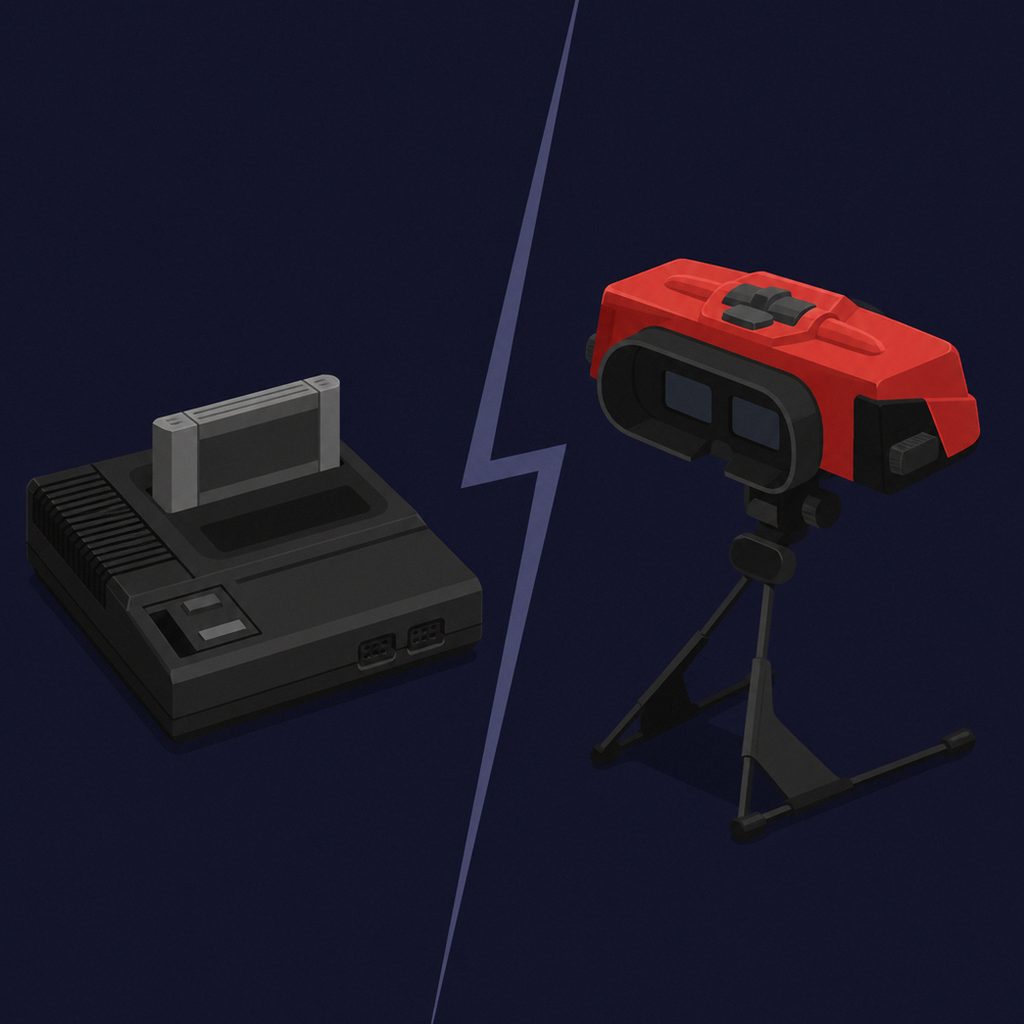
Nintendo’s worst hardware year and Sega’s best both trace back to the same date on the calendar. On August 14, 1989, the Sega Genesis launched in test markets across New York and Los Angeles, kicking off Sega’s most successful console generation. On August 14, 1995, exactly six years later, the Nintendo Virtual Boy launched nationwide in the US and became one of the shortest-lived consoles Nintendo ever shipped, discontinued within seven months. Same day, six years apart, opposite outcomes. Nobody planned it that way, and nobody at either company has ever suggested otherwise. It’s simply a strange fact sitting quietly in the release calendar, waiting for someone to notice it.
1989: A Test Launch That Became a Turning Point
Sega didn’t roll the Genesis out nationally in August 1989. It tested the waters first, in two of America’s largest media markets, before the wider September rollout that followed. The console cost $189, ran a Motorola 68000 CPU that outpunched anything else on shelves, and came packed with Altered Beast. What made the launch matter wasn’t the specs alone. It was the moment Sega decided to fight Nintendo directly rather than around the edges, and the “Genesis does what Nintendon’t” campaign that followed over the next two years reframed the entire console market as a genuine rivalry rather than a Nintendo monopoly with a handful of also-rans circling around it.
Under Tom Kalinske, who took over Sega of America in mid-1990, that positioning sharpened into a real business with real numbers behind it. The Genesis climbed to roughly 65% of the 16-bit US market at its peak and finished its run at 30.75 million units worldwide, still Sega’s best-selling home console by a wide margin, and the high-water mark against which every later Sega system was measured and, fairly or not, found wanting. Full specs and library detail live on the Sega Genesis page.
1995: A Headache in a Box
The Virtual Boy is a different story entirely, and a much shorter one. It launched at $179.95 as a tabletop stereoscopic headset, not the wearable VR device its marketing sometimes implied, but a unit you leaned over and pressed your face into, displaying everything in monochrome red on black. Reviewers and players alike reported eye strain and headaches after even brief sessions. Nintendo pulled the plug within seven months, sold fewer than 800,000 units worldwide, and rarely spoke of the system as anything but a cautionary tale afterward. Details on its library and hardware sit on the Virtual Boy page.
The Virtual Boy is usually treated as a footnote in retrospectives of Nintendo’s otherwise dominant 1990s. It shouldn’t be quite so easy to dismiss. It’s the clearest evidence that even the company that owned the decade could ship a genuine disaster, and the fact that the disaster and the triumph six years apart share a launch date is the kind of detail that makes console history more interesting than the highlight-reel version most people remember.
Two Companies, Two Very Different Bets
Put the two launches side by side and the contrast sharpens quickly. Sega in 1989 was betting on raw power and an attitude shift: speed, edge, a mascot with a sneer instead of a smile. Nintendo in 1995 was betting on a genuinely novel form factor at a moment when the company badly needed something to bridge the gap before the Nintendo 64 arrived the following year. One bet paid off for six years straight. The other paid off for less than one.
There’s also a personnel story worth pausing on, since it rarely makes it into the short version of this history. The Virtual Boy was overseen by Gunpei Yokoi, the Nintendo engineer who had already created the Game Boy and led the company’s R&D1 division through some of its most inventive years. Yokoi left Nintendo in 1996, not long after the Virtual Boy’s failure, and died the following year in a road accident while inspecting a car near his workshop. None of that is presented, in any serious account of his career, as the Virtual Boy having ruined it. Yokoi’s reputation as one of the most important hardware designers in the industry’s history was secure well before 1995. But the timing sits uncomfortably close, and it’s worth knowing, when reading a list of launch dates and specs, that a real engineer’s professional arc runs underneath one of the entries on it.
How Each Launch Actually Looked From a Store Aisle
It’s worth picturing what a shopper actually walked into at each of these two launches, because the retail experience diverged almost as sharply as the sales figures did. In August 1989, a buyer in New York or Los Angeles found the Genesis sitting next to NES cartridges with a marketing push that made a direct, confident argument: better graphics, arcade-quality sound, a game already in the box that showed both off immediately. The pitch was simple and it worked on contact.
In August 1995, a buyer walked into a very different situation. The Virtual Boy sat on a shelf as a standalone tabletop unit rather than something worn on the head, with a demo unit that, if the store even had one set up correctly, required leaning over an eyepiece in a way that felt awkward in a retail environment built for quick browsing. Reviewers at the time noted that the in-store experience undersold the headache risk that only became apparent after fifteen or twenty minutes of continuous play, which is longer than most shoppers spent trying a demo unit before buying. Nintendo effectively shipped a product whose most serious flaw was invisible at the point of sale, and that flaw only became widely known once units were already in living rooms.
Why the Coincidence Doesn’t Mean Anything, and Why It’s Still Worth Noting
It would be tidy to draw a lesson out of two consoles sharing a launch date, something about hubris, or about how six years can flip an industry’s fortunes entirely. Resist that urge. Sega’s success in 1989 came from a marketing and business strategy that had nothing to do with the calendar, and Nintendo’s failure in 1995 came from a hardware and health-and-safety problem that had nothing to do with it either. The date is a coincidence, full stop, and treating it as more than that would be reading tea leaves into a spreadsheet of release dates.
What the pairing is actually good for is a reminder that console history doesn’t move in one direction for any single manufacturer. Sega’s 1989 was Nintendo’s problem to solve. Nintendo’s 1995 solved itself only because the N64 arrived in 1996 with Super Mario 64 in the box, and by the time anyone was compiling “best of the decade” lists, the Virtual Boy had already been filed away as an outlier rather than a warning sign of a company in decline. Compare the two consoles’ specs, sales figures, and library depth directly on the Genesis and Virtual Boy pages, or see how both fit into their respective decades on the 1980s and 1990s console guides.
One more date worth filing away, for anyone keeping track: three years after the Virtual Boy, on August 19, 2012, Nintendo launched the 3DS XL, a stereoscopic-adjacent handheld, glasses-free this time, that actually worked as advertised. Not on the 14th. Close, but not quite.
Frequently Asked Questions
What happened on August 14, 1989?
Sega test-launched the Genesis in New York and Los Angeles at $189, the opening move in what became Sega's most successful console generation, eventually selling 30.75 million units worldwide.
What happened on August 14, 1995?
Nintendo launched the Virtual Boy nationwide in the US at $179.95. It caused reported eye strain and headaches in many users and was discontinued within seven months, selling fewer than 800,000 units worldwide.
Is there any connection between the Genesis and Virtual Boy launches beyond the date?
No direct connection — the shared August 14 launch date across 1989 and 1995 is a coincidence, not a deliberate pattern by either company. The two launches involved different design philosophies, different Nintendo and Sega teams, and unrelated business strategies.
Who designed the Virtual Boy?
Gunpei Yokoi, the Nintendo engineer who previously created the Game Boy and led the company's R&D1 division. He left Nintendo in 1996 and died in a road accident in 1997.
Did the Virtual Boy's failure hurt Nintendo long-term?
Not materially. The Nintendo 64 launched the following year, in September 1996, with Super Mario 64 as its pack-in system-seller, and the Virtual Boy was quickly treated as an outlier rather than a sign of broader trouble.
How many units did the Genesis sell compared to the Virtual Boy?
The Genesis sold approximately 30.75 million units worldwide over its life. The Virtual Boy sold fewer than 800,000 — roughly 1/40th as many, across a system that was on shelves for less than a year.