
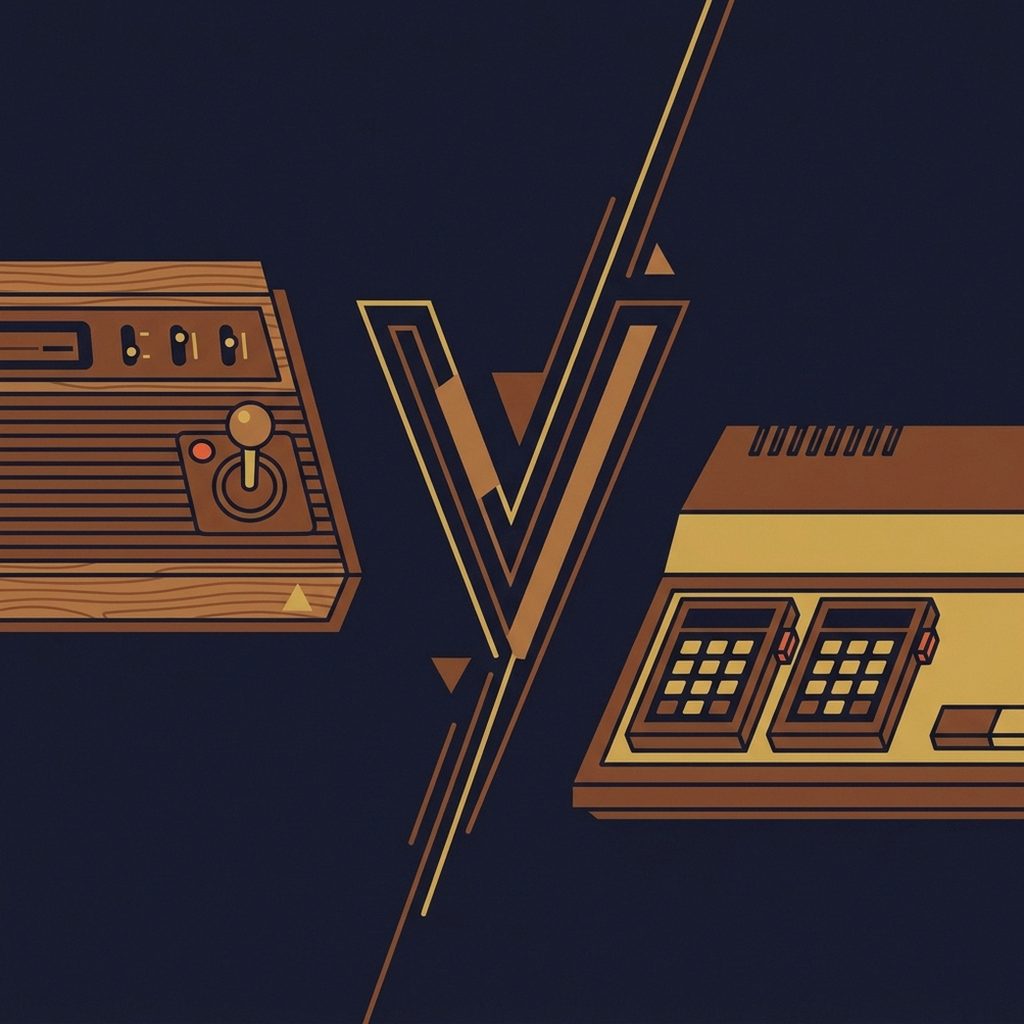
A well-dressed man in his forties stares into the camera, unimpressed, and says a computer just ran side-by-side tests comparing two home game systems. Then he shows you the Atari 2600 version of a football game next to the Intellivision version, and the Atari picture looks like blocky abstract art next to it. That commercial, fronted by writer and Paris Review founder George Plimpton, ran for years in the early 1980s and was Mattel’s entire strategy in miniature: don’t out-market Atari, out-graphics it, on camera, one screen comparison at a time.
Atari’s Head Start
Atari got there first, and by a wide margin. The Atari 2600, originally sold as the Atari Video Computer System, launched in September 1977 at $199 and had the North American living room to itself for more than two years. That head start mattered. By the time Mattel’s Intellivision arrived in December 1979 at $299, Atari already had a growing third-party software ecosystem, a lower price, and millions of consoles already sitting under television sets.
Intellivision’s pitch wasn’t lower price or a bigger library. It was raw graphical fidelity, and on that specific point, it wasn’t exaggerating.
Mattel wasn’t a games company stumbling into hardware by accident, either. It was already one of the largest toy manufacturers in the country, with Barbie and Hot Wheels behind it, and it brought that same marketing muscle to a category Atari had mostly had to itself. That mattered. A challenger with real advertising budget and shelf presence at every major toy retailer is a different threat than a scrappy startup, and Atari’s own executives treated Intellivision as the first competitor they took genuinely seriously.
The Sports-Game Claims
Mattel built Intellivision’s entire competitive identity around sports. NFL Football, NBA Basketball, and Major League Baseball shipped with rosters, statistical modeling, and player movement that felt closer to a real broadcast than anything the Atari 2600’s simpler cartridges attempted. Contemporary reviewers largely agreed the comparison was fair, not just marketing spin, which is precisely why the side-by-side Plimpton ads worked as well as they did. Atari didn’t sit still. Its own marketing team ran comparison spots pushing back, and the two companies spent the early 1980s essentially litigating console superiority through prime-time television.
The Keypad Controller
Intellivision’s controller was as distinctive as its graphics. Instead of Atari’s single-button joystick, it paired a round directional disc with a 12-button numeric keypad, styled like a landline phone. Every game shipped with a thin plastic overlay that snapped over the keypad, relabeling the buttons for that specific title, turning a generic numeric grid into a football play-selector or an RPG’s spell menu depending on what was loaded. It was more capable than Atari’s controller and considerably less intuitive, especially for a five-year-old who just wanted to move a paddle. That trade-off, depth against simplicity, ran through nearly every design decision separating the two systems.
Pricing and the Cost of Being Second
Being the newer, more capable console came at a price, literally. Intellivision launched at $299 in December 1979, a full $100 above the Atari 2600’s original $199 asking price, and that gap never fully closed during the years both consoles competed directly. For a lot of households, the graphics comparisons in Mattel’s ads were persuasive right up until the moment a parent looked at the price tag next to an already-cheaper Atari system sitting on a store shelf. Being right about picture quality and winning the sale turned out to be two different problems, and Mattel only ever really solved the first one.
Hardware Under the Hood
The graphical gap Plimpton kept pointing at was real, and it came down to different design philosophies rather than one company simply trying harder. The Atari 2600 ran on a MOS Technology 6507 processor with only 128 bytes of RAM, a design built in the mid-1970s around minimizing chip cost, which forced Atari’s programmers to generate graphics through clever, often exhausting low-level tricks rather than straightforward frame-by-frame rendering. Intellivision’s General Instrument CP1610 processor and dedicated graphics chip, designed a few years later, could push more colors and sprites on screen with considerably less programmer contortion. Atari’s engineers weren’t behind on talent. They were working with older, cheaper silicon by the time Mattel entered the market with a newer design built specifically to beat it on the spec sheet.
The Third-Party Software War
Both companies also had to fight a battle neither fully anticipated: their own former employees. In 1979, four Atari programmers, frustrated that the company credited games to itself rather than the individuals who made them, left to found Activision, the first third-party game publisher in the industry’s history. Activision released games for the Atari 2600 without Atari’s permission or a licensing deal, and Atari sued; the case settled with Activision agreeing to pay a royalty, establishing the licensing model that would define the industry for decades afterward. Intellivision faced its own version of the same pressure from a company called Imagic, founded partly by ex-Atari staff as well, which released games for both the 2600 and Intellivision simultaneously. Third-party software didn’t just add competition between platforms. It added competition within each platform’s own library, often from people who had built the hardware’s earliest hits in the first place.
1983 and the End of the War
Neither company’s console war ended with a winner. The North American video game market collapsed in 1983, undone by an oversaturated shelf of licensed and shovelware cartridges, a public that had stopped trusting console gaming as a category worth the money, and a retail glut nobody had priced correctly. Revenue across the US industry fell by roughly 97 percent between 1983 and 1985. Atari, Mattel, and a newer entrant, Coleco with its ColecoVision, all took direct hits, and the rivalry that had defined the previous four years simply stopped mattering once there was barely an industry left to compete in.
Atari came out of the whole period as the clear historical winner by volume. The 2600 sold roughly 30 million units over its life, more than the Intellivision’s approximately 3 million, and its longer production run stretched into 1992, a full two years past Intellivision’s 1990 discontinuation. But sales totals miss what actually made the rivalry memorable, which was never really about final unit counts. It was about a company willing to put a real television personality on air arguing its sports games looked more real than the market leader’s, and for a few years, being right about it.
What Happened to Both Companies After
Neither Atari nor Mattel walked away unscathed, even though Atari’s console technically outlasted Intellivision on shelves. Warner Communications, which owned Atari at the time of the crash, split the company in 1984, selling its home computer and console division to Commodore founder Jack Tramiel, who reorganized it as Atari Corporation. Mattel, badly burned by Intellivision’s losses, sold the entire division to a group of its own employees in 1984, who continued limited operations under the name INTV Corporation into the early 1990s, mostly serving a shrinking base of loyal owners rather than competing for new ones. The console war that Plimpton had spent years narrating on television ended not with a decisive winner, but with both original combatants effectively leaving the business that had made them famous.
Full specs and release details for both systems are on the Atari 2600 and Mattel Intellivision console pages.
Frequently Asked Questions
Which console started the Atari vs Intellivision rivalry?
Atari had the market to itself first. The Atari 2600 launched in September 1977, and Mattel's Intellivision followed more than two years later, in December 1979, arriving with noticeably sharper graphics and positioning itself directly against Atari's aging hardware.
What were the George Plimpton Intellivision ads?
Mattel ran a long-running ad campaign fronted by writer and broadcaster George Plimpton, showing side-by-side screen comparisons between Intellivision and Atari 2600 versions of the same sport games. The ads argued Intellivision's graphics were dramatically more realistic, and Atari's marketing team fought back with comparison ads of its own.
What was the Intellivision controller like?
The Intellivision controller paired a round directional disc with a 12-button numeric keypad, and each game shipped with a printed plastic overlay that slid over the keypad to relabel the buttons for that specific title. It was more versatile than Atari's single-button joystick but less intuitive for younger players.
Which console had better sports games, Atari 2600 or Intellivision?
Intellivision, by most contemporary accounts. Its sports library, including NFL Football, NBA Basketball, and Major League Baseball, offered more realistic player movement, team rosters, and statistical detail than the Atari 2600's simpler sports titles, and Mattel built its entire marketing strategy around that gap.
What ended the Atari vs Intellivision console war?
The North American video game crash of 1983 ended it for both companies. An oversaturated market, a flood of poor-quality third-party games, and collapsing consumer confidence in cartridge-based consoles wiped out most of the industry's revenue within about two years, badly damaging Atari and Mattel alike.
Which console sold more, the Atari 2600 or Intellivision?
The Atari 2600 sold far more, with lifetime sales around 30 million units against roughly 3 million for the Intellivision. Atari's earlier launch, broader third-party game library, and lower price point outweighed Intellivision's graphical advantage over the long run.