
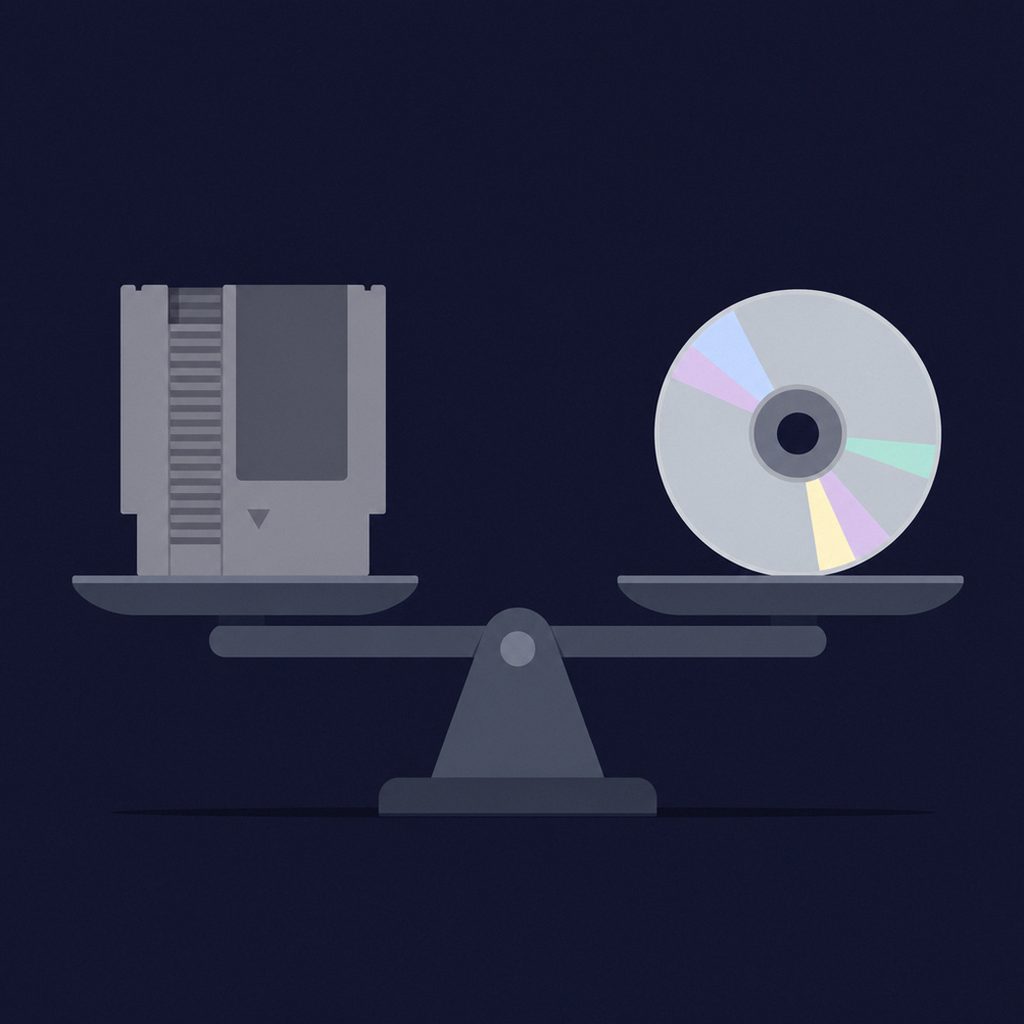
Games switched from cartridges to discs in the mid-1990s because optical discs held more than a hundred times the data of the largest cartridge and cost a fraction as much to manufacture. The trade-off was load times and fragility. Cartridges later returned on the Nintendo Switch because flash memory finally delivered high capacity in a small, solid-state package, which suits a portable far better than a spinning disc.
Few decisions shaped console history as much as the choice of game media. The move from cartridges to discs and, two decades later, the partial move back was never about which format was simply better. Each format trades capacity, cost, speed, and durability against the others, and the winner in any given era was whichever balance fit the technology and economics of the moment. This page compares the two head to head; the formats are set in their full timeline in the history of game media.
The Core Trade-Off
Cartridges and discs are opposites in almost every dimension. A cartridge is solid-state storage the console reads directly, so it is fast and tough but small and expensive to produce. A disc is removable optical media read by a laser, so it is cheap and capacious but slow and delicate. The table below summarizes the contrast.
| Property | Cartridge (mask ROM era) | Optical disc (CD-ROM era) |
|---|---|---|
| Capacity | Up to about 64 MB (N64) | About 650 to 700 MB |
| Manufacturing cost | High (tens of dollars) | Very low (about a dollar) |
| Load times | Effectively none | Noticeable; loading screens |
| Durability | Very high, no moving parts | Lower; scratches, disc rot |
| Extra hardware | Can carry enhancement chips | None; read-only data |
| Production lead time | Weeks (chips must be ordered) | Days (discs pressed quickly) |
Why Did Games Stop Using Cartridges?
By the mid-1990s the two factors that mattered most to publishers, capacity and cost, both favored the disc overwhelmingly. A single CD-ROM held over a hundred times the data of the largest cartridge, which mattered enormously as games adopted full-motion video, recorded voice acting, and CD-quality music. At the same time, a pressed CD cost about a dollar to manufacture, while a high-capacity cartridge cost tens of dollars; contemporary 1996 reporting cited roughly a dollar for a PlayStation CD against around thirty dollars for a Nintendo 64 cartridge.
That cost gap hit publishers twice. It raised the retail price of cartridge games and squeezed publisher margins, and it forced developers to spend money compressing assets to fit limited ROM. Discs removed both problems at once. There was also a logistics advantage: discs could be pressed in days to meet demand, while cartridges required ROM chips to be ordered weeks ahead, a real risk if a game over- or under-sold.
The Tipping Point: Final Fantasy VII
The single clearest illustration of the shift was Final Fantasy VII (1997). Square had been a Nintendo partner since the NES, but it built the game for the disc-based Sony PlayStation rather than the Nintendo 64. The game’s pre-rendered cinematics and three-disc scope needed storage no cartridge could affordably provide; series creator Hironobu Sakaguchi later said a cartridge edition would have pushed the price far beyond what players would tolerate. Square’s move was part of a broad publisher exodus toward discs, and it left the Nintendo 64 as the last major cartridge-based home console of its generation.
What Cartridges Did Better
The disc won on economics, but the cartridge held real advantages that players felt every day. There were no load times: a cartridge game began instantly, while early disc consoles introduced the “Now Loading” screen as a permanent fixture. Cartridges were far more durable, with no reflective surface to scratch and no laser drive to wear out or skip. And because a cartridge is a circuit board, it could carry enhancement chips that boosted the console, something a disc, being pure data, can never do. These strengths are why portables stuck with solid-state media all through the disc era, as covered in the history of handheld consoles.
The Disc Era’s Own Limits
Discs were not the final answer either. Their capacity kept needing to grow: the Sega Dreamcast used a proprietary 1 GB GD-ROM, while the Nintendo GameCube chose a compact 8 cm optical disc holding about 1.5 GB, a deliberately smaller format that traded capacity for a smaller console and some copy resistance. Later generations climbed to DVD and then Blu-ray. Meanwhile the disc’s weaknesses, load times and physical fragility, never fully went away, and by the 2010s many disc games required full installs to a hard drive, with the disc serving mainly as proof of purchase.
Why Cartridges Came Back
The format returned for the same reason it had survived in handhelds. The Nintendo Switch (2017) is a hybrid portable, and a spinning optical drive is a poor fit for a device carried around and played on the move: drives are bulky, drain the battery, and skip when jostled. By 2017, flash memory had advanced enough that a tiny solid-state card could hold up to 32 GB, finally erasing the capacity disadvantage that drove the industry to discs in the first place. The Switch card brought back instant loading and durability without the old size penalty.
So games did not switch back because discs were a mistake; they switched back because the constraint that doomed cartridges, expensive low-capacity ROM, no longer exists. The deeper mechanics of both old and new cartridges are explained in how game cartridges work, and the format as a whole in video game cartridges explained.
Frequently Asked Questions
Why did games stop using cartridges?
Capacity and cost. By the mid-1990s a single CD-ROM held over a hundred times the data of the largest cartridge and cost roughly a dollar to manufacture, against tens of dollars for a high-capacity cartridge. Discs let publishers ship bigger games at lower cost, so the industry moved to optical media, leaving the Nintendo 64 as the last major cartridge home console of its era.
What are the advantages of cartridges over discs?
Cartridges load almost instantly because the console reads code directly from the chip, they are far more durable with no scratchable surface or laser drive, and they can carry enhancement chips that boost the console. Discs win on capacity and manufacturing cost but introduce load times and are more fragile.
Did discs hold more data than cartridges?
Yes, by a wide margin. A CD-ROM held about 650 to 700 MB, while even the largest Nintendo 64 cartridge held 64 MB, roughly a tenth as much. That capacity gap is what enabled disc-era features like full-motion video, voice acting, and orchestral soundtracks.
Why did Final Fantasy VII move from Nintendo to PlayStation?
Final Fantasy VII needed far more storage than a cartridge could affordably provide, with its pre-rendered cinematics spanning three discs. Series creator Hironobu Sakaguchi said a cartridge version would have pushed the retail price far too high, so Square built the game for the disc-based PlayStation, marking a turning point in the cartridge-to-disc shift.
Why did the Nintendo Switch switch back to cartridges?
The Switch is a hybrid handheld, and optical drives are bulky, power-hungry, and prone to skipping when carried around. By 2017, flash memory had advanced enough that a tiny solid-state card could hold up to 32 GB, removing the capacity disadvantage that originally drove the industry to discs, so a cartridge again made sense.
Were discs better than cartridges?
Neither was simply better; each fit a different era. Discs won when ROM was expensive and low-capacity, because they were cheap and held far more data. Cartridges returned once flash memory made high-capacity solid-state storage affordable, which suits a portable console better than a spinning disc. The format choice always followed the technology and economics of the time.