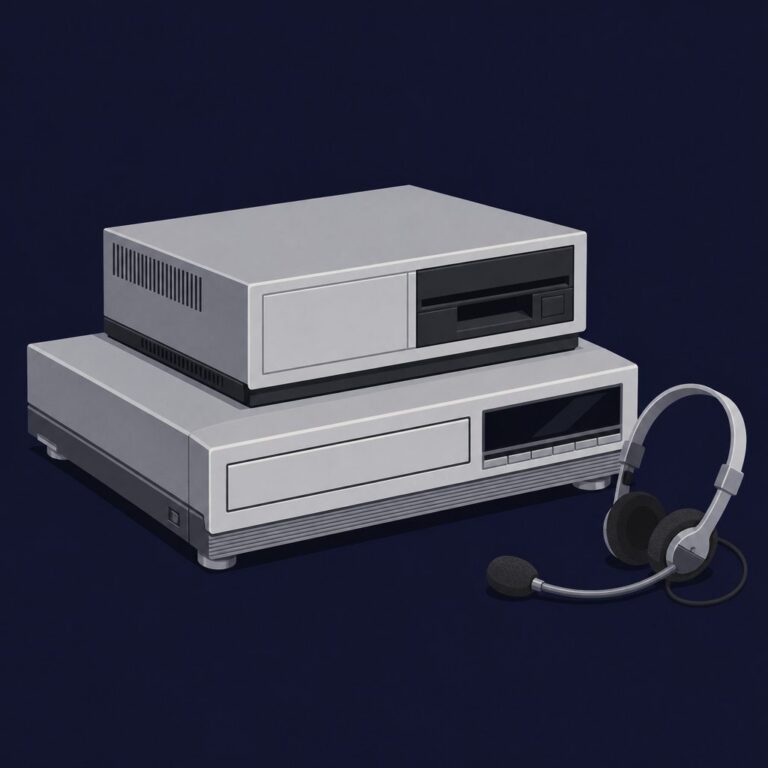
The RDI Halcyon is a LaserDisc-based home system built by RDI Video Systems of Carlsbad, California, and designed by Rick Dyer, the creator of Dragon’s Lair. It was announced for January 1985 in the United States at a planned price of US$2,500, and only two games were released for it.
The RDI Halcyon was a home computer that talked, listened and played video from a LaserDisc. Rick Dyer wanted players to speak to their games in plain English, which was a bold target for 1985 hardware. The price put it far outside the toy aisle, the company behind it ran short of money, and the machine vanished almost as soon as it appeared. Fewer than a dozen units are known to exist today, and that scarcity makes it one of the most sought-after pieces in the cancelled and short-lived console database.
Rick Dyer and the Level 3 Idea
Rick Dyer ran RDI Video Systems (short for Rick Dyer Industries) and had already scored with the laserdisc arcade games Dragon’s Lair and Space Ace. His next project was a “Level 3” computer and laserdisc system with voice synthesis and voice recognition. According to an AtariHQ Museum reprint of a 1985 news piece, it was meant to sell at $2,500.
The name carries a joke. Dyer partly chose “Halcyon” because its first syllable is “Hal”, the talking computer of 2001: A Space Odyssey. A machine you could talk to, and that answered back, was the whole pitch.
Dyer also wanted a home for his own fantasy world, Shadoan, which he based on the Lord of the Rings and on his liking for the game Adventure. Dragon’s Lair itself was never made for the Halcyon. Speech recognition was too slow for its timed moves, and licensing restrictions stood in the way.
Launch and Price
The January 1985 date comes from two directions. The planned launch was January 1985, and the AtariHQ page quotes Dyer saying that shipping began in the second week of January 1985. RDI’s finances were shaky by then. The same reprint describes a creditor receiving a form letter asking to hold off for 90 days, and Dyer said the creditors voted for that extension before shipping began.
The announced price was $2,500 for the full system, including the disc player. The computer portion alone was priced at $1,700. Retail adverts from 1985 in the Los Angeles Times show how loosely that figure held. Beverly Stereo and Video asked $2,498 and later cleared stock at $999, while Video Scene in San Diego advertised the system at $1,898. Those advertisements suggest that some stock did reach retailers. Another account puts the intended range at $1,800 to $2,100, depending on the model.
Hardware
The Halcyon was built around a Zilog Z80 with 64 KB of memory partitioned between ROM and RAM. Game programs came on 16 KB ROM cartridges, while the video came from the LaserDisc. A Votrax speech-synthesis chip spoke, fed phonetically by a licensed text-to-speech algorithm. A separate speech-recognition computer with its own firmware listened through a noise-cancelling headset microphone.
The video source changed late in development. The first design used an RCA CED videodisc player connected by a serial link. After RCA stopped CED production, RDI redesigned the system around LaserDisc. The finished machine controlled an unbadged Pioneer player through an infrared LED mounted on a suction cup, so the player remained a separate unit. The Halcyon therefore existed in two hardware generations: a CED-based prototype and the LaserDisc version.
Accessories
The headset microphone was the accessory that made voice play possible. RDI also planned a pricey “Control Module” for remote-controlling other devices, but that never reached shops.
The Games
Two games were released. Thayer’s Quest was developed in parallel with its 1984 arcade version, and the Halcyon disc is double-sided, carrying material that does not appear on the coin-op disc. NFL Football: LA Raiders vs SD Chargers arrived in 1985 at $94. It was an NFL-sanctioned game and drew on three seasons of live footage.
Six titles were planned in all. A Dallas versus Washington football disc and a Thayer’s Quest sequel were announced. Other unreleased titles include Voyage to the New World, Shadow of the Stars, Orpheus and The Spirit of the Whittier Mansion. Thayer’s Quest lived on in a different form when it was adapted in 1995 as Kingdom: The Far Reaches.
Why It Ended
RDI went bankrupt around the planned 1985 launch and folded before the console reached a wide audience. Secondary accounts list the same causes: the high price, the cost of each disc, the need for a separate player, speech recognition that was not yet mature, and the shaky finances of the company. SlashGear adds that it failed to attract many preorders.
The machine arrived in the shadow of the video game crash of 1983. Its laserdisc approach is one of the stranger branches of the history of game media, which follows how games moved from cartridges to discs.
Collecting and Preservation Today
Surviving units are mostly prototypes or pre-production machines. A complete working bundle, with the system, both games, accessories, manuals and a Return of the Jedi LaserDisc, sold at auction for $22,800 including buyer’s premium at the end of 2023. In February 2025 the San Diego Air and Space Museum sold an untested part from its holdings on eBay for $3,500.
A Halcyon is also on display at the National Videogame Museum in Frisco, Texas. The 1980s console overview places the machine among its contemporaries, and the console timeline shows where it sits in the wider sequence.
Frequently Asked Questions
How much did the RDI Halcyon cost?
The announced price was US$2,500 for the full system with disc player, with the computer portion alone at US$1,700. Retail adverts in 1985 showed $2,498 and $1,898, and one store later cleared stock at $999.
Was the RDI Halcyon ever released?
Barely. Rick Dyer said shipping began in January 1985, but RDI folded within months and fewer than a dozen units are known today.
How many games were released for the Halcyon?
Two: Thayer's Quest and NFL Football: LA Raiders vs SD Chargers. Six titles were planned.
Did the Halcyon play Dragon's Lair?
No. Speech recognition was too slow for the game's timed moves, and licensing restrictions also stood in the way.
Why did the RDI Halcyon fail?
The high price, the cost of each disc, the separate player, immature voice recognition and RDI's shaky finances are the reasons given. RDI went bankrupt around the planned launch.
How much is a Halcyon worth today?
A working bundle with both games, accessories and manuals sold at auction for $22,800 including buyer's premium at the end of 2023.