
Sweepstakes casinos are restricted in fourteen states as of September 2026, some by a specific new statute, some by enforcement of pre-existing gambling law. Oklahoma’s ban does not take effect until 1 November 2026, so it remains legal there for now. Illinois has not banned the model by statute, but the state’s Gaming Board sent 65 cease-and-desist letters to operators in February 2026, leaving the market there in an unsettled, actively contested state rather than a clean yes or no.
The 14 States Where Sweepstakes Casinos Are Banned
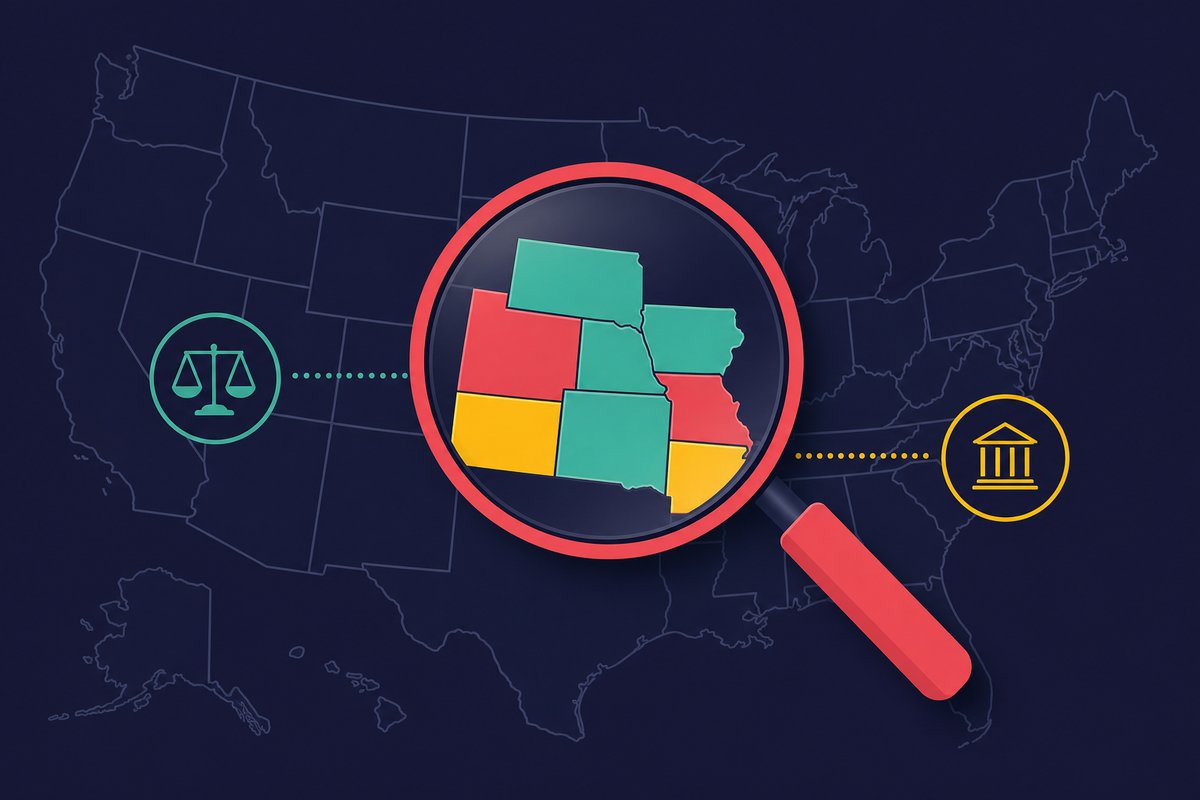
The table below lists all fourteen restricted states, the statute or legal basis behind each restriction, and the date it took, or takes, effect.
| State | Statute / Basis | Effective Date |
|---|---|---|
| California | AB 831, a dual-currency sweepstakes ban that also extends liability to vendors and payment processors, signed as a criminal misdemeanor | 1 January 2026 |
| Connecticut | Public Act 25-112 (SB 1235, Section 14), classifying operation as a Class D felony | 1 October 2025 |
| Idaho | Enforcement under pre-existing state gambling law; no dedicated sweepstakes statute | Standing, not newly dated |
| Indiana | HB 1052, with sweepstakes poker explicitly carved out and up to $100,000 in civil penalties per violation | 1 July 2026 |
| Louisiana | HB 53 and HB 883, the latter adding sweepstakes casino operation to the state’s racketeering statute (up to $1 million and 50 years) | 1 August 2026 |
| Maine | LD 2007, with penalties of $10,000 to $100,000 per violation | 14 July 2026 |
| Michigan | Enforcement under pre-existing state gambling law; no dedicated sweepstakes statute | Standing, not newly dated |
| Montana | SB 555, the first explicit state-level sweepstakes ban in the country | 1 October 2025 |
| Nevada | SB 256, adding felony penalties up to ten years and $50,000 plus profit disgorgement, on top of the state’s existing broad gambling definition under NRS Chapter 463 | 1 October 2026 |
| New Jersey | A5447, passed by the legislature and signed by the governor | Effective on signing, mid-2025 |
| New York | S5935A / Chapter 605, preceded by attorney-general cease-and-desist letters to 26 operators | Effective on signing, December 2025 |
| Oklahoma | SB 1589, enacted via a legislative override of a gubernatorial veto | 1 November 2026 |
| Tennessee | SB 2136 / HB 1885, effective immediately upon signing with no wind-down period | Signed May 2026 |
| Washington | Enforcement under pre-existing state gambling law; the longest-standing of the three enforcement-only states | Standing, not newly dated |
A pattern worth noticing across that list: the pace of new bans has been close to one every couple of months since Montana moved first in October 2025, and the penalties attached vary enormously between states. Louisiana’s decision to fold sweepstakes casino operation into its own racketeering statute is the most severe legal treatment among the fourteen, a considerably heavier tool than Indiana’s civil-penalty-only approach under HB 1052. New Jersey and New York both list “effective on signing,” not a delayed date, meaning operators in those states had no wind-down period once the law passed, unlike Maine’s roughly three-month gap between signing and the 14 July 2026 effective date.
Three States Where No New Law Was Needed
Idaho, Michigan and Washington stand apart from the rest of the fourteen because none of them required a dedicated sweepstakes statute at all. Each already had gambling law broad enough that state regulators, and most operators voluntarily, treat the dual-currency sweepstakes model as falling under existing prohibitions. Washington in particular is the longest-standing of the three; operators have avoided the state for years instead of testing the definition in court, well before the recent wave of purpose-written bans elsewhere began.
That distinction matters for a practical reason: these three states will not appear in news coverage of “new sweepstakes casino bans” the way California or Louisiana did, since nothing new was signed into law there. A reader searching for a specific statute or bill number covering Idaho, Michigan or Washington will not find one, because the restriction predates and sits outside the current legislative wave entirely.
Illinois: Cease-and-Desist Without a Ban
Illinois does not appear on the fourteen-state list above, and that is accurate: the state has not passed a sweepstakes-specific ban. What it has done is considerably more aggressive than most states that also have not banned the model. On 5 February 2026, the Illinois Gaming Board and the state Attorney General sent cease-and-desist letters to 65 sweepstakes operators at once, naming essentially every major platform in the category, including several covered on this site.
The compliance picture since then has been messy rather than clean. As of the last reported count, only a handful of the 65 named operators, among them WOW Vegas, formally restricted Illinois access; the large majority kept operating there under an active but unenforced legal threat. That leaves Illinois in a genuinely unsettled position: not legally banned, but not a stable, low-risk market either, and this guide is not going to flatten that nuance into a simple yes or no it does not deserve. A reader in Illinois should expect the market there to keep shifting as individual operators decide, one by one, whether to comply.
It is worth naming the practical effect of that ambiguity directly: a reader in Illinois attempting to sign up at any of the 65 named operators may find the account creation process working normally at one platform and blocked at another, purely as a function of which individual operator decided to comply with a letter that carries real legal weight but no fixed enforcement deadline. That inconsistency is not a bug in this guide’s research, it is an accurate reflection of a genuinely unresolved regulatory situation.
What Happens to an Account When a State Bans the Model
A ban taking effect on a specific date does not necessarily mean every platform disappears from a state on that exact day with no warning. Several operators in this category have a documented pattern of exiting a state ahead of its formal ban date instead of waiting for the deadline to force the issue, and of giving existing account holders a defined wind-down window to redeem whatever balance they were holding. High 5 Casino, for instance, cut both Indiana and Iowa on 16 June 2026, ahead of Indiana’s 1 July statutory ban, but left redemptions open through 30 June for players who already held a balance there. It followed a similar pattern in Maine, cutting the state on 26 June 2026 with a redemption deadline of 10 July, again ahead of that state’s own 14 July effective date.
Not every operator handles an exit the same way, and this guide is not going to claim a universal grace-period policy that would not hold up platform by platform. Some operators in the wider sweepstakes category have gone dark in a restricted state essentially overnight, not offering a wind-down window at all; several brands under one common ownership group went fully offline in Tennessee the day its ban took effect, with no redemption grace period documented in the sources behind this guide. The safest general advice does not assume either pattern applies: a player in a state approaching a ban date should redeem any meaningful Sweeps Coins balance well before the effective date instead of assuming a grace period will be offered.
Is a Sweepstakes Casino Legal Where You Are?
Because this is decided state by state, and because three of the fourteen restrictions above had not yet taken effect as this guide was written, the lookup below checks a specific state directly, without asking a reader to cross-reference a table by hand.
Pending Bills and What Might Change Next
Several states considered a sweepstakes casino ban in their 2026 legislative sessions without passing one. Bills died without a vote in Virginia, Florida and Massachusetts, meaning no change in those states for now, though that could shift in a future session. Ohio’s HB 298 and SB 197 stalled in 2025 and reportedly remain live legislative vehicles, not dead ones. Trade press covering the category has named Massachusetts, Mississippi, Maryland, Pennsylvania and Ohio specifically as states likely to see renewed legislative or enforcement activity in the 2026 to 2027 cycle, each having either an active attorney-general investigation, pending legislation, or both.
Not every state is trending toward restriction. Missouri and Georgia currently have no pending ban identified in this guide’s sources, though Missouri in particular has seen lawsuits filed against individual operators, not a statewide legislative push. A reader in either state should not read “no pending ban” as a permanent guarantee, given how quickly the list of fourteen has grown since Montana’s first-mover ban in October 2025, but as of September 2026 neither state has a ban in motion.
This guide reflects the picture as of September 2026 and will not stay accurate forever; state gambling law in this category has changed on a roughly bimonthly basis for the past year. A reader making a decision based on legal status in a specific state, not simply browsing, should treat a sweepstakes casino’s own current terms page as the final word for that exact moment. The sweepstakes casinos ranking and the how sweepstakes casinos work guide cover the platforms and mechanics this legal picture applies to, and the USA online casino overview covers the separate, seven-state regulated real-money track that exists alongside the sweepstakes model this guide focuses on. Anyone whose sweepstakes casino play has started to feel less like entertainment and more like a habit worth examining should read this site’s responsible play guide, and a reader who simply wants a quick yes-or-no answer for a specific state without reading the full table above can get one from the legality lookup tool.
Frequently Asked Questions
Which states have banned sweepstakes casinos?
Fourteen states restrict the model as of September 2026: California, Connecticut, Idaho, Indiana, Louisiana, Maine, Michigan, Montana, Nevada, New Jersey, New York, Oklahoma, Tennessee and Washington. The statute and effective date for each is listed in the table above.
Is Oklahoma's sweepstakes casino ban already in effect?
No. Oklahoma's ban, under SB 1589, does not take effect until 1 November 2026. Sweepstakes casinos remain legally available there until that date.
Why do Idaho, Michigan and Washington ban sweepstakes casinos without a specific new law?
Each already has gambling law broad enough that regulators treat the dual-currency sweepstakes model as covered. No dedicated sweepstakes statute was needed, which is why there is no recent bill or signing date to point to for these three.
Has Illinois banned sweepstakes casinos?
No, not by statute. The Illinois Gaming Board sent 65 cease-and-desist letters to operators on 5 February 2026, but as of the last reported count most named operators had not formally complied, leaving the market there unsettled rather than clearly banned or clearly legal.
What happens to my account if my state bans sweepstakes casinos?
Practice varies by operator. Some platforms give existing account holders a defined window to redeem their balance before cutting a state, while others have gone offline in a restricted state with no documented grace period. Redeeming any meaningful balance before a ban's effective date is the safer approach.