
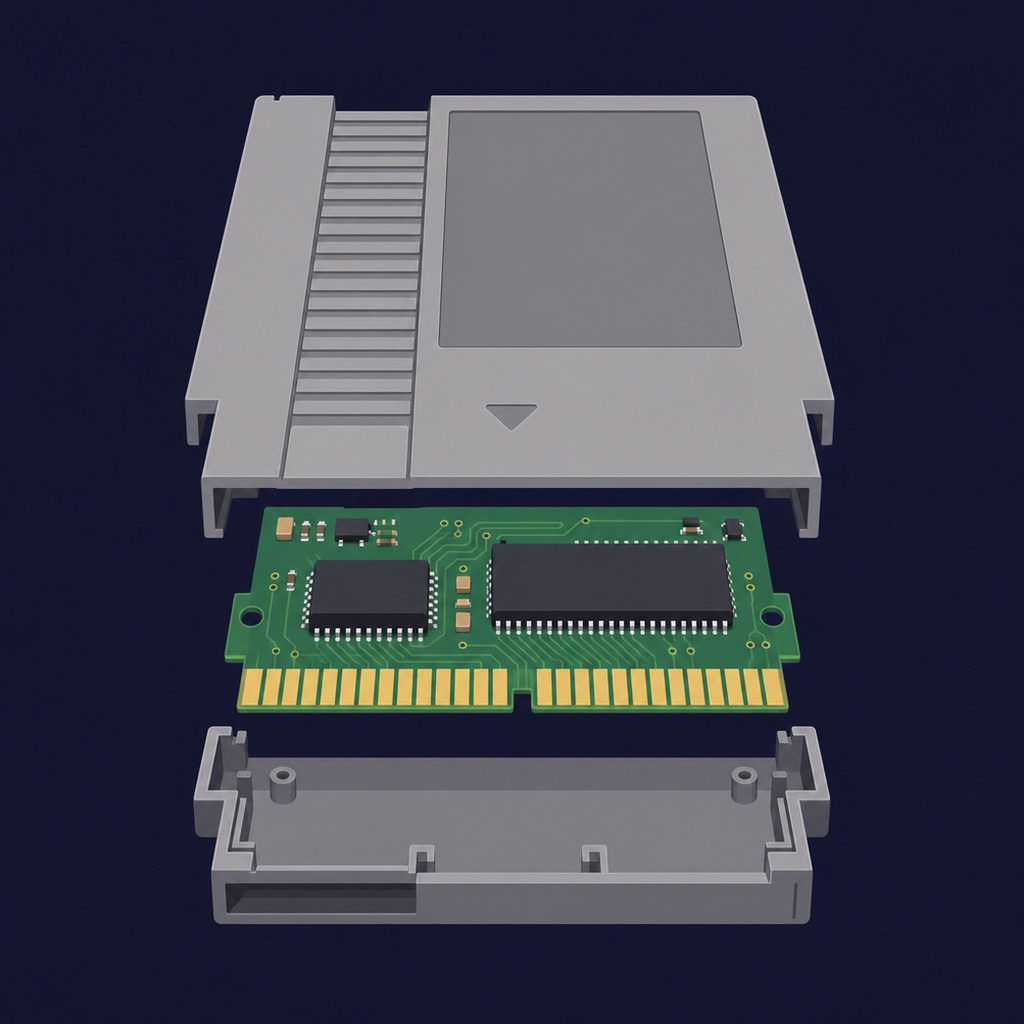
A video game cartridge is a removable plastic shell housing a circuit board with one or more memory chips that store a game’s code and data. The console reads that code directly, so cartridges load almost instantly and have no moving parts to wear out. They dominated home consoles from the late 1970s through the mid-1990s, lost ground to cheaper, higher-capacity optical discs, and returned as the primary format for the Nintendo Switch in 2017 thanks to flash memory that finally made small, durable, high-capacity carts practical again.
The cartridge is one of the most influential ideas in the history of video games. Before it existed, a console could only ever play the handful of games soldered into its circuitry. The arrival of a removable module carrying its own memory chip turned a single piece of hardware into an open-ended platform that could run an unlimited library of separately sold software. That shift created the modern games industry, and the format’s rise, decline, and unexpected comeback trace the same economic forces that have shaped every generation of gaming hardware.
What Is a Game Cartridge?
A game cartridge is a self-contained storage module that plugs into a console’s edge connector. Inside the plastic housing sits a small printed circuit board (PCB) with gold-plated contacts along one edge. When inserted, those contacts meet pins inside the console, connecting the cartridge’s chips directly to the system’s address and data buses. The most important chip is the ROM (read-only memory), which permanently holds the game’s program code, graphics, music, and other assets.
Because the console reads instructions straight from the ROM as if it were an extension of the system’s own memory, there is no need to copy data into the console first. This is the defining advantage of the format and the reason cartridge games start almost instantly. A more detailed look at the chips, circuitry, and save hardware is covered in how game cartridges work.
From Hardwired Logic to Removable Software
The earliest home consoles had no removable media. The Magnavox Odyssey (1972) and the wave of dedicated Pong machines that followed contained their games in fixed circuitry, so the console could only ever do what it shipped with. The breakthrough came with the Fairchild Channel F in 1976, which introduced the ROM cartridge and let owners buy new games as separate plug-in modules.
The Atari 2600 (1977) turned that concept into an industry. By selling hardware cheaply and profiting from a growing catalog of cartridge games, Atari established the platform business model that every console maker has used since. The cartridge made software a product in its own right, and the library, rather than the box, became the reason to own a system. This evolution is set in its wider context in the broader history of game media and the console generations guide.
Why Cartridges Won the Early Console Era
For nearly two decades the cartridge was the obvious choice for home consoles, and its strengths still matter to collectors and engineers today.
- Near-instant loading. The console reads code directly from the ROM, so there are no load screens between the cartridge and the processor.
- Durability. With no moving parts and no exposed reflective surface, a cartridge survives drops, dust, and decades of storage far better than an optical disc.
- Expandable hardware. Because a cartridge is a circuit board, it can carry extra chips that boost the host console. The Super Nintendo used enhancement chips such as the Super FX (which rendered the 3D polygons in Star Fox) and the SA-1 co-processor inside certain cartridges.
- On-board saving. Cartridges could include battery-backed memory to store progress, the technology behind every save file in games like The Legend of Zelda.
How Big Could Cartridges Get?
Storage was always the format’s tightest constraint, and capacity grew slowly across the generations. Early NES games occupied as little as a few kilobytes, while later titles used mapper chips to address much more. SNES cartridges typically topped out around 6 MB. The Nintendo 64 pushed the format about as far as it would go: its Game Paks ranged from 4 MB up to a maximum of 64 MB, reached by late titles such as Resident Evil 2 (1998) and Conker’s Bad Fur Day (2001).
| Format | Typical / maximum ROM capacity |
|---|---|
| NES cartridge | 8 KB to about 1 MB |
| SNES cartridge | up to about 6 MB |
| Nintendo 64 Game Pak | 4 MB to 64 MB |
| CD-ROM (for comparison) | about 650 to 700 MB |
| Nintendo Switch game card | 1 GB to 32 GB |
Those numbers explain why the format eventually fell behind: even the largest N64 cartridge held roughly a tenth of a single CD-ROM, and at far higher manufacturing cost.
Why the Industry Switched to Discs
The economics turned decisively against cartridges in the mid-1990s. ROM chips, circuit boards, and plastic shells were expensive to produce, while a pressed CD cost a fraction as much and held more than a hundred times the data. Contemporary reporting in 1996 put the gap starkly: a Nintendo 64 cartridge cost on the order of tens of dollars to manufacture, against roughly a dollar for a PlayStation CD. That difference fed directly into higher retail prices and tighter game budgets.
The most famous casualty was Final Fantasy VII (1997). Square, a long-time Nintendo partner, moved the project to the Sony PlayStation because a CD could hold its lavish cinematics and three-disc scope at a viable price. Series creator Hironobu Sakaguchi later said a cartridge release would have driven the retail price well beyond what players would accept. The defection symbolized a wider exodus of third-party publishers toward optical media. The Nintendo 64 became the last major cartridge-based home console of its era, and its successor, the GameCube, used a proprietary 8 cm optical disc instead. The full trade-off is explored in cartridges vs discs.
Cartridge Formats Varied by Console
Though the principle was always the same, the physical format differed sharply from system to system, and those differences shaped what each console could do. The standardization that players take for granted today did not exist; each manufacturer designed its own shell, connector, and chip arrangement.
- Atari 2600. The format that built the home market used a simple ROM board in a chunky shell, with early games measured in single-digit kilobytes.
- NES and SNES. Nintendo’s cartridges relied heavily on mapper chips to address ever-larger ROMs, and SNES carts could carry full co-processors that upgraded the console itself.
- Sega Master System. Alongside standard cartridges, the Sega Master System briefly supported the Sega Card (My Card in Japan), a thin credit-card-style ROM that was cheaper but far smaller in capacity, holding only a few kilobytes to about 32 KB. Sega published only a handful of card titles before returning entirely to cartridges.
- GCE Vectrex. The Vectrex, a unique console with its own built-in vector monitor, used compact cartridges to swap the vector games on its integrated screen.
- Nintendo 64. Its Game Pak pushed the home cartridge to its practical ceiling at 64 MB and, depending on the title, saved progress to EEPROM, battery-backed SRAM, or flash, plus an optional removable Controller Pak memory card.
These divergent formats are part of why the cartridge era produced such distinct hardware identities across the console generations, and why a modern collection requires the right shell, slot, and tooling for each system.
Cartridges Never Left Handhelds
While home consoles moved to discs, portable systems kept using cartridges and card-based media throughout the disc era. The reasons were physical: optical drives are bulky, power-hungry, and vulnerable to skipping when jostled, none of which suits a device meant to be played on a bus or a couch. The Game Boy, Game Boy Advance, Nintendo DS, 3DS, and Sony’s PS Vita all relied on solid-state cards. That unbroken handheld lineage, traced in the history of handheld consoles, kept the format alive and pointed toward its eventual return to the living room.
The Switch and the Return of the Cartridge
The Nintendo Switch (March 2017) brought cartridges back to a home console for the first time since the Nintendo 64, because the Switch is also a portable and inherits the handheld logic above. Its game cards use modern flash memory rather than the mask ROM of older carts, which is what makes them viable: a fingernail-sized card can hold up to 32 GB (and 64 GB on the Switch 2 standard card), capacities that were unimaginable for the chips of the 1990s.
One widely noted detail is that Switch cards are coated in denatonium benzoate, an intensely bitter but non-toxic compound, to discourage small children from putting them in their mouths. The bitter taste has nothing to do with the data and everything to do with the cards being small enough to swallow. The comeback is less a reversal of the disc era than a recognition that a hybrid handheld needs solid-state media, the same conclusion handhelds reached decades earlier.
The Hidden Time Bomb: Dying Save Batteries
Many cartridges that store progress do so in SRAM (static RAM), a fast but volatile memory that forgets everything the moment it loses power. To keep saves alive while the cartridge sits on a shelf, those carts include a small lithium coin cell, usually a CR2032, soldered to the board. These batteries last a long time, often two to three decades, but they are not eternal. As the original SNES and Nintendo 64 libraries age, more of these cells are reaching the end of their life, and when one dies the save file vanishes the next time the cartridge is unplugged.
The good news is that the battery, not the game, is what fails, and it can be replaced with a fresh CR2032 (ideally one with solder tabs). The catch is that swapping the cell does not recover a save that is already gone, and replacing it without losing the existing save requires keeping the memory powered during the operation. The full procedure and the reasons saves disappear are covered in detail in the guide to old game save batteries and how to replace them.
Collecting and Preserving Cartridge Games
The same durability that made cartridges appealing in the 1980s makes them prized by collectors now. A clean cartridge can be tested in seconds, displays well on a shelf, and rarely suffers the disc rot or laser-drive failure that plagues optical formats. Sealed and graded cartridge games for early consoles have sold for life-changing sums at auction, and even loose carts for popular systems hold value because the cartridge itself is so survivable.
Preservation-minded owners keep contacts clean (isopropyl alcohol on a cotton swab, never a pencil eraser, which leaves grit and abrasion), store carts upright away from heat and humidity, and replace failing save batteries before data is lost. Because a ROM chip is non-volatile, a well-kept cartridge can remain playable far longer than the console it was made for, which is precisely why the format remains central to how the early decades of gaming are studied and remembered.
Frequently Asked Questions
What is a video game cartridge?
A video game cartridge is a removable plastic module containing a circuit board with one or more memory chips. The main chip is a ROM that permanently stores the game's code and data. When the cartridge is plugged into a console, the system reads that code directly, which is why cartridge games load almost instantly and have no discs to scratch.
Why did game consoles stop using cartridges?
Cost and capacity. By the mid-1990s a pressed CD held over a hundred times the data of the largest cartridge and cost a fraction as much to manufacture. That gap pushed publishers toward optical discs; Final Fantasy VII famously moved to the disc-based PlayStation, and the Nintendo 64 became the last major cartridge home console of its era.
Why did the Nintendo Switch go back to cartridges?
The Switch is a hybrid handheld, and portable systems have always favored solid-state media because optical drives are bulky, power-hungry, and prone to skipping. Modern flash memory now lets a fingernail-sized Switch card hold up to 32 GB, making cartridges practical again for a device meant to be carried around.
How much data can a game cartridge hold?
It varies enormously by era. Early NES games held a few kilobytes to about 1 MB, SNES carts up to roughly 6 MB, and Nintendo 64 Game Paks from 4 MB up to a maximum of 64 MB. Modern Nintendo Switch flash cards range from 1 GB to 32 GB, far beyond what older ROM chips could store.
Why do Nintendo Switch cartridges taste bitter?
Switch game cards are coated with denatonium benzoate, an extremely bitter but non-toxic compound, to discourage young children from swallowing the small cards. The bitter taste is a safety measure and has no effect on the data stored on the card.
Do old cartridges lose their saved games?
Some do. Cartridges that save progress in volatile SRAM rely on a small lithium coin-cell battery to retain data while unplugged. Those batteries typically last two to three decades; when one dies, the save file is lost the next time the cartridge loses power. The battery can be replaced, though that does not recover a save that is already gone.