
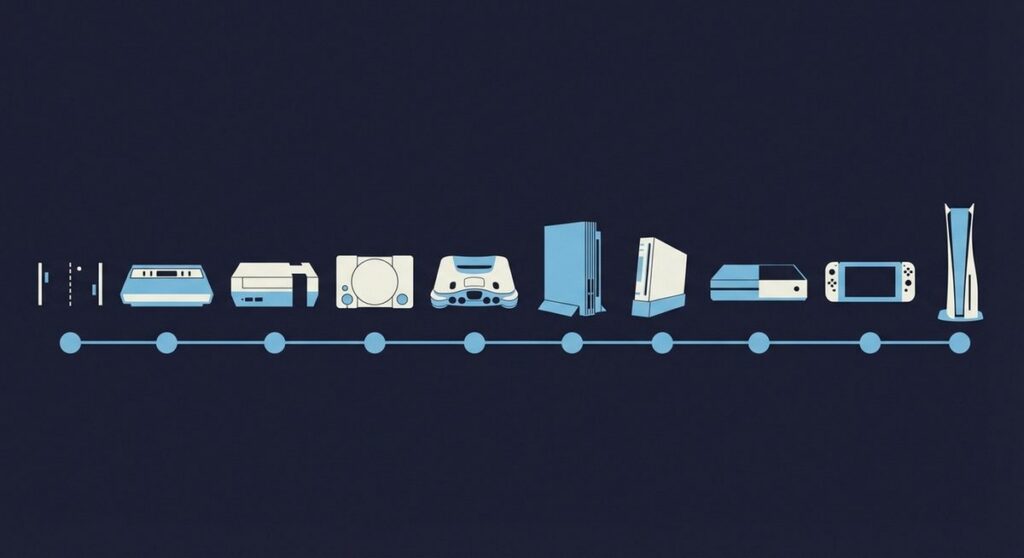
The history of video game consoles spans over five decades, from a brown box with plastic overlays taped to a television screen to machines capable of photorealistic rendering at 120 frames per second. It is a story of engineering ambition, corporate warfare, spectacular failures, and cultural shifts that transformed interactive entertainment from a novelty into a $180+ billion global industry. Every generation built on the last, and understanding that progression reveals how we got to where gaming stands today.
The Birth of Home Gaming (1970s)
The home console story begins with Ralph Baer, a German-American engineer at Sanders Associates who prototyped an interactive television device he called the “Brown Box” in the late 1960s. Licensed to Magnavox, it became the Magnavox Odyssey, released in 1972 as the first commercial home video game console. The Odyssey was primitive — it displayed simple white dots and lines on screen, with plastic overlays placed on the TV to provide “graphics.” There were no scores, no sound, and gameplay was rudimentary. It sold approximately 350,000 units, enough to prove the concept but not enough to create a mass market.
That mass market arrived courtesy of Atari. Founded by Nolan Bushnell in 1972, Atari released Pong as an arcade game that same year, then brought it home as a dedicated console in 1975. Pong machines and their imitators flooded the market, creating the first wave of home gaming. But it was Atari’s Video Computer System (VCS/2600), launched in 1977 at $199, that transformed the industry. The 2600 used interchangeable ROM cartridges, allowing a single console to play an expanding library of games. By 1980, the 2600 had become a cultural phenomenon, with hits like Space Invaders, Pac-Man, and Pitfall! driving sales past 30 million units.
The Fairchild Channel F (1976) actually beat the 2600 to market as the first cartridge-based console, but Atari’s marketing muscle and game library overwhelmed it. Other 1970s competitors — the Bally Astrocade, Magnavox Odyssey 2, and Mattel Intellivision — carved out niches but couldn’t challenge Atari’s dominance.
The Golden Age and the Crash (Early 1980s)
The early 1980s were a gold rush. The success of the 2600 attracted dozens of companies into the market — both console manufacturers and game publishers. ColecoVision (1982) offered near-arcade-quality graphics. GCE Vectrex (1982) shipped with its own built-in vector monitor. Atari 5200 (1982) was Atari’s premium successor. Third-party publishers like Activision (the first independent game developer, founded by former Atari programmers) and countless imitators flooded stores with software.
Then it all collapsed. The video game crash of 1983 was caused by a perfect storm: market oversaturation with low-quality games, consumer confusion from too many competing platforms, and the growing availability of home computers (Commodore 64, Apple II) as alternatives. The industry’s revenues plummeted from $3.2 billion in 1983 to approximately $100 million by 1985. Retailers slashed prices and refused to stock new game products. Atari buried millions of unsold E.T. cartridges in a New Mexico landfill — a story so absurd it became urban legend until the dump site was excavated in 2014.
Nintendo Resurrects the Industry (Mid-1980s)
The recovery came from Japan. Nintendo had released the Famicom in Japan in July 1983, where the crash was less severe. By 1985, the Famicom was dominant in Japan, and Nintendo turned its attention to the devastated North American market. The console was redesigned, rebranded as the Nintendo Entertainment System (NES), and launched with strict quality controls that prevented the flood of terrible software that had sunk Atari.
The NES didn’t just revive the market — it reshaped it. Nintendo’s Seal of Quality program, mandatory licensing agreements, and control over cartridge manufacturing established the platform-holder business model that persists today. Games like Super Mario Bros., The Legend of Zelda, and Metroid didn’t just sell consoles; they created franchises that remain relevant four decades later. The NES sold 61.91 million units and made Nintendo synonymous with video games for a generation.
Sega entered the home market with the Master System (1986), which competed directly with the NES. While it couldn’t break Nintendo’s grip in North America or Japan, the Master System found enormous success in Europe, Brazil, and other markets, establishing Sega as a viable competitor and setting the stage for the 16-bit era.
The 16-Bit Console Wars (Late 1980s – Early 1990s)
The rivalry between the Sega Genesis/Mega Drive (1988) and the Super Nintendo/Super Famicom (1990) produced gaming’s most famous corporate battle. Sega struck first, launching the Genesis with arcade-quality hardware and the combative slogan “Genesis does what Nintendon’t.” Under CEO Tom Kalinske, Sega of America targeted older gamers, positioned the Genesis as the cool alternative, and created Sonic the Hedgehog as a direct rival to Mario.
Nintendo countered with the SNES’s superior color palette, Mode 7 scaling effects, and the Sony SPC700 sound chip that delivered richer audio. The SNES became the definitive platform for RPGs (Chrono Trigger, Final Fantasy VI), while the Genesis excelled at sports games and action titles. Both consoles benefited from the competition — it drove innovation, expanded the market, and created a level of consumer engagement that the industry hadn’t seen before. The SNES ultimately outsold the Genesis globally (49.10 million vs. 30.75 million), though Sega held the North American lead for several critical years.
The 16-bit era also saw NEC’s TurboGrafx-16 (1989) and SNK’s Neo Geo AES (1990) compete for market share. The TurboGrafx-16 found a passionate niche audience, while the Neo Geo’s arcade-perfect gaming came at a prohibitive price ($649 at launch) that limited it to dedicated enthusiasts.
The 3D Revolution (Mid-1990s)
The mid-1990s brought the most dramatic technological leap in console history: the transition from 2D sprites to 3D polygons. Three consoles defined this era, and the outcome reshuffled the industry’s power structure permanently.
The Sony PlayStation (1994 in Japan, 1995 in NA) was the newcomer that changed everything. Born from a failed CD-ROM partnership between Sony and Nintendo, the PlayStation offered powerful 3D hardware, CD-ROM storage (enabling cinematic games with full soundtracks and FMV cutscenes), and a developer-friendly architecture. Sony courted third parties aggressively, offering better royalty terms than Nintendo. The result was an avalanche of exclusive content, including Final Fantasy VII — which moved from Nintendo to PlayStation and became one of the most important game releases in history. The PlayStation sold 102 million units and established Sony as the industry leader.
The Sega Saturn (1994) was technically impressive but notoriously difficult to develop for, with a complex dual-CPU architecture that frustrated programmers. Its surprise early launch in North America — announced at E3 1995 with consoles already in stores — backfired, angering retailers and leaving the system without a sufficient game library. The Saturn thrived in Japan (particularly for 2D fighting and shooting games) but failed commercially in the West, selling approximately 9.26 million units globally.
The Nintendo 64 (1996) arrived last, powered by impressive 64-bit hardware but hobbled by its commitment to cartridges in a CD-ROM world. The N64 produced some of the era’s most acclaimed games — Super Mario 64, Ocarina of Time, GoldenEye 007 — and pioneered four-player local multiplayer and analog stick controls. But limited third-party support and a smaller library (387 games vs. PlayStation’s 2,400+) left it in second place with 32.93 million units sold.
The Sixth Generation and Beyond (2000s)
The Sega Dreamcast (1998/1999) launched the sixth generation with innovative features — built-in modem for online play, a VMU memory card with its own screen, and impressive graphics. Despite critical acclaim and strong early sales, the Dreamcast couldn’t overcome Sega’s damaged brand reputation and the overwhelming anticipation for the PlayStation 2. Sega discontinued the Dreamcast in 2001 and exited the hardware business entirely, becoming a third-party publisher.
The PlayStation 2 (2000) became the best-selling console in history at 155 million units. Its DVD playback, backward compatibility with PS1 games, and staggering library of 4,489 titles made it the default entertainment device of the 2000s. The Nintendo GameCube (2001) delivered excellent first-party games but finished third in sales. Microsoft’s Xbox (2001) entered the market with a PC-derived architecture and Xbox Live, which laid the foundation for modern online console gaming.
The seventh generation brought further disruption. The Nintendo Wii (2006) used motion controls to attract non-gamers and sold 101.63 million units, outselling both the PlayStation 3 and Xbox 360. Microsoft’s Xbox 360 (2005) established Xbox Live as the premier online service and pioneered achievements. Sony’s PS3 (2006) launched at a controversial $599 and struggled early but recovered through strong exclusives and the adoption of Blu-ray.
Motion Controls, HD, and the Modern Era (2010s – Present)
The eighth generation saw Nintendo stumble with the Wii U (2012), whose confusing branding and tablet controller failed to resonate — it sold only 13.56 million units. Sony’s PlayStation 4 (2013) dominated the generation with 117 million units, benefiting from a gamer-friendly launch strategy and strong third-party support. Microsoft’s Xbox One (2013) suffered from a disastrous reveal focused on TV integration and always-online requirements (later reversed) but recovered through the Game Pass subscription service.
Nintendo’s Switch (2017) — a home console/portable hybrid — was the generation’s surprise megahit, selling over 140 million units and proving that innovation in form factor could still drive massive commercial success. The ninth generation, launched in 2020 with the PlayStation 5 and Xbox Series X|S, continues the push toward higher fidelity, faster loading (via SSD storage), and subscription services (PlayStation Plus, Game Pass) that are reshaping how games are distributed and consumed.
What Defines a Video Game Console?
At its core, a video game console is a dedicated computing device designed primarily for playing video games, connected to an external display. This distinguishes it from personal computers (general-purpose), arcade machines (commercial, coin-operated), and handheld/portable gaming devices (integrated displays). The line has blurred considerably — modern consoles stream media, browse the web, and run apps — but the gaming-first design philosophy and closed hardware ecosystem remain the defining characteristics. From the Magnavox Odyssey’s plastic overlays to the PlayStation 5’s ray-traced visuals, the core promise has remained constant: plug in, pick up a controller, and play.