
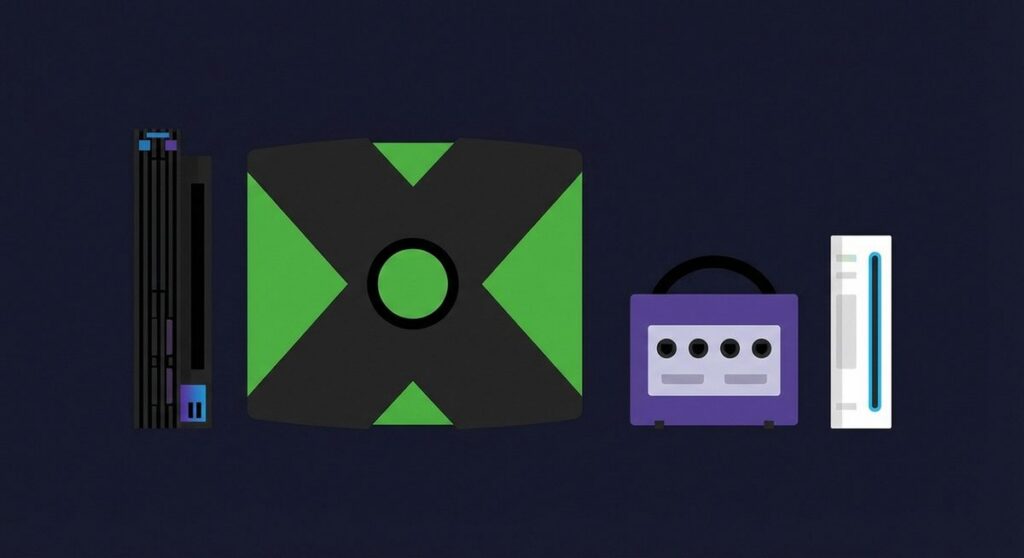
The 2000s were the decade gaming went mainstream. The industry entered the millennium as entertainment for enthusiasts and exited as a cultural force rivaling film and music. Two full console generations launched within ten years. The best-selling console of all time dominated the first half. A software giant from Redmond entered the hardware business. And a motion-controlled console from Nintendo proved that the biggest market was the one nobody was targeting. The sheer volume of hardware released between 2000 and 2009 makes this the densest decade in console history.
2000-2001: The Sixth Generation Takes Shape
The PlayStation 2 launched in Japan on March 4, 2000 and immediately became the most sought-after piece of consumer electronics on the planet. Sony shipped 980,000 units against pre-orders exceeding one million. The chaos at launch was unprecedented — scalpers resold units at double or triple the ¥39,800 retail price.
The PS2’s secret weapon wasn’t its Emotion Engine CPU or Graphics Synthesizer GPU — it was its DVD player. In 2000, standalone DVD players still cost $300-500. The PS2 played DVDs, played the entire PS1 library through backward compatibility, and played games, all for $299 USD. For millions of households, the PS2 was the most cost-effective way to enter the DVD era. The gaming was almost a bonus. By the time the PS2 was discontinued in 2013, it had sold 155 million units — a record that still stands.
The Nintendo GameCube arrived on September 14, 2001 in Japan and November 18, 2001 in North America at $199. Its compact, colorful design with a carry handle was distinctly Nintendo — playful where the PS2 was sleek. The proprietary miniDVD format (1.5 GB capacity) prevented DVD movie playback, a decision that cost Nintendo casual buyers. The GameCube finished third in its generation with 21.74 million units, but its first-party library — Super Smash Bros. Melee, Metroid Prime, Wind Waker, Resident Evil 4 — earned a devoted following that has only grown with time.
Microsoft entered the console market on November 15, 2001 with the Xbox. Built on PC-derived hardware (a custom Intel Celeron CPU and Nvidia NV2A GPU), the Xbox was the most powerful console of its generation. Its built-in hard drive eliminated memory cards and enabled game installs and downloadable content. But the Xbox’s true legacy was Xbox Live, launched in November 2002 — the first successful paid online service for consoles, with features like friends lists, voice chat, and matchmaking that defined online console gaming. Halo: Combat Evolved was the launch title that justified the hardware, selling over 6.4 million copies and establishing the Xbox brand identity. The original Xbox sold 24 million units.
The Dreamcast’s Final Days
The Sega Dreamcast, launched in late 1998/1999, was technically a sixth-generation console competing in this era. Despite critical acclaim and innovative features (built-in modem, VMU memory card, exceptional game library), the Dreamcast couldn’t overcome the PS2’s hype and Sega’s damaged reputation. Sega announced the Dreamcast’s discontinuation on January 31, 2001 and exited hardware manufacturing, becoming a third-party publisher. The Dreamcast sold 9.13 million units — a modest number for hardware of its quality.
2001-2004: Niche Hardware and Experiments
The early 2000s produced several interesting niche consoles:
The Panasonic Q (December 2001), a Japan-exclusive GameCube/DVD player hybrid manufactured by Matsushita under Nintendo license, combined full GameCube compatibility with DVD/CD playback in a premium brushed-metal enclosure for approximately $439. It was discontinued in 2003 and is now one of the most collectible console variants.
The NUON (2000) was a technology platform integrated into select Samsung and Toshiba DVD players, allowing them to play a small library of games. Only 8 games were released. It’s one of the most obscure gaming platforms ever commercially available.
The Nintendo iQue Player (2003) was a China-exclusive plug-and-play console that played N64 games downloaded to a built-in flash memory card. Designed to combat piracy and comply with Chinese regulations that banned traditional game consoles at the time, the iQue Player was an innovative distribution model ahead of its era.
The Infinium Labs Phantom was announced in 2003 as a PC-based console with game-on-demand streaming — essentially anticipating cloud gaming by a decade. It never launched. After years of delays, SEC investigations, and controversy, the Phantom became one of gaming’s most famous vaporware products.
The Sony PSX (DVR) (December 2003) was a Japan-only PS2/digital video recorder hybrid with a built-in hard drive, TV tuner, and the XrossMediaBar interface that Sony would later use on the PS3 and PSP. At approximately $700, it was too expensive for mass adoption.
2005-2006: The Seventh Generation Arrives
The seventh generation was defined by three companies pursuing three radically different strategies.
Microsoft struck first with the Xbox 360 on November 22, 2005, a full year ahead of competitors. The strategy was deliberate: build an installed base and game library before Sony and Nintendo could respond. The 360’s IBM Xenon triple-core CPU at 3.2 GHz and ATI Xenos GPU delivered genuine HD gaming. Xbox Live evolved into the gold standard for online console services, introducing the Achievement/Gamerscore system that became industry-standard and Xbox Live Arcade that legitimized digital distribution for indie games.
The 360’s greatest crisis was the Red Ring of Death (RROD) — a hardware failure rate estimated between 23-54% caused by GPU solder joint failures. Microsoft took a $1.15 billion charge to extend warranties and repair affected units. The decision preserved consumer trust and allowed the 360 to recover. The console ultimately sold 84 million units.
The Sony PlayStation 3 launched on November 11, 2006 in Japan and November 17 in North America. Its Cell Broadband Engine processor — a collaboration between Sony, Toshiba, and IBM — was architecturally ambitious but notoriously difficult to develop for. The PS3’s most controversial decision was its $499/$599 launch price, partially driven by the inclusion of a Blu-ray disc drive at a time when standalone Blu-ray players cost $1,000+. Sony bet on Blu-ray winning the format war against HD DVD (it did), but the high price crippled early adoption. The PS3 recovered through strong first-party exclusives (Uncharted, The Last of Us, God of War III, LittleBigPlanet) and eventually sold 87.4 million units.
The Nintendo Wii launched on November 19, 2006 at $249 and upended every assumption about what a console should be. Its Wii Remote motion controller made games physically intuitive — swing to swing, point to aim. The bundled Wii Sports became a global phenomenon, selling 82.9 million copies. The Wii attracted demographics that had never touched a game controller: seniors in retirement homes, families at holiday gatherings, fitness enthusiasts using Wii Fit. It was technically underpowered (essentially an overclocked GameCube with no HD output) and flooded with low-quality third-party shovelware, but none of that mattered. The Wii sold 101.63 million units, outselling both competitors.
2007-2009: Late Entries and Oddities
The late 2000s saw a few more notable console releases:
The Tectoy Zeebo (June 2009) was a Brazilian digital-distribution-only console running on a Qualcomm BREW platform with 3G connectivity. Targeted at emerging markets where piracy made traditional disc-based consoles unviable, it launched at approximately $249 with 73 downloadable games. It was discontinued in 2011.
The Envizions EVO Smart Console (2009) was an Android-based gaming console that attempted to bridge mobile and TV gaming years before the Ouya made the same attempt (and failed). The EVO found minimal market traction.
Microsoft’s Kinect (November 2010, technically early next decade but developed and announced in 2009 as “Project Natal”) brought controller-free gaming to the Xbox 360 using depth cameras and skeletal tracking. It sold 35 million units and held a Guinness record as the fastest-selling consumer electronics device, though its game library was widely considered shallow.
Complete List of Major 2000s Home Consoles
- 2000 — Sony PlayStation 2, NUON Technology
- 2001 — Nintendo GameCube, Microsoft Xbox, Panasonic Q (JP), Sega Dreamcast discontinued
- 2003 — Nintendo iQue (China), Sony PSX DVR (JP), Infinium Labs Phantom (announced, never shipped)
- 2005 — Microsoft Xbox 360
- 2006 — Sony PlayStation 3, Nintendo Wii
- 2009 — Tectoy Zeebo (Brazil), Envizions EVO Smart Console
Legacy
The 2000s established the modern console landscape. Three platform holders — Sony, Microsoft, and Nintendo — solidified their positions as the industry’s pillars. Sega’s departure from hardware marked the end of an era, while Microsoft’s arrival brought the resources and infrastructure of the world’s largest software company. Online gaming transitioned from novelty to expectation. Digital distribution moved from experiment to standard practice. Motion controls proved that innovation in input could be as important as innovation in processing power.
The decade also produced extremes that defined the industry’s boundaries: the PS2’s 155 million units set the all-time sales record. The Wii proved that targeting non-gamers could be as profitable as targeting core gamers. The Xbox 360’s RROD demonstrated the cost of rushing hardware to market. And the PS3’s $599 launch price showed the limits of consumer tolerance, even for a premium brand. Every lesson from the 2000s continues to shape console strategy today.