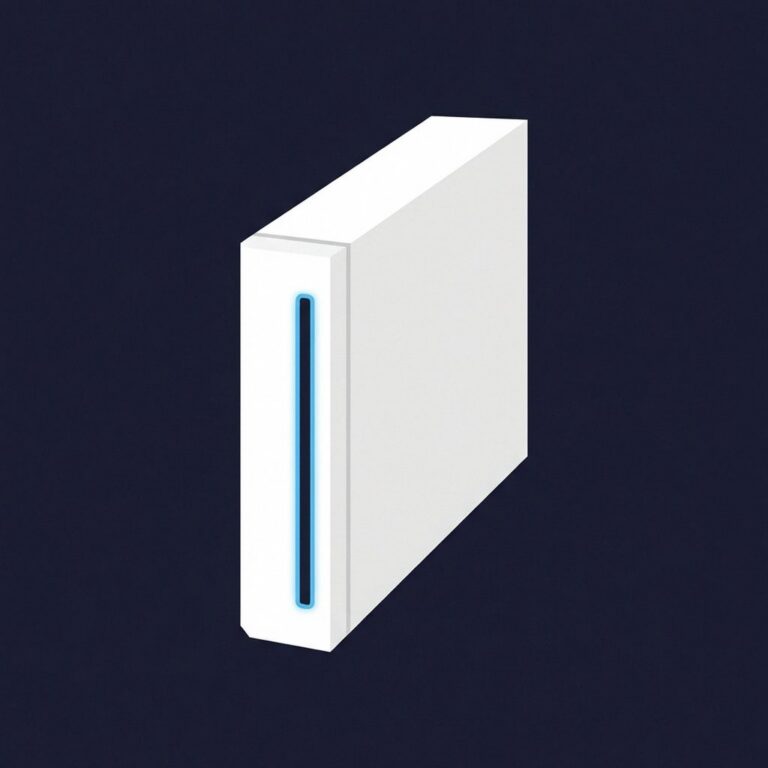
The Nintendo Wii launched first in North America on November 19, 2006, then Japan on December 2, 2006, Australia on December 7, 2006, and Europe on December 8, 2006. It was Nintendo’s seventh-generation home console and sold over 101 million units.
The Nintendo Wii broke every rule the gaming industry thought it understood. While Sony and Microsoft fought over polygon counts and processing power, Nintendo released a console with last-generation graphics, a TV remote-shaped controller, and a name that made people giggle. It then outsold both the PlayStation 3 and Xbox 360, moving 101.63 million units worldwide and bringing video games to demographics — seniors in nursing homes, families at holiday gatherings, fitness enthusiasts — that had never touched a controller before.
History & Development
The Wii’s origins lie in the GameCube’s commercial struggles. Nintendo president Satoru Iwata and legendary designer Shigeru Miyamoto recognized that competing on raw hardware power was a losing strategy against Sony and Microsoft’s deeper pockets. Instead, they pursued what Iwata called a “blue ocean strategy” — creating new demand rather than fighting over existing gamers. The console, codenamed “Revolution”, would focus on a new way to interact with games.
The key innovation was the Wii Remote (Wiimote), a wireless controller incorporating an accelerometer and infrared sensor that detected motion and pointing. The concept was deceptively simple: swing the controller like a tennis racket, and your character swings a tennis racket. Point it at the screen to aim. Tilt it to steer. The barrier to entry dropped to nearly zero — anyone who could wave their arm could play a Wii game.
The console launched on November 19, 2006 in North America at $249 USD — a full $150-350 less than the PS3’s launch configurations. It was bundled with Wii Sports, a collection of five simple motion-controlled sports games that became the console’s killer app and, at 82.9 million copies, one of the best-selling games in history. The Wii was nearly impossible to find at retail for over a year after launch, with demand consistently outstripping supply through 2007 and into 2008.
The cultural impact was immediate and unprecedented. News broadcasts showed retirement homes hosting Wii bowling tournaments. Physical therapists adopted Wii Sports and later Wii Fit (with its Balance Board peripheral) as rehabilitation tools. The console appeared in television shows, movies, and became shorthand for accessible gaming. Nintendo’s stock price more than tripled between 2006 and 2008.
Hardware & Technical Specifications
The Wii’s internal hardware was essentially an overclocked GameCube — a fact that drew criticism from core gamers but enabled backward compatibility, low manufacturing costs, and a compact form factor. The IBM Broadway CPU was a PowerPC chip running at 729 MHz (versus the GameCube’s Gekko at 485 MHz). The ATI Hollywood GPU was an evolution of the GameCube’s Flipper chip. Total system memory was 88 MB (24 MB of fast 1T-SRAM plus 64 MB of GDDR3), roughly quadrupling the GameCube’s available RAM.
The most significant limitation was video output: 480p maximum, with no high-definition output of any kind. In 2006, when HDTVs were rapidly becoming standard and the PS3 and Xbox 360 supported up to 1080p, the Wii’s SD-only output was a deliberate trade-off. Nintendo bet that casual gamers cared more about how games felt to play than how many pixels were on screen. They were right — for a while.
The Wii Remote itself was the real hardware star. It communicated with the console via Bluetooth and used a sensor bar (actually just two clusters of infrared LEDs placed above or below the TV) for pointing accuracy. The Nunchuk attachment added an analog stick and additional accelerometer for games requiring more complex input. In 2009, Nintendo released Wii MotionPlus, an adapter (later built into the Wii Remote Plus) that added a gyroscope for significantly improved motion detection accuracy. Wii Sports Resort, the sequel to Wii Sports, was designed around MotionPlus and demonstrated the improved precision convincingly.
The console featured 512 MB of internal flash memory (expandable via SD card), two USB ports, built-in Wi-Fi, and full backward compatibility with GameCube discs, controllers, and memory cards (via ports hidden under a flip-top panel on the top of the unit).
Game Library & Legacy
The Wii’s library of 1,637 games is sharply divided between exceptional first-party titles, a handful of strong third-party exclusives, and a massive volume of shovelware that remains one of the platform’s lasting criticisms.
Nintendo’s own output was, as usual, outstanding. Super Mario Galaxy (2007) and its sequel are among the highest-rated games of all time, using gravity-based platforming and orchestral soundtracks to create something genuinely magical. The Legend of Zelda: Twilight Princess (a cross-generation launch title from GameCube) and Skyward Sword (a MotionPlus showcase) bookended the console’s life. Metroid Prime 3: Corruption proved that pointer-based FPS controls could feel natural and precise. Super Smash Bros. Brawl sold 13.3 million copies. Mario Kart Wii (with the Wii Wheel peripheral) sold 37.4 million, making it one of the best-selling games ever.
Third-party success stories were rarer but notable. Xenoblade Chronicles (Monolith Soft, published by Nintendo) became a cult RPG phenomenon. No More Heroes (Grasshopper Manufacture) brought Suda51’s irreverent style to the platform. Monster Hunter Tri found a dedicated audience. Rayman Origins and Zack & Wiki were critical darlings that deserved larger audiences.
The Virtual Console service was a significant early digital distribution effort, offering legal downloads of NES, SNES, N64, Sega Genesis, TurboGrafx-16, and other classic games. For many players, the Virtual Console was the first convenient way to access retro libraries, and it drove awareness of gaming history to a mainstream audience.
The Wii Channels — including the Mii creator, weather, news, photo viewer, and internet browser — positioned the console as a living room hub. The Mii avatar system, where users created cartoonish digital representations of themselves, became iconic and was carried forward through the Wii U and 3DS.
How well do you know the Wii?
8 questions, every answer explained. No sign-up.
Models & Variants
The Wii launched exclusively in white and remained white-only for its first two years. A black model arrived in 2009, followed by red (bundled with New Super Mario Bros. Wii and a red DSi in a holiday package) and blue (a limited edition tied to the console’s later years). Special edition bundles included a black Wii with Wii Sports Resort and MotionPlus, and various color/game combinations that varied by region.
In 2011, Nintendo released the Wii Family Edition (RVL-101), a revised model that removed GameCube backward compatibility — both the disc compatibility and the controller/memory card ports were eliminated. The console was positioned horizontally only (the original could stand vertically with an optional stand).
The Wii Mini (RVL-201), released in Canada in late 2012 and other territories in 2013, was a dramatically stripped-down budget model. It removed Wi-Fi, SD card slot, online connectivity, GameCube support, and even component video output (composite only). The red-and-black design was compact, but the removed features made it suitable only for offline disc-based play. Wii Mini units are inexpensive today but limited in functionality.
How Much Is a Wii Worth Today?
As of mid-2026, a working Nintendo Wii with a Wiimote, Nunchuk and cables is worth about $30–60. Boxed consoles rarely clear $100 unless sealed or special-edition. The original RVL-001 model with GameCube ports carries a modest premium over later revisions.
The Wii is one of the most affordable consoles to collect for. Working units with Wiimote, Nunchuk, and cables sell for $30-60 USD. The massive installed base means supply is abundant. Even boxed consoles rarely exceed $100 unless they’re sealed or special editions. The original white RVL-001 model (with GameCube compatibility) is the most desirable from a functionality standpoint.
Most Wii games are extremely affordable at $3-10, making the platform ideal for budget collectors. However, several titles have appreciated significantly. Xenoblade Chronicles (particularly the US release, which was initially a GameStop exclusive) sells for $50-80. Metroid Prime Trilogy (the steelbook Collector’s Edition) commands $60-100+. Dokapon Kingdom, a party RPG with limited print run, reaches $80+. Fire Emblem: Radiant Dawn regularly exceeds $70.
The Wii’s biggest collecting consideration is that online services were discontinued in 2014 (and the Wii Shop Channel closed for purchases in 2019). Virtual Console purchases, online multiplayer, and leaderboards are no longer available through official channels. This means any game relying on online features is permanently diminished. Homebrew solutions exist but are outside the scope of standard collecting. Physically, Wii hardware is reliable, though the disc drive’s slot-loading mechanism can accumulate dust over time, leading to read errors solvable with a lens cleaning disc.
Frequently Asked Questions
How much is a Wii worth today?
As of mid-2026, a working Nintendo Wii with controller and cables is worth about $30-60. Boxed consoles rarely exceed $100 unless sealed or special-edition. The original RVL-001 revision with GameCube compatibility is the most sought-after model.
When did the Wii come out?
November 19, 2006 in North America, December 2, 2006 in Japan, and December 8, 2006 in Europe.
How many Wii consoles were sold?
101.63 million worldwide (as of March 2016) — Nintendo's best-selling home console.
What was the launch price of the Wii?
US $249.99 (€249.99 / ¥25,000 / £179.99), bundled with Wii Sports in most regions.
Is the Wii backward compatible with GameCube?
Yes — the original model plays GameCube discs and uses GameCube controllers and memory cards. The later RVL-101 revision and the Wii Mini removed this support.
What replaced the Wii?
The Wii U, released in November 2012.
When was the Wii discontinued?
The original Wii model was discontinued in October 2013.