
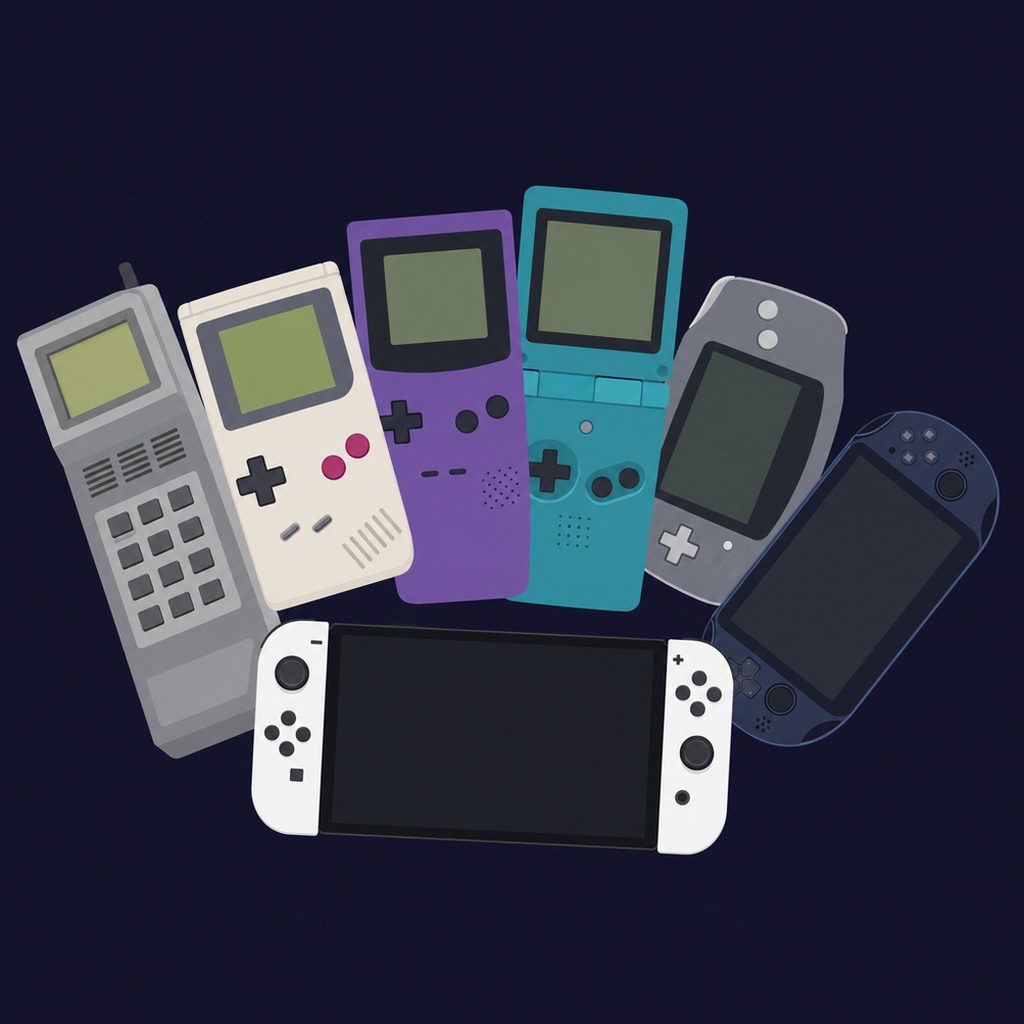
A handheld game console is a self-contained portable gaming device with a built-in screen, controls, and battery, designed to be played in the hand rather than connected to a television. The category runs from Nintendo’s Game & Watch (1980) and the Game Boy (1989) through the record-setting Nintendo DS and on to today’s hybrid and PC-class portables such as the Nintendo Switch and Valve Steam Deck. The best-selling dedicated handheld of all time is the Nintendo DS, at roughly 154 million units.
Portable gaming is almost as old as the home console itself, but for decades it sat in the shadow of the living-room machine. That changed gradually and then completely: the most successful gaming device Nintendo ever made was a handheld, the line between portable and console has dissolved into the hybrid Switch, and a wave of pocketable PC-class machines and cheap emulation devices has made the early 2020s one of the most active periods the category has ever seen. This guide explains what handheld consoles are, the form factors they come in, how the modern landscape breaks down, and how to choose one. For a strict chronological account of every major device, see the companion history of handheld consoles.
What Is a Handheld Game Console?
A handheld console is defined by self-containment. Everything needed to play — display, input controls, processor, storage, and power source — is built into a single unit that fits in the hands. This separates it from a home console, which outputs to an external television and draws power from the wall, and from a smartphone, which is a general-purpose computer that happens to run games. The defining trade has always been the same one: a handheld accepts compromises in raw power, screen size, and battery life in exchange for the freedom to be played anywhere.
Three categories are often confused. A dedicated handheld plays interchangeable software — cartridges, cards, or downloads — and represents the mainstream of the market: Game Boy, DS, PSP. A handheld electronic game plays only a single built-in title, such as the LED Mattel Football (1977) or most Game & Watch units. A plug-and-play or microconsole device blurs the boundary further. In modern usage, “handheld console” almost always means the dedicated category, and increasingly includes hybrids and handheld PCs that can also output to a screen.
Handheld Versus Phone Gaming
Smartphones command vastly more total play time than dedicated handhelds, yet the dedicated category has not disappeared. The reasons recur across the market’s history: physical controls (buttons, D-pads, and analog sticks that a touchscreen cannot replicate), curated libraries built for the hardware, and the absence of the notifications, microtransactions, and battery drain that define phone gaming. The persistence of dedicated portables despite the phone’s dominance is one of the clearest signals that tactile, focused play remains a distinct product.
Handheld Form Factors
Handhelds have settled into a handful of recurring physical shapes, each with characteristic strengths.
- Horizontal slab — the original Game Boy layout, with the screen above and controls flanking it. Durable and simple; revived by modern emulation handhelds and PC portables.
- Clamshell — a folding two-panel design that protects the screen when closed, pioneered at scale by the Game Boy Advance SP and perfected by the Nintendo DS family, whose lower panel housed a touchscreen.
- Widescreen multimedia — the PSP‘s template: a wide 16:9 display centered between controls, optimized for video and console-style 3D games.
- Hybrid tablet — the Switch model, a tablet with detachable controllers that docks to a television, dissolving the home-versus-portable distinction.
- Handheld PC — a large, powerful slab such as the Steam Deck, running a full desktop operating system and a PC game library.
How the Modern Handheld Market Breaks Down
The contemporary portable landscape is best understood as four overlapping segments rather than a single product line.
The Hybrid Console
The Nintendo Switch (2017) is the dominant device of the era and the proof that the handheld and the home console no longer need to be separate products. Played portably on its built-in screen or docked to a television with detachable Joy-Con controllers, it runs the same library either way. Its commercial success — surpassing the lifetime sales of the Nintendo DS in 2025 to become Nintendo’s best-selling platform — confirmed that flexibility outweighs raw power for most buyers. Full coverage lives on the Nintendo Switch page.
The Handheld Gaming PC
Valve’s Steam Deck, released in February 2022, brought the entire PC gaming library to a portable form factor running a Linux-based operating system. It validated a category that had previously existed only as expensive niche hardware, and it triggered a wave of Windows-based competitors: the ASUS ROG Ally (2023, launched at $599) and the Lenovo Legion Go (2023, $799) among them. These devices offer the most power available in a handheld but demand the most in price, weight, battery management, and setup complexity. Independent estimates place Steam Deck lifetime sales in the low single-digit millions — modest beside Nintendo’s numbers, but enough to anchor a fast-growing segment.
The Retro and Emulation Handheld
A parallel boom has produced inexpensive devices built specifically to play older games through emulation. Brands such as Anbernic, Miyoo, Retroid, and Ayn sell ARM-based Linux or Android handhelds, frequently for well under $100, that run software from classic platforms. A separate, premium branch — exemplified by Analogue‘s FPGA-based Pocket — reproduces original hardware at the chip level and plays genuine cartridges rather than emulating them. The retro-handheld surge is examined alongside dedicated classics in the ranked best retro handheld consoles guide.
The Legacy Dedicated Handheld
The traditional dedicated handheld — a self-contained device with its own exclusive library — is no longer being manufactured by the major platform holders, who have either exited the segment (Sony, after the Vita) or folded it into a hybrid (Nintendo, with the Switch). These machines now live on as collectible and second-hand hardware, their value and appeal traced through the retro collecting guide.
The Technologies That Made Handhelds Possible
Every advance in portable gaming has been a balancing act between four constrained resources: display, battery, processing power, and storage. Understanding how each evolved explains why handhelds developed the way they did.
Displays
The screen has always been the defining limitation. Early devices used segmented LED or fixed LCD displays that could only show predetermined shapes, which is why Game & Watch units played a single game each. The original Game Boy’s reflective dot-matrix LCD had no backlight, requiring external light to play — a compromise that bought its famous battery life. Backlighting and color, which arrived early on rivals like the Lynx and Game Gear at a heavy cost to battery, only became standard on Nintendo’s portables with the Game Boy Advance SP. Later devices pushed to bright OLED panels, as on the PlayStation Vita and the Switch OLED, where deep blacks and vivid color finally caught up to home displays.
Batteries and Power
Disposable AA batteries powered the entire early era, and the device that asked least of them usually won. The shift to internal rechargeable lithium-ion packs, standard from the Game Boy Advance SP and PSP onward, removed the constant battery expense but introduced a new long-term concern: aging cells that need replacement decades later, a familiar issue for collectors of vintage hardware. Power remains the hardest constraint of all; modern handheld PCs deliver desktop-class performance but often run for only a couple of hours, the same fundamental trade the Game Boy navigated in 1989.
Storage and Media
Portable software has moved through distinct media. Solid-state cartridges and cards dominated for good reason: they are compact, durable, fast to access, and they survive being carried around. The PSP’s experiment with optical UMD discs proved the format’s fragility in a portable context. The current standard is digital download to internal and removable flash storage, which maximizes convenience at the cost of tying libraries to online accounts. The history of these formats across both portable and home hardware is traced in the dedicated coverage of game media on the site.
Devices That Defined the Category
A handful of machines did more than sell well — they set the template that others followed.
- Game & Watch (1980) proved there was a mass market for portable play and gave gaming the D-pad.
- Game Boy (1989) established that library and battery life beat raw power, a lesson the market relearned for decades.
- Nintendo DS (2004) introduced the touchscreen to mainstream gaming and became the best-selling handheld ever.
- PlayStation Portable (2004) demonstrated genuine console-scale 3D and multimedia in the hand.
- Nintendo Switch (2017) merged handheld and home into one device and one library.
- Steam Deck (2022) made the full PC library portable and launched the modern handheld-PC segment.
A Brief Map of the Eras
Handheld hardware is usually grouped into loose eras that mirror, but do not perfectly align with, home console generations. A full breakdown is available in the handheld console generations guide; the broad shape is as follows.
| Era | Defining devices | Approximate span |
|---|---|---|
| Early portables | Mattel LED games, Game & Watch, Microvision | 1976–1988 |
| The Game Boy line | Game Boy, Game Boy Color, Game Boy Advance | 1989–2003 |
| Dual screen vs. multimedia | Nintendo DS, PlayStation Portable | 2004–2011 |
| The last dedicated handhelds | Nintendo 3DS, PlayStation Vita | 2011–2019 |
| Hybrid and handheld PC | Nintendo Switch, Steam Deck and rivals | 2017–present |
This map sits inside the broader story of console hardware; the relationship between portable and home eras is covered in the general console generations guide.
How to Choose a Handheld in 2026
Because the modern market spans four very different segments, the right device depends almost entirely on what a buyer wants to play.
Match the Device to the Library
The single most useful question is which games the buyer intends to play. Someone who wants current first-party releases and a large family-friendly catalog is served by the Switch. Someone who already owns a large Steam library and wants it portable should look at the Steam Deck or a Windows handheld. Someone whose interest is classic 8-bit through 32-bit games is better served by an inexpensive emulation handheld or genuine retro hardware than by any expensive modern device.
Weigh Power Against Battery and Cost
The recurring lesson of handheld history is that battery life, library, and price matter more than raw specifications. Every era’s most powerful portable — the backlit Atari Lynx, the multimedia PSP, the technically superb PlayStation Vita — lost to a less powerful rival with better games and longer endurance. Handheld PCs reintroduce this tension sharply: they are the most capable devices ever made, but their short battery life and high cost remain the chief reasons a buyer might choose a simpler machine instead.
Consider Ecosystem and Format
Storage and software format shape long-term experience. Cartridge and card formats are durable and collectible; optical formats like the PSP’s UMD proved fragile in the market; digital storefronts offer convenience but tie a library to an account and an active service. Buyers planning to keep a device for years should weigh whether its store and online features are likely to remain supported.
Why Handhelds Endured
For most of gaming’s history, portable devices were treated as the junior partner to the home console. Sales figures tell a different story: the Game Boy line moved roughly 119 million units, the DS family about 154 million, and the hybrid Switch more than any Nintendo platform before it. Portability created its own genres, design philosophies, and legendary libraries, and the modern convergence of phone, handheld PC, and hybrid console has only widened the audience for games played in the hand. Far from a footnote to the console story, the handheld has repeatedly defined where the industry was heading next.
Frequently Asked Questions
What is a handheld game console?
A handheld game console is a self-contained portable gaming device with a built-in screen, controls, processor, storage, and battery, designed to be played in the hands rather than connected to a television.
What is the best-selling handheld console of all time?
The Nintendo DS, with roughly 154 million units sold across the DS, DS Lite, and DSi models. It remains the best-selling dedicated handheld ever made.
Is the Nintendo Switch a handheld console?
The Switch is a hybrid: it plays as a portable on its built-in screen and docks to a television with detachable controllers. It runs the same library either way, which is why it blurred the line between handheld and home console.
What is the difference between a handheld console and a phone for gaming?
A dedicated handheld has physical controls, a curated game library built for the hardware, and no notifications or microtransaction-driven design. A phone is a general-purpose computer with touch controls that also runs games.
Are handheld gaming PCs like the Steam Deck consoles?
They are a distinct segment. Handheld PCs such as the Steam Deck and ASUS ROG Ally run a full desktop operating system and a PC game library in a portable form factor, offering the most power but the highest cost and shortest battery life.
What is the cheapest way to play retro games on a handheld?
Inexpensive emulation handhelds from brands such as Anbernic, Miyoo, and Retroid run classic-era software and often cost under $100, making them the most affordable entry point for portable retro gaming.