
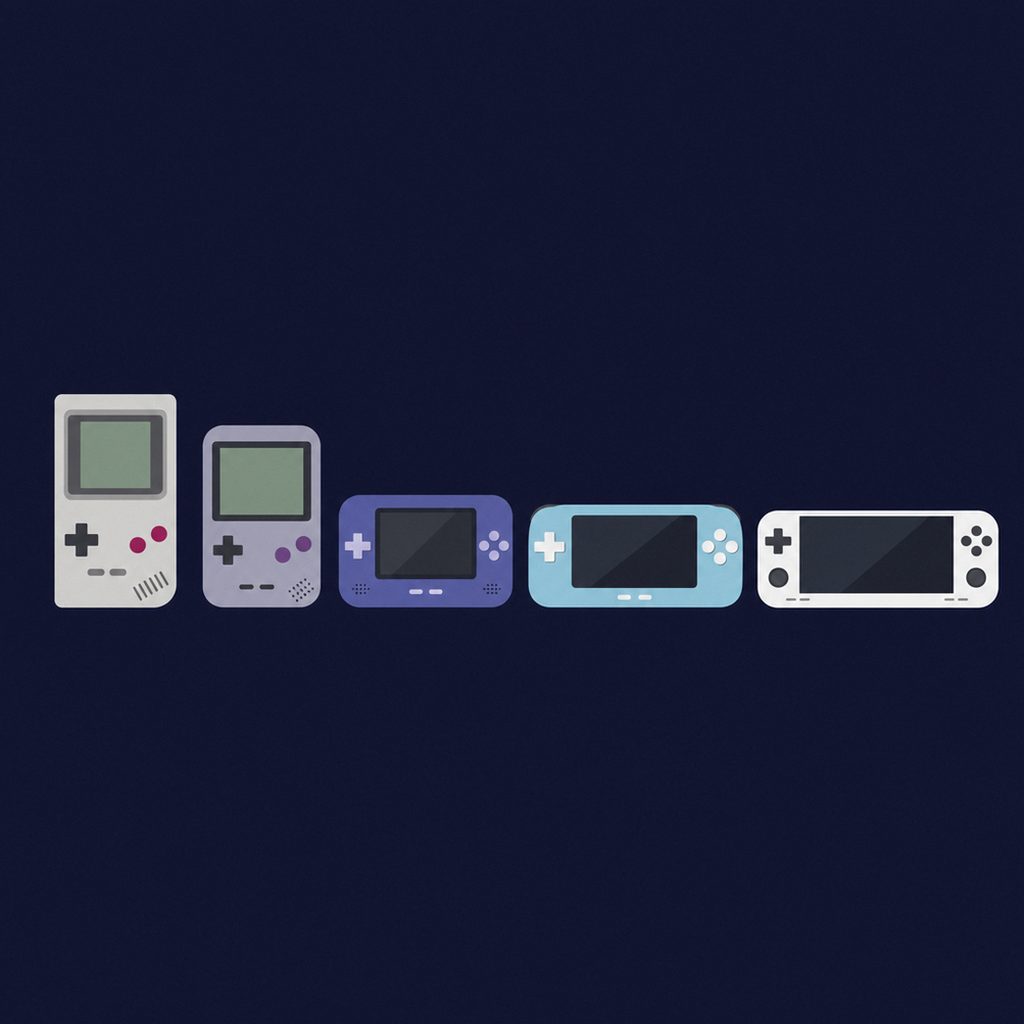
Portable gaming hardware is usually grouped into eras, much like home consoles, but the boundaries are looser and the milestones are different. Handheld generations are marked less by leaps in raw power than by shifts in form factor and concept: the move from single-game devices to cartridges, from monochrome to color, from one screen to two, and finally from dedicated portable to hybrid and handheld PC. This guide walks through those eras and the devices that defined them. It complements the general console generations guide and the broader handheld game consoles overview; for a strictly chronological account, see the history of handheld consoles.
How Handheld Generations Are Defined
There is no official body that declares handheld generations, and they do not map cleanly onto the numbered home console generations. A portable launched in one home generation often competes for years into the next. Instead, handheld eras are best understood by their defining shift in technology or concept — the introduction of interchangeable cartridges, of color screens, of touch input, of the hybrid form. The eras below follow that logic rather than a rigid bit-count or release-year scheme.
The Early Portables (1976–1988)
The first portable gaming devices played a single built-in game. Mattel Auto Race (1976) and Mattel Football (1977) used simple LED displays and sold in the millions. Nintendo’s Game & Watch series, launched in 1980 and designed by Gunpei Yokoi, produced dozens of LCD models and sold around 43.4 million units; its 1982 multi-screen Donkey Kong unit introduced the cross-shaped D-pad that Nintendo would carry to the NES and nearly every controller since.
The first portable to play interchangeable cartridges was the Milton Bradley Microvision (1979), but its tiny screen and minimal library doomed it. The technology of the era — battery life, screen quality, and processing power — simply was not ready for a true portable console. That readiness arrived at the end of the decade.
The Game Boy Era (1989–2003)
The Nintendo Game Boy (1989) established the dedicated handheld as a mass-market product. Designed once again by Gunpei Yokoi, it deliberately used a monochrome screen to maximize battery life and keep the price low — a choice mocked by rivals and vindicated by sales. Its color competitors, the backlit Atari Lynx (1989) and Sega Game Gear (1990), were technically superior and commercially crushed. The Game Boy line, including the Game Boy Color (1998), sold roughly 119 million units.
The Game Boy Advance (2001) was a generational leap to Super Nintendo-class 16-bit graphics in a horizontal slab, and the Game Boy Advance SP (2003) added a clamshell shell and, in its later revision, a backlit screen. The Advance line sold over 81 million units, closing an era in which Nintendo faced no surviving handheld rival.
| Device | Launched | Defining trait |
|---|---|---|
| Game Boy | 1989 | Monochrome, long battery, mass market |
| Game Boy Color | 1998 | Color, backward compatible |
| Game Boy Advance | 2001 | 16-bit class, horizontal slab |
| Game Boy Advance SP | 2003 | Clamshell, lit screen, rechargeable |
Dual Screen Versus Multimedia (2004–2011)
The era’s two devices took opposite approaches. Nintendo’s DS (2004) added a second screen and a touchscreen, enabling a wave of novel software and becoming the best-selling handheld of all time at about 154 million units across the DS, DS Lite, and DSi. Sony’s PlayStation Portable (2004–2005) instead pursued console-quality 3D and multimedia on a wide screen, playing games, movies, and music from its UMD discs; it sold around 80 million units, a strong result overshadowed only by the DS.
The contest reinforced the central lesson of portable hardware: the more powerful, more expensive multimedia device lost to the cheaper, more inventive one with the broader library. The PSP is covered in full on its console page.
The Last Dedicated Handhelds (2011–2019)
Nintendo’s 3DS (2011) added glasses-free 3D to the dual-screen formula. After a rocky, overpriced launch and a swift price cut, it recovered to sell about 75.94 million units, carried by Pokemon X/Y, Fire Emblem Awakening, and Animal Crossing: New Leaf. Sony’s PlayStation Vita (2011–2012) was a technical marvel — an OLED touchscreen, dual analog sticks, near-console graphics — but Sony’s thin first-party support and absurdly expensive proprietary memory cards held it to roughly 15–16 million units. Sony exited the dedicated handheld market afterward, marking the end of the standalone-portable era.
The Hybrid and Handheld PC Era (2017–Present)
The current era dissolved the boundary between portable and home. The Nintendo Switch (2017) is a tablet with detachable controllers that docks to a television and plays the same library either way; it surpassed the DS in lifetime sales in 2025 to become Nintendo’s best-selling platform. Details are on the Nintendo Switch page.
Alongside it, Valve’s Steam Deck (February 2022) brought the full PC game library to a portable, spawning Windows-based rivals such as the ASUS ROG Ally (2023) and Lenovo Legion Go (2023). A parallel surge of inexpensive emulation handhelds from brands like Anbernic and Miyoo, and premium FPGA devices like the Analogue Pocket, rounds out one of the most active periods the category has ever seen — the focus of the ranked best retro handhelds guide.
What the Generations Reveal
Read end to end, the handheld eras tell a consistent story. Each generation’s most powerful device — the Lynx, the Game Gear, the PSP, the Vita — lost to a cheaper, longer-lasting rival with a deeper library, until the Switch resolved the tension by being both portable and home at once. The arc from a single-game LED toy to a docking PC-class hybrid is, in microcosm, the story of gaming hardware itself, and it sits inside the wider sweep mapped in the console generations guide.
Frequently Asked Questions
How many handheld console generations are there?
Handheld eras are not officially numbered, but they fall into roughly five phases: the early single-game portables, the Game Boy era, the dual-screen versus multimedia era, the last dedicated handhelds, and the current hybrid and handheld PC era.
What was the first handheld game console?
Single-game LED handhelds like Mattel Auto Race (1976) came first, followed by Nintendo's Game & Watch in 1980. The first to play interchangeable cartridges was the Milton Bradley Microvision in 1979.
Who invented the D-pad?
Gunpei Yokoi at Nintendo introduced the cross-shaped directional pad on the multi-screen Game & Watch version of Donkey Kong in 1982, and it was carried over to the NES controller and nearly every controller since.
Which handheld generation sold the most?
The dual-screen era's Nintendo DS family is the best-selling handheld line ever, at around 154 million units, ahead of the Game Boy line at roughly 119 million and the Game Boy Advance at over 81 million.
When did dedicated handhelds end?
The traditional dedicated handheld era closed around 2019. Sony exited after the PlayStation Vita, and Nintendo folded the portable into the hybrid Nintendo Switch rather than releasing a standalone successor to the 3DS.
Is the Steam Deck part of a handheld generation?
Yes. The Steam Deck (2022) belongs to the current hybrid and handheld PC era alongside the Nintendo Switch, the ASUS ROG Ally, and the Lenovo Legion Go, defined by portables running full console or PC libraries.