
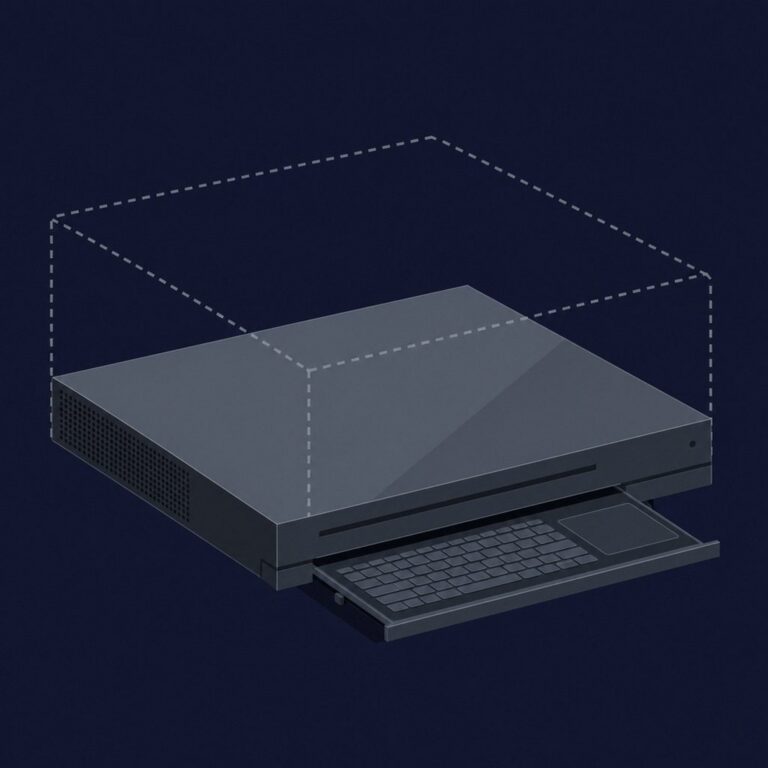
The Infinium Labs Phantom holds a unique and inglorious distinction in video game history: it is the most infamous vaporware console ever announced. Unveiled in November 2003 by a small Florida-based company called Infinium Labs, the Phantom promised to revolutionize gaming with an all-digital, PC-based home console that would deliver games exclusively through broadband downloads. It was a genuinely forward-thinking concept — digital distribution would eventually reshape the entire industry — but the Phantom never came close to reality. Not a single unit was ever sold. Not a single game was ever released. The console existed only as a series of press releases, SEC filings, rendered images, and one suspicious prototype displayed behind glass at E3 2004. It became gaming’s ultimate cautionary tale about hype, deception, and the gap between ambition and execution.
The Promise: A Digital-Only Console in 2003
Infinium Labs announced the Phantom console in November 2003, positioning it as a direct competitor to the PlayStation 2, Xbox, and GameCube. The pitch was bold: a console that would eliminate physical media entirely, delivering all games via broadband internet to an integrated hard drive. At a time when most gamers were still buying titles on disc, this was a radical proposition.
The man behind the Phantom was Timothy Roberts, CEO and founder of Infinium Labs. Roberts described the console as a device that would bring PC gaming to the living room without the complexity of owning a PC. Players would subscribe to a service, browse a digital storefront, download games directly, and play them on their television. The announced price point was $199 USD — aggressively positioned to undercut the competition.
On paper, the concept anticipated what would eventually become mainstream. Steam launched in September 2003, just weeks before the Phantom announcement, though it was initially just a distribution platform for Valve’s own games. The notion of a dedicated console built entirely around digital delivery was years ahead of the curve. Microsoft’s Xbox 360 would introduce Xbox Live Arcade in 2005. Sony’s PlayStation 3 launched with a PlayStation Store in 2006. But a console with zero physical media in 2003? That was uncharted territory.
Infinium Labs claimed to have secured partnerships with major game publishers and middleware providers. The company touted deals with companies like Vivendi Universal Games and claimed access to a vast library of PC titles. Press releases flowed steadily, each one promising imminent breakthroughs. A launch window of late 2004 was announced, and the gaming press — hungry for disruption in a market dominated by three established players — gave the Phantom significant coverage.
The Technology: A Locked-Down PC
The Phantom’s planned hardware specifications revealed what the console actually was: a mid-range Windows PC in a custom case. The system was designed around an Intel Pentium 4 processor and an NVIDIA GeForce FX series GPU, with 256 MB of DDR RAM and a built-in hard drive for game storage. Output would support resolutions up to 1080i through component, S-Video, and composite connections, with 5.1 surround sound capability.
The operating system was to be a customized, locked-down version of Windows — essentially stripping the PC interface down to a console-like experience. Users would boot directly into the Phantom’s proprietary game service, browse available titles, purchase and download them, and play using a standard gamepad or, eventually, a keyboard and mouse accessory. Four controller ports were planned for local multiplayer.
The digital distribution infrastructure was described as a content delivery network that would serve game files to Phantom consoles over broadband. Infinium Labs talked about DRM systems to prevent piracy, subscription tiers for access to game libraries, and a user-friendly interface designed for non-technical consumers. In theory, it sounded like a precursor to Xbox Game Pass or PlayStation Now — a decade before those services existed.
The problem was not the concept but the credibility of the company behind it. Building a content delivery network, negotiating licensing agreements with dozens of publishers, manufacturing custom hardware, and developing a proprietary OS interface required enormous capital, engineering talent, and industry relationships. Infinium Labs had none of these in meaningful quantities. The company’s total assets were modest, its engineering team was small and largely anonymous, and its claimed publisher partnerships could not be independently verified.
Red Flags and Controversy
Skepticism about the Phantom began almost immediately and intensified throughout 2004. Technology journalists and forum communities noticed several troubling patterns. Infinium Labs was a publicly traded penny stock company with minimal revenue, no finished product, and a CEO with a questionable background. The company’s SEC filings showed mounting losses and heavy spending on executive compensation relative to actual research and development.
The gaming press grew increasingly critical. Kyle Bennett of HardOCP published a series of investigative articles in early 2004 that raised serious questions about the Phantom’s viability and Roberts’ history. Bennett reported that Roberts had been involved in previous businesses that ended in litigation and allegations of fraud. The articles prompted a lawsuit from Infinium Labs against HardOCP — a move widely seen as an attempt to silence criticism rather than address it. The lawsuit was eventually dropped.
At E3 2004, the gaming industry’s largest trade show, Infinium Labs displayed a Phantom prototype unit. However, the console was shown behind glass and was never demonstrated in a playable state. Attendees could look at the hardware but not interact with it. No games were shown running on the system. For a console that was supposedly launching within months, this was a devastating credibility gap. Competing consoles at E3 had playable demos, launch lineups, and tangible developer support. The Phantom had a box behind glass.
Throughout 2004 and into 2005, Infinium Labs repeatedly delayed the Phantom’s launch date. Each delay was accompanied by a new press release citing refinements, partnership negotiations, or strategic pivots. The pattern was unmistakable: the console was not being delayed — it was never going to ship. Industry analysts and enthusiast press increasingly treated the Phantom as a joke, and the name itself became a pun on its nonexistence.
In 2004, the company changed its name from Infinium Labs to Phantom Entertainment Inc., ostensibly to align the corporate brand with its flagship product. Critics saw the name change as an attempt to distance the company from the growing negative press associated with the Infinium Labs name.
Tim Roberts and the SEC Investigation
Timothy Roberts was the central figure in the Phantom saga, and his background proved to be as problematic as the console itself. Before founding Infinium Labs, Roberts had been involved in multiple business ventures that ended in legal disputes. Investigators and journalists uncovered a pattern of companies that raised capital, spent aggressively, and collapsed without delivering promised products or returns.
The U.S. Securities and Exchange Commission (SEC) opened an investigation into Infinium Labs and Roberts’ activities. The SEC’s concerns centered on potential securities fraud and stock manipulation. Infinium Labs was a publicly traded company on the OTC Bulletin Board, and the steady stream of optimistic press releases about the Phantom — publisher partnerships, technological breakthroughs, imminent launch dates — had the effect of inflating the company’s stock price. As the SEC examined the situation, the question became whether these announcements were legitimate progress updates or deliberate attempts to manipulate share value.
The investigation concluded with Roberts being fined $300,000 by the SEC. While the specific findings were complex, the outcome confirmed that regulatory authorities had serious concerns about how Infinium Labs conducted its business and communicated with investors. The fine was a significant amount for an individual associated with a small company, and it cemented the Phantom’s reputation as something closer to a financial scheme than a genuine hardware venture.
Roberts’ involvement with Phantom Entertainment effectively ended in the wake of the SEC action. The company limped on under new leadership, but the Phantom console was quietly abandoned. No official cancellation was ever announced — the product simply faded into silence, which was perhaps the most fitting end for a console named Phantom.
Comparison to Other Failed Consoles
The mid-2000s saw several high-profile console failures, but the Phantom stands apart from all of them because it never actually existed as a consumer product. Other notorious failures at least made it to market.
The Nokia N-Gage, launched in October 2003, was a mobile phone and handheld gaming hybrid that sold poorly due to its awkward design (the “sidetalking” meme, where users held the device sideways to make phone calls, became legendary). But Nokia shipped millions of units and had a real game library. The N-Gage was a commercial failure; the Phantom was a conceptual one.
The Gizmondo, released in March 2005, was a handheld console backed by a company whose executives included a man later revealed to be a member of the Swedish mafia. The Gizmondo sold fewer than 25,000 units and became infamous for its spectacular corporate collapse. But again — it shipped. Consumers could buy one and play games on it. The Phantom could not make even that basic claim.
The Atari Jaguar and 3DO Interactive Multiplayer from the early 1990s were legitimate products that failed commercially due to high prices, weak libraries, and poor market timing. The Virtual Boy was a genuine Nintendo product that simply failed to find an audience. These were real consoles with real engineering teams, real manufacturing, and real retail presence. The Phantom had none of these.
What made the Phantom uniquely damaging was that it exploited the hype cycle of the gaming industry. Journalists covered it because a new console challenger was inherently newsworthy. Investors bought stock because the press releases sounded promising. And gamers followed the story because the concept of an all-digital console was genuinely appealing. The Phantom weaponized enthusiasm.
The Phantom Lapboard
In a strange epilogue, Phantom Entertainment did eventually ship one product — though it was not a console. The Phantom Lapboard was a keyboard and mouse accessory designed for couch gaming. The concept was a curved lap desk that held a full keyboard and mouse surface, allowing PC gamers to play comfortably from a sofa or recliner without needing a desk.
The Lapboard was announced in 2007 and finally began shipping in limited quantities in 2008. It received mixed but not entirely negative reviews. The idea was sound — couch-based PC gaming was becoming more popular, and a well-designed lapboard could serve a real niche. Some reviewers praised the ergonomics while criticizing the price point and build quality.
However, sales were minimal. The Phantom brand was so thoroughly tainted by the console debacle that few consumers or retailers took the product seriously. The Lapboard existed in a narrow market segment — serious PC gamers who played from the couch — that would not grow significantly until the era of Steam Big Picture Mode and the Steam Link several years later. Phantom Entertainment dissolved shortly after, ending the company’s improbable journey from would-be console revolutionary to failed peripheral manufacturer.
Ironically, the Lapboard concept proved prescient. Companies like Corsair, Razer, and Roccat later released their own lapboard-style products as living room PC gaming gained popularity. The Phantom Lapboard was the right product from the wrong company at the wrong time.
Legacy and Cultural Impact
The Infinium Labs Phantom became the definitive example of vaporware in the gaming industry. The term “vaporware” — software or hardware that is announced but never released — existed long before the Phantom, but no product embodied the concept more completely. When gamers, journalists, or analysts want to reference an overpromised, undelivered console, the Phantom is the first name mentioned. It is the gold standard of nonexistence.
The Phantom’s legacy extends beyond its status as a punchline. It serves as a cautionary tale about due diligence, hype culture, and the vulnerability of enthusiast communities to well-packaged promises. The gaming press learned hard lessons about covering unverified claims from unknown companies. Investors learned about the risks of penny stocks tied to consumer electronics announcements. And the broader industry was reminded that building a console is one of the most capital-intensive, partnership-dependent undertakings in technology — not something achievable through press releases alone.
The story also resonates because the Phantom’s core idea was not wrong. Digital-only game distribution did become the dominant model — just not through the Phantom. Steam, Xbox Live Arcade, PlayStation Network, the Nintendo eShop, and eventually subscription services like Xbox Game Pass all realized the vision that Infinium Labs described in 2003. The Xbox 360 and PlayStation 3 made digital storefronts standard. By the 2020s, disc-less console variants from Sony and Microsoft showed that the all-digital future the Phantom promised was finally arriving — just fifteen years late and from companies with the resources to actually deliver it.
For collectors, the Phantom occupies a strange space. Because it was never commercially released, there is no standard consumer unit to collect. However, prototype units, marketing materials, press kits, and the rare Phantom Lapboard are genuine collector items. A verified Phantom prototype would be among the rarest and most unusual items in any video game hardware collection. The collector value is high precisely because the console never existed — it is the ghost in the machine, a piece of gaming history defined entirely by what it failed to become.
The Phantom’s name was prophetic in a way its creators never intended. A phantom is something that appears real but has no substance — an illusion, a specter, a thing that vanishes when you reach for it. The Infinium Labs Phantom console was exactly that: a projection of what gaming could be, backed by nothing solid, destined to disappear. It remains one of the most remarkable stories in the history of video game hardware — not for what it achieved, but for the sheer audacity of what it promised and the spectacular completeness of its failure.