
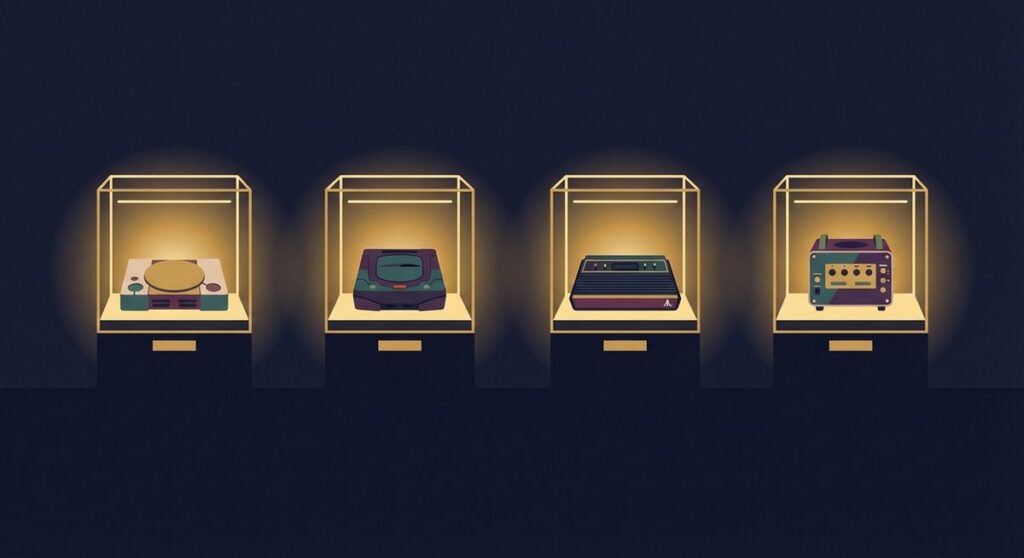
For every console that sold millions, dozens were produced in quantities so small that finding one today requires deep pockets, extraordinary patience, or both. The rarest video game consoles span from unreleased prototypes that never left the factory to limited-edition variants produced in numbered runs. Some are historically significant machines that shaped the industry. Others are obscure curiosities known only to dedicated hardware collectors. All of them share one quality: scarcity that transforms consumer electronics into genuine artifacts.
Unreleased Prototypes & Cancelled Hardware
Atari Cosmos (1981)
The Atari Cosmos was a tabletop game system using holographic overlays combined with LED-based game displays. Announced in 1981, it was cancelled before release due to the impending crash. Approximately 5 working prototypes are believed to exist. When one appeared at auction in 2011, it sold for $18,853.
Sega Neptune (1994-1995)
The Sega Neptune was a planned combination console integrating the Genesis and 32X into a single unit, eliminating the stacked-hardware problem. Sega cancelled it before production, choosing to focus resources on the Saturn. A small number of prototype/engineering sample units exist in private collections. Confirmed Neptunes have sold at auction for $10,000-40,000+.
Sega Pluto (1997)
The Sega Pluto was a Saturn variant with an integrated NetLink modem for online gaming. Only two prototypes are confirmed to exist — both surfaced in 2013 when a former Sega employee revealed them. They have never been publicly sold, making the Pluto effectively priceless as a collectible.
Atari Panther (1991)
Planned as Atari’s 32-bit competitor before the Jaguar, the Panther was cancelled during development when Atari decided to leapfrog directly to the Jaguar’s more powerful hardware. Development kits and prototype boards exist in very small numbers.
Konix Multisystem (1989)
A British console designed around a unique hydraulic seat controller that would tilt and move during gameplay. Financial problems prevented its release despite being demonstrated at trade shows. Prototype units occasionally surface and have sold for $3,000-5,000+.
Extremely Limited Production Consoles
Nintendo PlayStation / Play Station Prototype (1991)
Perhaps the most famous rare console in existence: the Nintendo PlayStation, a prototype of the SNES CD-ROM add-on developed by Sony before the partnership collapsed (leading Sony to create the standalone PlayStation). Only one working unit is confirmed, discovered by Terry Diebold in a lot of abandoned Advanta Corporation equipment. It sold at auction in 2020 for $360,000 — the most expensive console ever sold publicly.
Panasonic Q (2001-2003)
While not technically a prototype, the Panasonic Q was produced in limited quantities as a Japan-exclusive GameCube/DVD player hybrid. Production ended in 2003, and units in complete, working condition now sell for $500-1,500+ depending on condition and included accessories.
Sharp Twin Famicom AN-505 (1986)
A Japan-only combination console integrating the Famicom and Famicom Disk System into a single unit, produced by Sharp under Nintendo license. While not extremely rare by 1980s standards, working units with functional disk drives are becoming scarce. Expect to pay $200-400+ for a complete, working unit.
Pioneer LaserActive (1993)
A LaserDisc player that could play LaserDisc games and, with optional “PAC” modules, run Sega Genesis/Mega CD or TurboGrafx-16/PC Engine CD games. The base unit cost $970 and each PAC module added $600. The combination of high price and limited market resulted in very low sales. Complete units with PAC modules now sell for $1,000-3,000+.
Bandai Pippin ATMARK / @WORLD (1995-1996)
An Apple-designed multimedia console based on PowerPC Macintosh architecture, marketed by Bandai. Fewer than 42,000 units were sold across Japan and North America before discontinuation. The @WORLD (US version) is particularly rare, with working units selling for $300-800+.
Rare Regional & Special Edition Variants
Nintendo 64DD (1999)
The 64DD was a magnetic disk drive add-on for the N64, released only in Japan through a subscription service called Randnet. Approximately 15,000 units were manufactured. Only 10 retail games were released. Complete 64DD units with Randnet kit sell for $1,000-3,000+, with individual games ranging from $100-500+ each.
Sega Nomad (1995)
A portable Sega Genesis that played standard Genesis cartridges on a built-in color LCD. Sold only in North America for $179, the Nomad arrived at the end of the Genesis lifecycle and sold poorly. Working units now command $150-300+, with boxed units reaching $400-700+.
Nintendo Game Boy Light (1998)
The Japan-exclusive Game Boy Pocket with an electroluminescent backlight. It was the first Nintendo handheld with a built-in screen light and was produced for less than a year before the Game Boy Color arrived. Units sell for $100-250+, with certain limited colors (Astro Boy, Tezuka Osamu World Shop) reaching $500+.
Xbox 360 Halo 3 Legendary Edition Console
Various limited-edition Xbox 360 consoles were produced, but certain variants like the Halo 3 Edition and the Star Wars R2-D2 Edition (which played R2-D2 sounds on startup) are increasingly collectible at $200-500+ for complete, boxed units.
PlayStation 2 Automobile Edition (SCPH-77000)
Several manufacturer-specific PS2 variants were produced for the Japanese market in extremely limited runs — Toyota, Nissan, and other automotive companies commissioned branded PS2 units for promotional purposes. These typically sell for $500-2,000+ when they surface.
Obscure Commercial Releases
Casio Loopy (1995)
A Japan-only console marketed exclusively at girls, featuring a built-in thermal sticker printer. Players could capture screenshots from games and print them as stickers. Only 10 games were released, all developed by Casio. The console and its games are rare outside Japan, with units selling for $200-400+.
Apple/Bandai Pippin (1995)
Already mentioned above, but worth emphasizing: the Pippin’s combination of major brand names (Apple and Bandai), tiny production run, and historical significance as Apple’s only game console makes it a uniquely collectible piece.
RDI Halcyon (1985)
A LaserDisc-based console with voice recognition, priced at $2,500 in 1985. Only two games were released (Thayer’s Quest and NFL Football). RDI went bankrupt shortly after launch. Complete, working Halcyon units are extraordinarily rare — likely fewer than 100 exist — and have sold for $10,000+ at auction.
VTech CreatiVision (1981)
An early console/computer hybrid from Hong Kong-based VTech, sold under various names worldwide (Dick Smith Wizzard in Australia, Hanimex Rameses in Europe). The CreatiVision had a small game library and limited distribution. Working units with games are uncommon and sell for $100-300+ depending on variant and region.
How to Evaluate Rare Console Authenticity
As prices for rare consoles climb, so does the incentive for forgery and misrepresentation. Key considerations when evaluating rare hardware:
Provenance matters. Where did the console come from? Prototypes and engineering samples should have documented history — ideally traced back to a known developer, Sega/Nintendo/Atari employee, or documented estate. Unprovenanced “prototype” claims should be treated with extreme skepticism.
Verify board revisions. Genuine prototypes typically have different PCB layouts, hand-soldered components, EPROM chips (often with handwritten labels), and debug features absent from retail hardware. Comparing internal photos against known authenticated units is essential.
Condition is relative. For prototypes and extremely rare consoles, cosmetic condition is less important than functionality and completeness. A working Sega Neptune with scratches is worth more than a non-functional pristine unit — there are too few units for condition-grading to follow standard collecting norms.
Regional variants aren’t always rare. A “rare Japanese exclusive” may have had a substantial production run in its home market. Research actual production numbers rather than relying on regional scarcity in your own market.
Be wary of aftermarket modifications. Some consoles are modified to appear as limited editions or special variants. Custom paint jobs, replacement shells, and aftermarket labels can be difficult to distinguish from genuine factory variants without experience.
The Future of Rare Console Collecting
Rare console values have generally trended upward as the collector base has expanded and the supply of surviving units has (naturally) declined. The $360,000 Nintendo PlayStation sale in 2020 demonstrated that the ceiling for gaming hardware collectibles is far higher than previously assumed. As the generation that grew up with 1990s and 2000s consoles enters peak earning years, demand for rare variants and prototypes from these eras is likely to increase.
However, the market is not without risks. Reproduction and counterfeit hardware is becoming more sophisticated. Digital gaming reduces the long-term cultural attachment to physical hardware. And unlike art or fine watches, consumer electronics degrade — capacitors leak, lasers weaken, batteries swell, and plastic yellows. Preservation — not just acquisition — is the challenge that rare console collectors must address to protect their investments and gaming history alike.