
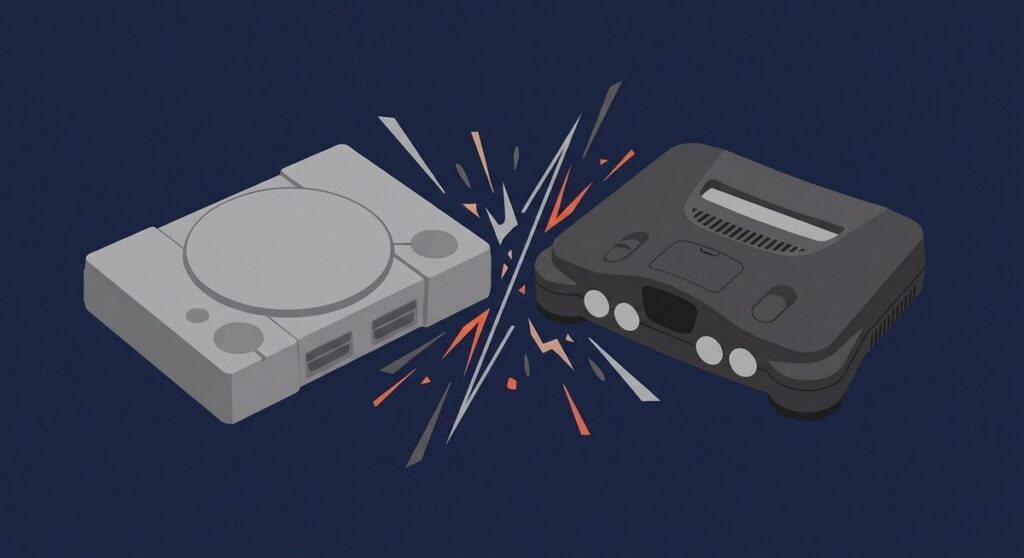
If the SNES vs. Genesis war was fought in schoolyards, the PlayStation vs. Nintendo 64 battle was fought in the future. Both consoles launched into the 3D revolution, but they had fundamentally different visions of what that revolution should look like. Sony bet on CD-ROMs, third-party developers, and mass-market appeal. Nintendo bet on cartridges, first-party brilliance, and raw graphical power. Sony’s bet won so decisively that it reshaped the entire industry.
Origins: A Partnership Destroyed
The PlayStation existed because of Nintendo. In the late 1980s, Nintendo contracted Sony to build a CD-ROM add-on for the Super Famicom. At CES 1991, Sony announced the “Play Station” — a hybrid SNES/CD device. The next day, Nintendo publicly abandoned the deal in favor of Philips, reportedly because Sony’s contract gave them too much control over CD software licensing.
Ken Kutaragi, the Sony engineer who had championed the project, convinced Sony’s leadership to build a standalone console. Nintendo’s betrayal didn’t just create a competitor — it created a rival motivated by revenge. The PlayStation was designed from the ground up to do everything Nintendo wouldn’t.
Hardware: CD vs. Cartridge
The PlayStation launched on December 3, 1994 (Japan) with a MIPS R3000A CPU at 33.8 MHz and a custom GPU capable of 360,000 polygons per second. Its CD-ROM drive provided 650 MB per disc at a manufacturing cost of under $2 per unit.
The Nintendo 64 launched on June 23, 1996 (Japan) with a MIPS R4300i CPU at 93.75 MHz and a Reality Coprocessor capable of hardware anti-aliasing and Z-buffering. The N64 was genuinely more powerful, with faster load times and smoother 3D rendering. But its cartridge format was limited to 64 MB maximum (most games used 8-32 MB) at a manufacturing cost of $10-15 per unit.
This cost difference was devastating. CD-ROM games could be produced cheaply and quickly, with room for full voice acting, pre-rendered cutscenes, and massive game worlds. N64 cartridges were expensive to manufacture and severely constrained by storage space. The format choice determined everything that followed.
The Third-Party Exodus
Sony offered developers something Nintendo never had: respect and reasonable terms. PlayStation development kits were affordable. Licensing fees were modest. Content restrictions were minimal. Sony actively courted Japanese developers with technical support and marketing assistance.
Nintendo, by contrast, maintained the same authoritarian approach that had worked in the NES era — strict licensing, expensive cartridge manufacturing, and content approval processes. When Square announced that Final Fantasy VII would be a PlayStation exclusive (the game required three CDs — impossible on cartridge), it was the tipping point. Enix, Konami, Capcom, and virtually every major Japanese publisher followed.
The numbers tell the story: the PlayStation received over 3,000 games. The N64 received 388.
Defining Games
The PlayStation’s library was defined by third-party masterpieces. Final Fantasy VII (1997) sold 10 million copies and brought RPGs to the mainstream. Metal Gear Solid (1998) pioneered cinematic storytelling. Resident Evil (1996) created survival horror. Crash Bandicoot gave Sony an unofficial mascot. Gran Turismo (1997) sold 10.85 million copies and defined simulation racing. Tekken 3, Castlevania: Symphony of the Night, Spyro the Dragon — the depth was staggering.
The N64 countered with arguably the greatest first-party lineup ever assembled. Super Mario 64 (1996) literally invented 3D platforming — every 3D game since owes it a debt. The Legend of Zelda: Ocarina of Time (1998) is frequently cited as the greatest game ever made. GoldenEye 007 (1997) proved first-person shooters could work on consoles and popularized split-screen multiplayer. Mario Kart 64, Star Fox 64, Super Smash Bros., Banjo-Kazooie, Perfect Dark — every game was a potential system-seller.
Innovation: The Analog Stick and Rumble
The N64 made two contributions that outlasted the console itself. The analog stick — centered on the N64’s unusual three-pronged controller — was the first analog input on a mainstream console controller. Sony quickly responded with the DualShock (1997), adding dual analog sticks to the PlayStation controller. Every controller since has featured analog sticks.
The Rumble Pak (1997) introduced force feedback to console gaming. Again, Sony adopted the feature with the DualShock’s built-in vibration motors. The N64 lost the generation but won the controller war.
Sales and Market Impact
The PlayStation sold 102.49 million units worldwide — the first console to cross 100 million. The N64 sold 32.93 million. In Japan, the gap was especially dramatic: 21.6 million PlayStation units versus 5.54 million N64s.
More importantly, the PlayStation fundamentally changed gaming’s audience. Its marketing targeted 18-35 year olds with edgy advertising, club culture tie-ins, and mature content. Gaming was no longer “just for kids.” The PlayStation made gaming cool for adults, and that demographic shift has driven the industry ever since.
Legacy
The PlayStation vs. N64 generation established the modern industry structure. Sony proved that third-party relationships and media format decisions mattered more than raw hardware power. Nintendo learned that first-party excellence alone couldn’t sustain a platform — a lesson they’d struggle with through the GameCube and Wii U before finally resolving with the Switch. The N64 produced some of the greatest games ever made. The PlayStation produced a gaming empire. Both shaped the medium we know today.