
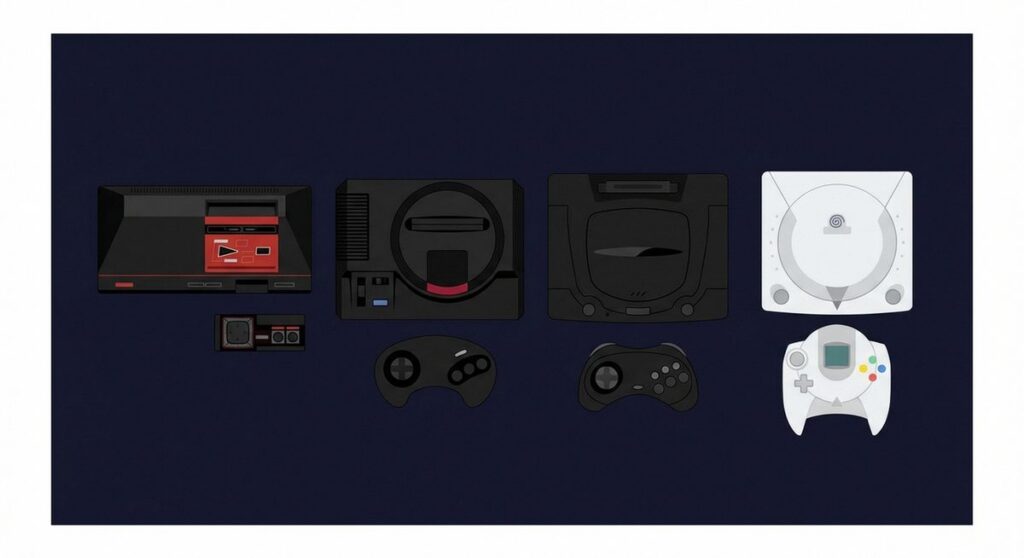
No company in gaming history burned brighter — or flamed out more spectacularly — than Sega. Over 18 years as a hardware manufacturer, Sega produced seven home consoles, pioneered online gaming, won the hearts of arcade enthusiasts worldwide, and ultimately destroyed itself through internal conflict and strategic overreach. The story of Sega’s consoles is the story of an company that was always bold, frequently brilliant, and fatally unable to get out of its own way.
SG-1000 (1983): The Beginning
Sega’s first home console launched on July 15, 1983 — the exact same day as Nintendo’s Famicom. This unfortunate coincidence set the tone for Sega’s entire hardware career: always competing, never quite winning in Japan. The SG-1000 was powered by a NEC 780C CPU at 3.58 MHz and used the same Texas Instruments TMS9918 video chip found in the ColecoVision. It was a competent machine with decent arcade ports, but it couldn’t compete with the Famicom’s superior hardware and Nintendo’s growing library.
The SG-1000 sold modestly in Japan and was released in parts of Asia, Australasia, and Europe. Sega followed it with the SG-1000 Mark II in 1984, which replaced the joysticks with gamepads and added a keyboard attachment option. While commercially unremarkable, the SG-1000 established Sega as a home console manufacturer and laid the groundwork for everything that followed.
Master System (1985): The Global Challenger
The Sega Mark III launched in Japan in October 1985, rebranded as the Master System for Western markets in 1986. Technically superior to the NES with better graphics capabilities and a larger color palette, the Master System should have been a serious contender. It wasn’t — at least not everywhere.
In Japan and North America, Nintendo’s iron grip on third-party developers (enforced through strict exclusivity contracts) starved the Master System of software. Sega sold approximately 13 million units worldwide, but the regional breakdown tells the real story. The Master System was a massive success in Brazil (where Tec Toy manufactured and sold the console well into the 2000s) and throughout Europe, where Nintendo’s dominance was less absolute. In these markets, the Master System built the brand loyalty that would fuel the Genesis era.
Genesis / Mega Drive (1988): The Golden Age
The Mega Drive launched in Japan on October 29, 1988, and arrived in North America as the Genesis on August 14, 1989. This was Sega’s masterpiece — a Motorola 68000 CPU at 7.67 MHz powering arcade-quality graphics and Sega’s aggressive “Genesis does what Nintendon’t” marketing campaign.
Under Tom Kalinske’s leadership at Sega of America, the Genesis became a cultural phenomenon. Sonic the Hedgehog (1991) gave Sega a mascot that could stand toe-to-toe with Mario. Sports titles from EA Sports (the Madden series was a Genesis exclusive early on) attracted an older demographic. The Genesis outsold the SNES in North America for several years, capturing roughly 65% of the 16-bit market at its peak.
The Genesis ultimately sold approximately 30.75 million units worldwide. It remains Sega’s best-selling console and the high point of the company’s hardware legacy.
The Add-On Disaster: Sega CD and 32X (1991-1994)
This is where things went wrong. The Sega CD (1991) was a CD-ROM add-on that attached to the bottom of the Genesis. Priced at $299, it offered enhanced audio, full-motion video, and scaling/rotation effects. While it produced some excellent games (Sonic CD, Lunar: The Silver Star, Snatcher), the library was plagued by terrible FMV games. It sold approximately 2.24 million units.
The 32X (1994) was far worse. A mushroom-shaped peripheral that plugged into the Genesis cartridge slot, the 32X was supposed to bridge the gap to the next generation. It launched at $159 with weak software support and was abandoned within months when the Saturn arrived. The 32X sold only 665,000 units and became a symbol of corporate confusion. Consumers who bought into the Sega CD + 32X + Genesis stack — the infamous “tower of power” — felt betrayed when Sega essentially told them to buy yet another new system.
Saturn (1994): Brilliant and Doomed
The Saturn launched in Japan on November 22, 1994 and was an immediate success there, outselling the PlayStation in its early months. The hardware was formidable: dual Hitachi SH2 CPUs at 28.6 MHz, dedicated sprite and background processors, and sophisticated audio. It was designed as the ultimate 2D machine with 3D capabilities, but the architecture’s complexity — particularly the dual CPUs that couldn’t easily share memory — made development difficult.
The North American launch was catastrophic. Sega of America, panicked by the approaching PlayStation launch, surprised retailers and developers by releasing the Saturn four months early at E3 1995 for $399. Sony’s legendary response — stepping to the podium and simply saying “$299” — sealed the Saturn’s fate in America. The Saturn sold 9.26 million units worldwide and was discontinued in 2000.
Dreamcast (1998): The Beautiful Failure
The Dreamcast launched on September 9, 1999 in North America (“9/9/99”), setting a new US launch record with $98.4 million in first-day sales. Powered by a Hitachi SH-4 at 200 MHz and a NEC PowerVR2 GPU, it was the first console with a built-in modem and introduced online gaming as a standard feature.
The Dreamcast’s game library was extraordinary for its short life: SoulCalibur, Shenmue, Jet Set Radio, Phantasy Star Online, Crazy Taxi, Marvel vs. Capcom 2. But the PlayStation 2’s hype machine was relentless. Retailers and publishers remembered Sega’s history of abandoned hardware. Sales collapsed when the PS2 launched. On January 31, 2001, Sega announced it would exit hardware manufacturing.
The Dreamcast sold 9.13 million units. It remains one of the most beloved “failed” consoles in gaming history.
Why Sega Failed
Sega’s exit from hardware wasn’t caused by any single console’s failure. It was death by a thousand cuts:
Internal warfare. Sega of Japan and Sega of America were in constant conflict over strategy, hardware design, and marketing. The Saturn’s American team wanted 3dfx graphics; Japan chose PowerVR. Tom Kalinske’s successful US strategies were overridden by Japanese headquarters. This dysfunction meant Sega was often competing against itself.
Add-on fatigue. The Sega CD, 32X, and rapid console transitions exhausted consumer trust. By the Saturn era, buyers were rightfully skeptical that Sega would support any hardware for more than two years.
Financial hemorrhaging. The Saturn’s development costs, Shenmue’s $47 million budget, and consistent losses in the Western market drained Sega’s resources. By the Dreamcast era, there was no financial cushion left to weather a slow start.
Legacy
Sega became a third-party publisher in 2001, and its hardware legacy only grows. The Genesis represents the peak of the console wars mythology. The Dreamcast pioneered online gaming and remains an active homebrew platform. The Saturn’s Japanese library is revered by collectors. Even the failures — the 32X, the Game Gear’s battery appetite — are remembered with a strange fondness. Sega never played it safe, and gaming is richer for it.