
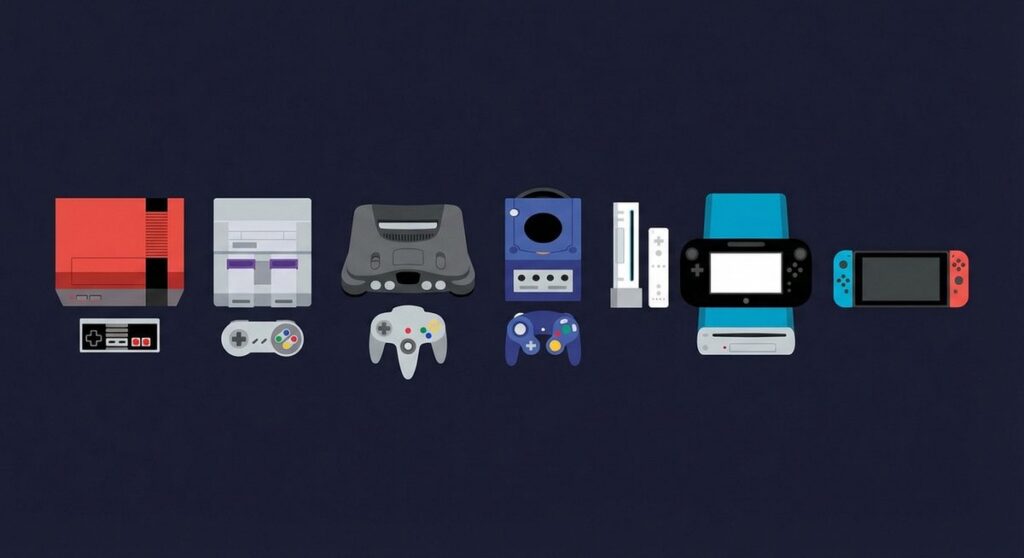
Nintendo has manufactured home gaming hardware for nearly five decades, producing some of the most iconic and commercially successful consoles in history. From the Color TV-Game in 1977 to the Switch in 2017, Nintendo’s philosophy has remained remarkably consistent: gameplay innovation over raw technical power. This approach has produced spectacular successes and humbling failures, but it has kept Nintendo relevant — and often dominant — through every generation of the gaming industry.
The Pre-Famicom Era (1977-1982)
Nintendo’s first home gaming products were the Color TV-Game series, launched in Japan starting in 1977. These were dedicated consoles with built-in games (no interchangeable cartridges), similar to Pong machines. The Color TV-Game 6 and Color TV-Game 15 sold a combined 3 million units in Japan alone — an impressive start that convinced Nintendo’s president, Hiroshi Yamauchi, that home gaming had serious commercial potential.
Nintendo also released the Game & Watch series (1980-1991), a line of handheld LCD games designed by Gunpei Yokoi. Over 43.4 million units were sold across 59 different games. The Game & Watch introduced the D-pad (directional pad) — Yokoi’s invention that would become the standard input device for every console that followed.
Famicom / NES (1983): Saving the Industry
The Family Computer (Famicom) launched in Japan on July 15, 1983, and arrived in North America as the Nintendo Entertainment System (NES) in October 1985. The NES didn’t just succeed — it single-handedly resurrected the North American gaming industry after the crash of 1983.
Nintendo’s approach was revolutionary: strict quality control through the Seal of Quality, limited third-party releases, and a lockout chip that prevented unlicensed games. The result was a curated library of excellent titles: Super Mario Bros., The Legend of Zelda, Metroid, Mega Man, Castlevania, Final Fantasy. The NES sold 61.91 million units worldwide and established Nintendo as the dominant force in gaming.
Game Boy (1989): Handheld Dominance
Gunpei Yokoi designed the Game Boy around a philosophy he called “lateral thinking with withered technology” — using mature, inexpensive components in creative ways rather than chasing cutting-edge specs. The Game Boy’s screen was a monochrome, unbacklit LCD — technically inferior to competitors like the Sega Game Gear and Atari Lynx. But it had 30+ hours of battery life (vs. the Game Gear’s 3-5 hours) and cost $89.99.
Bundled with Tetris — one of the most addictive games ever created — the Game Boy became a cultural phenomenon. Across all variants (original, Pocket, Color), the Game Boy line sold 118.69 million units, establishing Nintendo’s handheld monopoly that would last decades.
Super Famicom / SNES (1990): The 16-Bit King
The Super Famicom launched in Japan on November 21, 1990 and took over 80% of the Japanese market immediately. The SNES battled the Sega Genesis in the legendary 16-bit console wars, ultimately selling 49.1 million units worldwide. Its library — Chrono Trigger, Super Metroid, A Link to the Past, Final Fantasy VI, Donkey Kong Country — is arguably the greatest of any console.
Nintendo 64 (1996): 3D Pioneer
The N64 launched on June 23, 1996 in Japan with Super Mario 64 — the game that defined 3D platforming. The N64’s analog stick and later Rumble Pak introduced controller innovations adopted by every competitor. However, Nintendo’s stubborn insistence on cartridges drove away third-party developers to Sony’s PlayStation. The N64 sold 32.93 million units — respectable, but a fraction of the PlayStation’s 102 million.
GameCube (2001): The Underrated Gem
The GameCube launched on September 14, 2001 in Japan at $199. It used proprietary 8 cm mini-DVDs (which couldn’t play DVD movies, unlike the PS2). Despite excellent hardware and outstanding games — Metroid Prime, The Wind Waker, Resident Evil 4, Super Smash Bros. Melee — the GameCube sold only 21.74 million units, finishing third behind the PS2 and Xbox. It was Nintendo’s least commercially successful home console at the time.
Nintendo DS (2004): Dual Screen Innovation
The DS launched on November 21, 2004 with its distinctive dual-screen design, including a touchscreen on the bottom. Critics initially dismissed it as a gimmick. It wasn’t. The touchscreen enabled entirely new game designs: Nintendogs, Brain Age, Phoenix Wright, The World Ends with You. Combined with traditional hits like Pokémon Diamond/Pearl, Mario Kart DS, and New Super Mario Bros., the DS became a juggernaut. It sold 154.02 million units — the best-selling handheld ever and second-best-selling gaming device of all time (behind the PS2).
Wii (2006): The Motion Revolution
The Wii was Nintendo’s boldest gamble. While Sony and Microsoft competed on graphics horsepower with the PS3 and Xbox 360, Nintendo launched a console with essentially GameCube-level graphics and a motion-sensing remote control at just $249. Industry analysts predicted disaster. Instead, the Wii became a global phenomenon.
Wii Sports, bundled with the console, became the gateway game for millions of non-gamers — grandparents, parents, casual players who had never touched a controller. The Wii sold 101.63 million units, outselling both the PS3 (87.4M) and Xbox 360 (84M). It proved that expanding the gaming audience could be more profitable than competing for the existing one.
3DS (2011) and Wii U (2012): Highs and Lows
The 3DS offered glasses-free stereoscopic 3D and a rocky launch at $249 — too expensive. Nintendo slashed the price to $169 within months and the system recovered, eventually selling 75.94 million units with hits like Pokémon X/Y, Animal Crossing: New Leaf, and Fire Emblem: Awakening.
The Wii U (2012) was less fortunate. Its tablet-like GamePad controller confused consumers who thought it was a Wii accessory rather than a new console. Poor marketing, weak third-party support, and a thin launch lineup doomed it to just 13.56 million units — Nintendo’s worst-selling home console. The Wii U’s failure forced a fundamental rethink of Nintendo’s hardware strategy.
Nintendo Switch (2017): The Hybrid Triumph
The Switch launched on March 3, 2017 at $299 with a simple, brilliant concept: a home console that could seamlessly become a portable. Dock it for TV play, undock it for handheld mode. The NVIDIA Tegra X1 processor provided capable (if not cutting-edge) graphics, and the detachable Joy-Con controllers enabled portable multiplayer.
The Legend of Zelda: Breath of the Wild — a launch title — was immediately hailed as one of the greatest games ever made. Mario Kart 8 Deluxe (48+ million copies), Animal Crossing: New Horizons (44+ million), Super Smash Bros. Ultimate (33+ million), and Pokémon Sword/Shield followed. The Switch has sold over 143 million units, surpassing the Wii and Game Boy to become Nintendo’s best-selling home console ever.
Nintendo’s Philosophy
Across nearly 50 years of hardware, one pattern holds: Nintendo succeeds when it innovates the experience rather than competing on specifications. The D-pad, the analog stick, motion controls, dual screens, portable-home hybrid — Nintendo’s best ideas changed how people play, not just how games look. When Nintendo forgets this lesson (the Virtual Boy, the Wii U), it stumbles. When it remembers, it produces hardware that defines generations.