
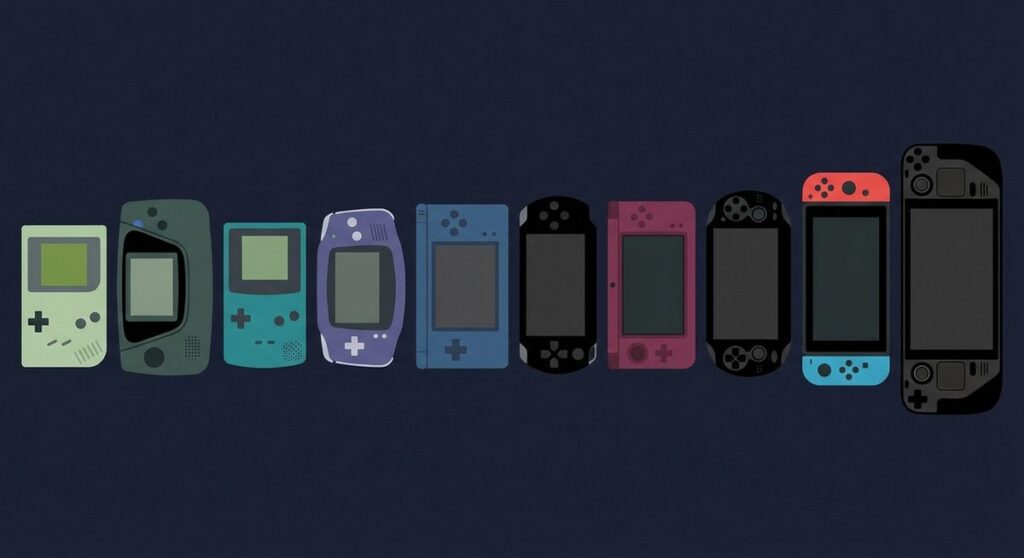
Handheld gaming consoles have always lived in the shadow of their home console siblings, but their impact on the industry is enormous. The Game Boy alone sold over 118 million units. The Nintendo DS sold 154 million — more than any home console except the PS2. Portable gaming created its own genres, its own design philosophies, and its own legendary libraries. This is the history of gaming you could take with you.
Before Game Boy: Early Portables (1976-1988)
Handheld electronic games existed before dedicated portable consoles. Mattel Auto Race (1976) and Mattel Football (1977) were LED-based handhelds that sold millions. Nintendo’s Game & Watch series (1980-1991), designed by Gunpei Yokoi, produced 59 models with simple LCD games and introduced the D-pad — which Yokoi would carry over to the NES controller.
The Microvision (1979) by Milton Bradley was the first handheld console with interchangeable cartridges, but its tiny screen and limited library doomed it. The Epoch Game Pocket Computer (1984) was Japan-only and equally obscure. The technology simply wasn’t ready for a true portable gaming system — battery life, screen quality, and processing power all fell short.
The Game Boy Dynasty (1989-2003)
The Nintendo Game Boy launched on April 21, 1989 at $89.99 with Tetris as the pack-in game — a decision that proved brilliant, as Tetris appealed to demographics far beyond traditional gamers. Gunpei Yokoi chose a monochrome green-tinted screen over color to maximize battery life (30+ hours on 4 AA batteries) and keep the price low. Competitors mocked the decision.
Those competitors — the Atari Lynx (1989, color, backlit), Sega Game Gear (1990, color, backlit), and NEC TurboExpress (1990, played full TurboGrafx-16 HuCards) — were all technically superior. All of them lost. The Game Boy’s combination of battery life, price, durability, and game library (especially Tetris and eventually Pokemon) made it untouchable. It sold 118.69 million units across all variants.
The Game Boy Pocket (1996) slimmed the design. The Game Boy Color (1998) added a color screen while maintaining backward compatibility. The Game Boy Advance (2001) was a generational leap with SNES-level graphics and a horizontal form factor. The GBA SP (2003) finally added a frontlit (later backlit) screen and a clamshell design — arguably the best Game Boy ever made.
The DS and PSP: Dual Screens vs. Multimedia (2004-2011)
Nintendo’s DS (2004) was a gamble: a dual-screen clamshell with a touchscreen, microphone, and Wi-Fi. Critics were skeptical. Then Nintendogs, Brain Age, Mario Kart DS, and New Super Mario Bros. demonstrated the touchscreen’s potential, and the DS became a phenomenon. The DS Lite (2006) refined the design into one of Nintendo’s most elegant hardware products. The DSi (2008) added cameras and a digital storefront. Total DS family sales: 154.02 million.
Sony entered handheld gaming with the PlayStation Portable (2004/2005) — a widescreen, multimedia powerhouse that played games on proprietary UMD discs, movies, music, and could browse the web. Its technical capabilities far exceeded the DS. Games like God of War: Chains of Olympus, Monster Hunter Freedom Unite, and Crisis Core: Final Fantasy VII demonstrated console-quality portable gaming. The PSP sold 80+ million units — a success by any standard except comparison to the DS.
3DS and Vita: The Last Traditional Handhelds (2011-2019)
The Nintendo 3DS (2011) added glasses-free 3D to the DS formula. Its launch was rocky — a $249 price point was too high, and Nintendo slashed it to $169 within months, offering early adopters free games as compensation. The 3DS recovered to sell 75.94 million units, driven by Pokemon X/Y, Animal Crossing: New Leaf, Fire Emblem Awakening, and The Legend of Zelda: A Link Between Worlds. The New 3DS (2014) added a second analog nub and improved hardware.
Sony’s PlayStation Vita (2011/2012) was a technical marvel — OLED touchscreen, dual analog sticks, rear touchpad, and graphics approaching PS3 quality. But Sony failed to support it with first-party games after launch, and its proprietary memory cards were absurdly expensive. The Vita found a passionate niche audience for Japanese games and indie titles but sold only 15-16 million units. Sony exited the handheld market entirely.
The Hybrid Era: Switch and Steam Deck (2017-Present)
The Nintendo Switch (2017) dissolved the boundary between home and handheld gaming. A tablet with detachable Joy-Con controllers and a TV dock, the Switch played the same games portably and on the big screen. It wasn’t the most powerful device in either category, but the flexibility was irresistible. The Legend of Zelda: Breath of the Wild, Animal Crossing: New Horizons, and Mario Kart 8 Deluxe drove sales past 141 million units. The Switch Lite (2019) offered a dedicated handheld version, while the Switch OLED (2021) upgraded the screen.
Valve’s Steam Deck (2022) brought the PC gaming library to a handheld form factor — a Linux-based portable that could play thousands of Steam games. It proved there was demand for a portable PC gaming device and spawned competitors from ASUS (ROG Ally), Lenovo (Legion Go), and others. The handheld PC category, unthinkable a decade ago, is now one of gaming’s fastest-growing segments.
Lessons from Handheld History
The consistent lesson of handheld gaming is that battery life, game library, and price matter more than raw power. Every generation’s most powerful handheld — Lynx, Game Gear, PSP, Vita — lost to the less powerful competitor with better games and longer battery life. The Switch’s triumph confirms this: players will accept graphical compromises for the freedom to play anywhere. As cloud gaming and handheld PCs continue to evolve, portability remains one of gaming’s most powerful value propositions.