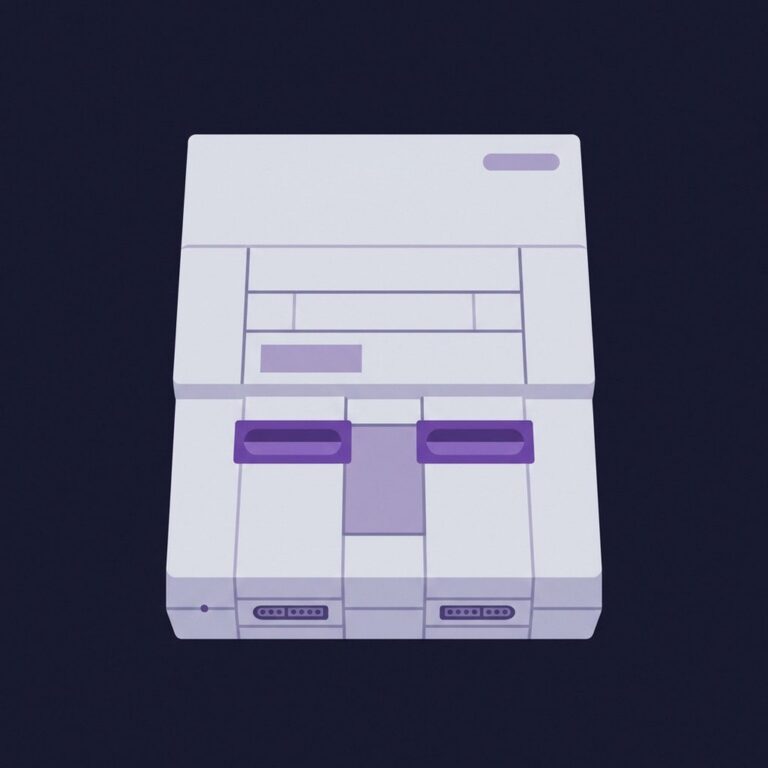
The Super Nintendo Entertainment System stands as arguably the greatest console of the 16-bit era — and a strong contender for the greatest of any era. Released as the Super Famicom in Japan on November 21, 1990 and as the SNES in North America on August 23, 1991, it sold 49.10 million units worldwide across a remarkably long lifespan that stretched into 2003. Its library of 1,757 games includes so many genre-defining titles that listing them feels like reciting a hall of fame.
History & Development
By the late 1980s, Nintendo’s dominance with the NES was being challenged. Sega had launched the Mega Drive (Genesis) in 1988 in Japan, and its aggressive marketing — particularly the “Genesis does what Nintendon’t” campaign in North America — was winning over older gamers. Nintendo needed a successor, and development of the Super Famicom began under the leadership of Masayuki Uemura, the same engineer who designed the original Famicom.
The Japanese launch on November 21, 1990 was a cultural event. Nintendo shipped 300,000 units, and they sold out within hours. Demand was so intense that the Japanese government reportedly asked Nintendo to schedule future console launches on weekends to prevent students from skipping school. The console arrived in North America nine months later at $199 USD, bundled with Super Mario World — a combination that moved over 500,000 units in the first month.
What followed was the fiercest console war the industry had ever seen. Sega positioned the Genesis as the cool, mature alternative. Nintendo countered with technical superiority and franchise power. The battle played out in schoolyards, magazine letters pages, and retail shelves throughout the early 1990s. Both companies benefited — the competition pushed game quality higher and expanded the overall market. The SNES ultimately outsold the Genesis globally, though Sega claimed the lead in North America for several years.
Hardware & Technical Specifications
The SNES was built around the Ricoh 5A22 CPU, a custom chip incorporating a WDC 65C816 core running at 3.58 MHz (or 2.68 MHz in some operating modes). On paper, its clock speed looked modest compared to the Genesis’s 7.6 MHz Motorola 68000. Sega exploited this in marketing with the infamous “blast processing” campaign. In practice, the SNES’s more sophisticated architecture — particularly its graphics and sound subsystems — more than compensated.
The graphics hardware was the SNES’s trump card. Two custom Picture Processing Units (S-PPU1 and S-PPU2) provided capabilities the Genesis simply couldn’t match: Mode 7, a hardware-based rotation and scaling effect for background layers, enabled pseudo-3D effects that became the console’s visual signature. F-Zero’s racing tracks, Super Mario World’s rotating boss rooms, and Pilotwings’ scaling landscapes all showcased Mode 7. The SNES also supported 32,768 colors versus the Genesis’s 512, and its sprites could be larger and more colorful.
Perhaps most remarkable was the audio system. Designed by Ken Kutaragi — who would later create the PlayStation — the Sony SPC700 sound chip delivered 8 channels of ADPCM audio with hardware reverb and echo effects. The result was music that sounded warm, layered, and cinematic. Composers like Nobuo Uematsu (Final Fantasy VI), Koji Kondo (Zelda, Mario), and Yasunori Mitsuda (Chrono Trigger) created soundtracks on the SNES that are still considered among the finest in gaming.
Nintendo also pioneered enhancement chips embedded in game cartridges. The Super FX chip (used in Star Fox and Stunt Race FX) added polygon rendering capabilities. The SA-1 provided a faster coprocessor for games like Super Mario RPG. The Cx4 handled wireframe calculations in Mega Man X2 and X3. These chips effectively upgraded the console’s capabilities on a per-game basis, extending its competitive life well into the 32-bit era.
Game Library & Legacy
The SNES library is staggering in both depth and quality. Nearly every major genre reached a peak or defining moment on this hardware.
RPGs flourished like nowhere else. Chrono Trigger, Final Fantasy IV, Final Fantasy VI, EarthBound, Secret of Mana, Super Mario RPG, and Breath of Fire II represent just the highlights. Square and Enix made the SNES their primary platform, and the volume of quality RPG content was unmatched until the PS1 era. Chrono Trigger, developed by a “Dream Team” of Square talent including Hironobu Sakaguchi, Yuji Horii, and Akira Toriyama, is still regularly cited as the greatest RPG ever made.
Platformers were equally dominant. Super Mario World refined everything the NES games built. Donkey Kong Country (and its two sequels) used pre-rendered 3D sprites to create visuals that looked impossibly good for 16-bit hardware, thanks to Rare’s Silicon Graphics workstations. Super Metroid defined atmospheric exploration gaming so thoroughly that an entire genre — Metroidvania — bears half its name. Mega Man X modernized the Blue Bomber for a new generation.
The Legend of Zelda: A Link to the Past set the template for top-down action-adventure games that persists to this day. Super Mario Kart invented the kart racing genre. Street Fighter II Turbo made the SNES the home fighting game platform of choice. Star Fox brought polygonal 3D to a 16-bit console. The breadth of innovation across one platform remains unparalleled.
Models & Variants
The SNES went through several hardware revisions across its global releases, with notable regional design differences.
The Japanese Super Famicom featured a sleek, curved design with colorful button accents (blue, green, yellow, red) on the controller. The North American SNES (SNS-001) received a boxier, more angular housing with a purple/gray color scheme and concave, symmetrical purple buttons — a deliberate redesign to differentiate it from the “toy-like” Famicom aesthetic and appeal to an older demographic. The PAL region SNES used the Super Famicom’s shell design but with the North American branding and a gray color scheme.
In 1997, Nintendo released the SNES Jr. (SNS-101 in North America, Super Famicom Jr. in Japan), a dramatically smaller and lighter redesign. The SNES Jr. removed the eject mechanism and RF output, offering only composite video. While more compact and visually clean, early SNS-101 units had a quirk that actually produced slightly better video quality than the original, making them desirable among videophiles.
No significant special editions or color variants were produced during the console’s original lifespan, though Nintendo released the Super NES Classic Edition (a miniature emulation console with 21 built-in games) in 2017, which sold over 5.28 million units and introduced the library to a new generation.
Collecting & Value Today
The SNES is one of the most active and expensive retro collecting markets. A working console with controller and cables sells for $80-120 USD loose, with boxed units reaching $200-400+. Super Famicoms are significantly cheaper, typically $40-70, making them an attractive option for collectors willing to deal with Japanese-language menus (many games are fully playable regardless of language).
Game prices vary enormously. EarthBound is the library’s most famous expensive title, regularly selling for $200+ loose and $800+ complete in box with its oversized packaging and strategy guide. Mega Man X3, Chrono Trigger, Harvest Moon, and Final Fight Guy all command triple-digit prices. Even mid-tier titles like Super Castlevania IV and Turtles in Time have climbed well above $40.
When evaluating SNES consoles, yellowing is the primary cosmetic concern. The original ABS plastic used in the casing is prone to oxidation and UV discoloration, turning the light gray housing a brownish-yellow over time. This is purely cosmetic and doesn’t affect functionality. Retrobright treatments can reverse the yellowing, though results vary. Super Famicom units tend to yellow less noticeably due to their lighter original color. Functionally, SNES hardware is extremely reliable — the cartridge connector rarely fails, and capacitor issues are uncommon compared to other consoles of the era.