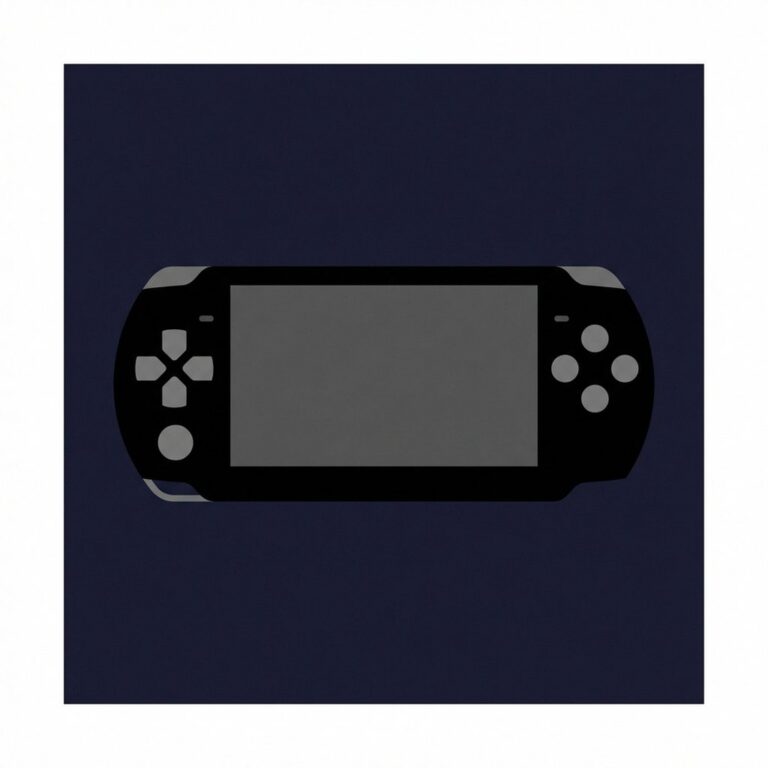
The PlayStation Portable was Sony’s first handheld and the first device to seriously challenge Nintendo’s portable gaming monopoly. Launched on December 12, 2004 in Japan, the PSP sold 80 million units worldwide and proved that there was a market for console-quality gaming on the go. With its stunning 4.3-inch widescreen display, multimedia capabilities, and a library of 1,367 games, the PSP carved out a permanent space in the portable gaming landscape — even if it never dethroned the Nintendo DS.
History & Development
Sony announced the PSP at E3 2003, and the gaming press treated it as a declaration of war against Nintendo’s unbroken handheld dominance. Ken Kutaragi described the device as a “Walkman for the 21st century” — a multimedia device that happened to play games exceptionally well, rather than a game device with multimedia features tacked on.
The Japanese launch on December 12, 2004 sold 200,000 units on day one. The North American launch on March 24, 2005 at $249 USD (the “Value Pack” including headphones, case, memory stick, and demo disc) positioned the PSP as a premium product — $100 more than the Nintendo DS. Sony marketed the PSP as a lifestyle device: sleek, black, widescreen, capable of playing movies and music alongside games. The messaging worked with older gamers and tech enthusiasts, though families and younger players gravitated toward the DS’s lower price and touchscreen novelty.
The PSP’s UMD (Universal Media Disc) format was Sony’s proprietary optical disc, holding 1.8 GB in a protective caddy. Sony pushed UMD as a multimedia format, releasing movies and TV shows on UMD alongside games. The bet failed — consumers preferred DVD (and later digital) for movies, and the UMD movie format was discontinued by most studios within two years. The disc format also had practical downsides for a portable: the spinning disc motor consumed battery life and generated noise, and the exposed disc mechanism was vulnerable to damage.
Despite never outselling the DS (which moved 154 million units), the PSP was far from a failure. 80 million units represented a larger installed base than every non-Nintendo handheld in history combined. It was particularly successful in Japan, where Monster Hunter became a cultural phenomenon that drove PSP sales for years, and in Asia and developing markets, where its multimedia capabilities and media playback made it a value proposition beyond gaming.
Hardware & Technical Specifications
The PSP’s hardware was genuinely impressive for a 2004 portable device. Its custom MIPS R4000-based processor operated at up to 333 MHz (initially capped at 222 MHz by Sony to preserve battery life, later unlocked for developers). A secondary processor handled media decoding and I/O. The integrated GPU could push polygon counts and texture quality comparable to the PS2 — an astonishing achievement for a battery-powered handheld.
The 4.3-inch TFT LCD widescreen display at 480×272 pixels was the PSP’s standout feature. In 2004, nothing else in portable gaming came close to its size, brightness, or resolution. The 16:9 aspect ratio meant games and media could fill the screen without letterboxing. Colors were vivid, viewing angles were acceptable, and the screen made PS2-era graphics look sharp and impressive at handheld scale.
Memory comprised 32 MB of main RAM and 4 MB of embedded DRAM. Storage used Memory Stick PRO Duo cards for saves, downloadable games, and media — Sony’s proprietary format that was more expensive than SD cards and contributed to ongoing accessory costs. The PSP included built-in Wi-Fi (802.11b) for multiplayer gaming, web browsing, and later, PlayStation Store access for digital game downloads.
The control layout featured a single analog nub (not a full stick), a D-pad, four face buttons, and two shoulder buttons. The analog nub was functional but imprecise compared to console analog sticks — it was a common complaint that the PSP lacked a second analog input, which limited camera control in 3D games. This issue was addressed (partially) by the “claw grip” technique that became standard for games like Monster Hunter, where players contorted their left hand to use the D-pad for camera control while the analog nub handled movement.
Game Library & Legacy
The PSP’s 1,367 games ranged from portable versions of major console franchises to original titles that found their strongest audience on the platform.
Monster Hunter Freedom Unite (2008) was the PSP’s defining game in Japan, selling over 5 million copies and turning the PSP into a social gaming device — groups of players hunting together via ad-hoc Wi-Fi became a common sight on Japanese trains and in cafés. The Monster Hunter series single-handedly sustained PSP hardware sales in Japan for years after Western interest had cooled.
Grand Theft Auto: Liberty City Stories (2005) and Vice City Stories (2006) proved that open-world console gaming could work on portable hardware. God of War: Chains of Olympus (2008) and Ghost of Sparta (2010) delivered console-quality action that pushed the hardware to its limits. Crisis Core: Final Fantasy VII (2007) was a system-seller for JRPG fans. Metal Gear Solid: Peace Walker (2010), directed by Hideo Kojima, was a full Metal Gear experience that Kojima considered a mainline entry rather than a spinoff.
Lumines (2004) was the PSP’s Tetris — a puzzle game so perfectly designed for the platform that it defined the launch experience. Patapon (2007) created a unique rhythm/strategy hybrid. LocoRoco (2006) was a charming physics platformer. Persona 3 Portable (2009) brought one of the PS2’s best RPGs to the handheld with added content.
The PSP also became a significant platform for Japanese visual novels, anime tie-ins, and niche JRPGs that never received Western releases, making it a popular import platform. Its region-free design (UMD games from any region play on any PSP) made importing straightforward.
The PSP’s most lasting hardware legacy may be its role in emulation and homebrew. Custom firmware (CFW) unlocked the PSP’s capabilities, enabling it to run emulators for dozens of retro platforms. For many users, the PSP became the ultimate portable retro gaming device — a role it held until smartphones and dedicated emulation handhelds became mainstream.
Models & Variants
The PSP went through four major hardware revisions:
The PSP-1000 (2004) was the original “fat” model: solid, well-built, with an IrDA port and a slightly heavier feel. It had 32 MB RAM and no video output. The screen quality is excellent, and many enthusiasts consider the 1000’s build quality the best of any revision.
The PSP-2000 (“Slim & Lite,” 2007) reduced weight by 33%, doubled RAM to 64 MB (improving load times and enabling some exclusive features), added video output (component and composite via a proprietary cable), and offered a slightly brighter screen. It also introduced a faster memory bus. The PSP-2000 is generally considered the best all-around model.
The PSP-3000 (2008) featured an improved screen with better contrast, wider color gamut, and reduced ghosting, plus a built-in microphone. The screen quality improvement is noticeable, though some users noted increased scanline visibility at certain viewing angles.
The PSP Go (PSP-N1000, 2009) was a radical redesign: smaller, lighter, with a sliding screen, 16 GB internal storage, Bluetooth, and — controversially — no UMD drive. Games were download-only from the PlayStation Store. At $249 (the same price as the original PSP’s launch five years earlier), the PSP Go was widely perceived as overpriced, and the limited digital library compared to UMD’s catalog made it a tough sell. It sold poorly but is now appreciated by collectors for its compact design and increasing scarcity.
The PSP-E1000 (“Street,” 2011) was a budget European-only model that removed Wi-Fi and the microphone, intended as a games-only device at a lower price point. It was the final PSP model.
Collecting & Value Today
The PSP is currently in a collecting sweet spot: recent enough that hardware and games are plentiful, but old enough that certain titles and models are appreciating. Working PSP-1000 through 3000 units sell for $50-100 USD depending on condition and included accessories. The PSP Go has climbed to $100-180+ as its compact design has found a nostalgic audience. Special edition colors and game-branded variants (God of War red, Monster Hunter, Final Fantasy) command modest premiums.
Most PSP games are affordable at $5-20. Expensive titles tend to be late-release JRPGs and niche Japanese imports: Persona 2: Eternal Punishment, Hexyz Force, and Legend of Heroes: Trails in the Sky SC can reach $50-100+. UMD movies, once worthless, have developed a small collector market for their novelty factor.
Battery degradation is the primary hardware concern. Original PSP batteries (especially in 1000 models) are frequently swollen or dead after nearly two decades. Third-party replacement batteries are available but vary in quality. The UMD drive’s laser can weaken over time, causing read errors. Screen condition varies — look for dead pixels and excessive scratching on the unprotected LCD. The analog nub can develop drift or dead zones with age.