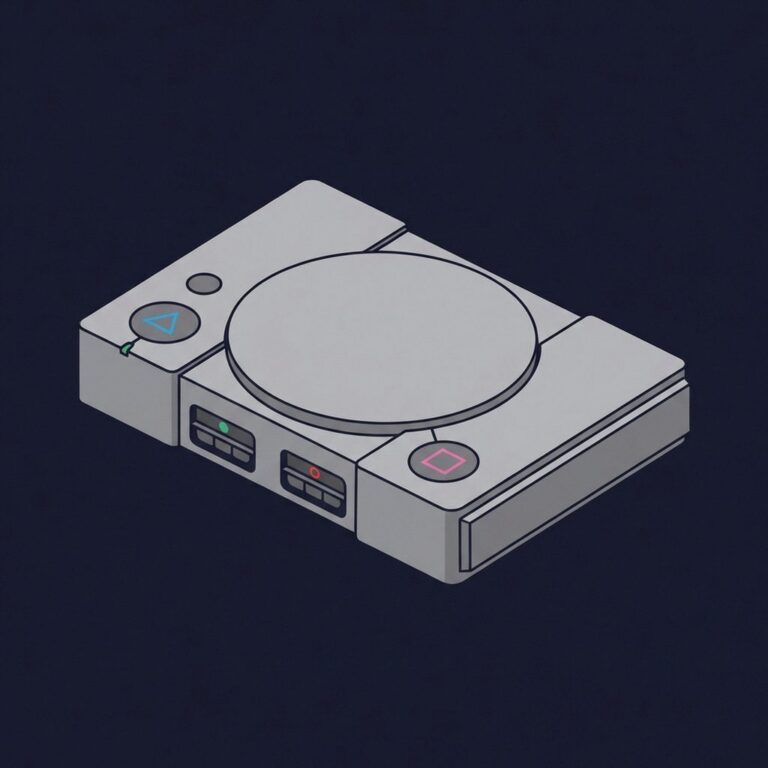
The original Sony PlayStation is the most important console ever released. Not the best — that’s subjective. Not the most innovative — the NES, Wii, and Switch all have stronger claims. But no single console has had a greater impact on the gaming industry’s trajectory. The PlayStation took a medium dominated by Nintendo and Sega, opened it to hundreds of developers, expanded its audience to adults, and sold 102.49 million units — the first console to cross 100 million. It transformed Sony from a consumer electronics company into gaming’s most powerful brand and established the template that the industry still follows.
History & Development
The PlayStation was born from betrayal. In the late 1980s, Nintendo contracted Sony to develop a CD-ROM add-on for the Super Famicom. Ken Kutaragi, a Sony engineer who had secretly contributed to the SNES’s sound chip design, led the project. The plan was a hybrid device: the “Play Station” would play both SNES cartridges and a new CD-ROM format, with Sony controlling CD software licensing.
At CES 1991, Sony publicly announced the Play Station. The next morning, Nintendo announced a rival deal with Philips, effectively killing the partnership. The reason was contractual — Nintendo’s president Hiroshi Yamauchi realized Sony’s agreement gave them excessive control over the lucrative software licensing revenue. The public humiliation infuriated Sony’s leadership. Chairman Norio Ohga authorized Kutaragi to develop a standalone console.
The PlayStation launched in Japan on December 3, 1994 at ¥39,800, followed by North America on September 9, 1995 at $299. The price was $100 less than the Sega Saturn, a gap that Sony exploited relentlessly in marketing.
Hardware & Technical Specifications
The PlayStation’s MIPS R3000A CPU at 33.8688 MHz was a 32-bit RISC processor derived from workstation technology. The custom Sony GPU could render 360,000 flat-shaded polygons per second (180,000 textured) with hardware support for Gouraud shading and texture mapping. 2 MB of main RAM and 1 MB of video RAM seem modest by later standards, but the architecture was designed for efficiency.
The PlayStation’s key technical decision was its CD-ROM drive. Compared to the N64’s cartridges (8-64 MB, $10-15 manufacturing cost), PlayStation CDs offered 650 MB of storage at under $2 per disc. This enabled pre-rendered cutscenes, full voice acting, CD-quality music, and massive game worlds. The trade-off was loading times — something cartridge-based systems didn’t suffer from — but developers quickly learned to mask loads with creative level design.
The PlayStation also featured a dedicated Sound Processing Unit (SPU) with 24 ADPCM channels at 44.1 kHz and 512 KB of sound RAM. Combined with CD-quality Red Book audio playback, the PlayStation’s sound capabilities were a generation ahead of cartridge-based competitors.
Game Library & Legacy
The PlayStation’s library of over 3,000 games is the largest and most diverse of its generation, earning a perfect library rating of 10. Sony’s strategy of courting third-party developers with reasonable licensing fees, affordable development kits, and creative freedom produced an unprecedented software ecosystem.
Final Fantasy VII (1997) was the system-seller that proved gaming could be mainstream entertainment — cinematic storytelling, orchestral music, and emotional narrative that reached audiences far beyond traditional gamers. It sold over 10 million copies and was the single most important exclusive of the generation.
Metal Gear Solid (1998) pioneered stealth gameplay and cinematic presentation. Resident Evil (1996) created survival horror. Gran Turismo (1997) sold 10.85 million copies and defined simulation racing. Crash Bandicoot became Sony’s unofficial mascot. Tekken 3 perfected 3D fighting. Castlevania: Symphony of the Night (1997) reinvented the Metroidvania genre. Spyro the Dragon, Tomb Raider, PaRappa the Rapper, Silent Hill, Ape Escape — the breadth was staggering.
The PlayStation also became a haven for Japanese RPGs: Final Fantasy Tactics, Xenogears, Suikoden II, Vagrant Story, Chrono Cross, Legend of Mana, Star Ocean: The Second Story. For RPG fans, the PS1 era was a golden age unmatched before or since.
Models & Variants
Sony released numerous hardware revisions, designated by SCPH model numbers. The original SCPH-1000 (Japan launch) is notable for having superior audio DAC quality compared to later revisions — audiophiles sometimes use it as a CD player. Subsequent revisions (SCPH-1001, 3000, 5000, 5500, 7000, 7500, 9000) progressively reduced manufacturing costs, improved reliability, and removed features like the serial I/O port and parallel port.
The PSone (SCPH-100/101), released in July 2000, was a dramatic redesign — smaller, curved, and more modern-looking than the original gray box. An optional LCD screen attachment made it a portable gaming device years before that concept became mainstream. The PSone extended the PlayStation’s commercial life well into the PS2 era.
The Net Yaroze (DTL-H3000/3001) was a special development kit sold to hobbyists and students for $750. It came in distinctive black (versus the standard gray) and allowed homebrew game development. Net Yaroze units are highly collectible today, selling for $400-800+.
Collecting & Value Today
Standard PlayStation consoles remain extremely affordable — $20-40 USD for a working unit with controller and cables. The system was produced in enormous quantities and is mechanically simple. The laser assembly is the primary point of failure; units that struggle to read discs can often be revived by adjusting the laser potentiometer, though replacement lasers are also widely available.
Game prices have escalated significantly for rare titles. Suikoden II regularly commands $150-300+ complete. Valkyrie Profile, Tomba!, Tail Concerto, and Mega Man Legends 2 all exceed $100. Japanese imports are generally much cheaper and many RPGs received fan translations playable on modded consoles.
The PlayStation uses proprietary memory cards (1 MB, 15 blocks) for save data. Third-party cards were common but are less reliable than Sony originals. The system outputs via composite, S-Video, and RGB (through the multi-AV connector), with RGB providing excellent image quality on compatible displays. The PlayStation’s 3D graphics have aged more roughly than its 2D sprite-based games, but the best titles remain thoroughly playable and the system’s library offers a depth of experience that few consoles can match.