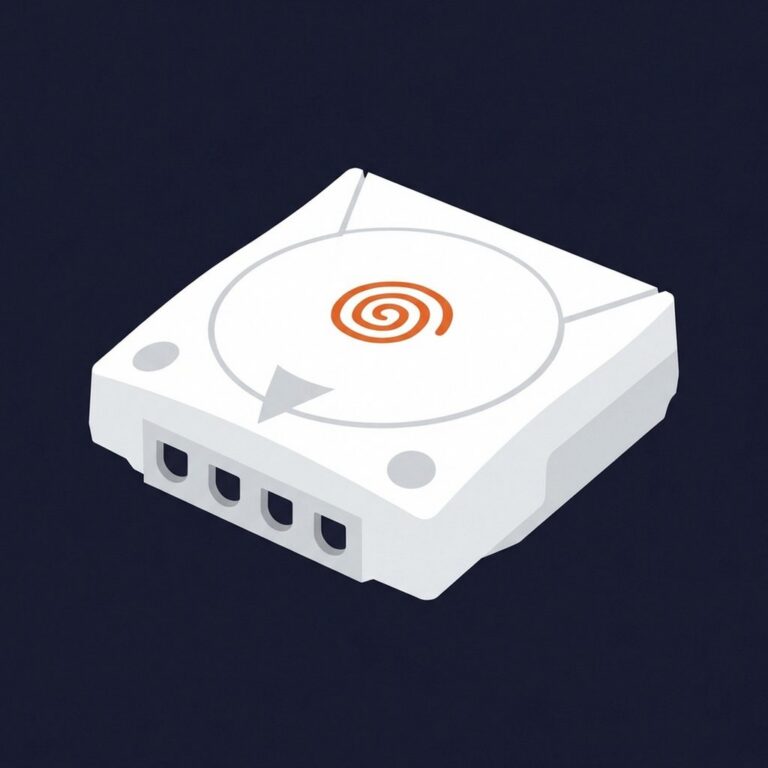
The Sega Dreamcast is gaming’s most celebrated “failure.” Discontinued after just two and a half years on the market, with only 9.13 million units sold, the Dreamcast ended Sega’s two-decade run as a hardware manufacturer. Yet it remains one of the most beloved consoles ever made — a machine that pioneered online console gaming, produced an extraordinary game library, and demonstrated what Sega could achieve when hardware design, software ambition, and arcade heritage aligned perfectly. The Dreamcast didn’t fail because it was a bad console. It failed because it was a great console made by a company that had exhausted its credibility.
History & Development
By the mid-1990s, Sega was in crisis. The Saturn was losing badly to the PlayStation in North America and Europe. The 32X debacle had fractured consumer trust. Internally, Sega of Japan and Sega of America were at war over strategy. The company needed a clean break — a new console that could restore confidence and compete with Sony’s inevitable PlayStation successor.
Two competing hardware designs emerged within Sega. The Japanese team, led by Hideki Sato, proposed a design using the Hitachi SH-4 CPU and NEC PowerVR2 GPU. The American team, led by Tatsuo Yamamoto from IBM, proposed a platform based on 3dfx Voodoo graphics technology. After internal deliberation, Sega chose the Japanese design. The 3dfx team, allegedly already told they had won the contract, sued Sega (the case was settled). The chosen hardware proved to be the right call — the PowerVR2’s tile-based rendering was remarkably efficient, producing clean, colorful visuals with minimal memory overhead.
The Dreamcast launched in Japan on November 27, 1998 to solid but not spectacular demand, hampered by a thin launch lineup. The North American launch on September 9, 1999 — the memorable “9/9/99” date — was a different story entirely. Sega invested heavily in marketing, and the console set a new US launch record: $98.4 million in first-day sales, moving 225,132 units in 24 hours. Bundled with a playable demo of Sonic Adventure and launching alongside strong titles like SoulCalibur, NFL 2K, and Hydro Thunder, the Dreamcast seemed poised for a genuine comeback.
But the PS2’s shadow loomed. Sony’s relentless hype machine — emphasizing the PS2’s DVD playback, backward compatibility, and the “Emotion Engine” processor — convinced many consumers to wait. Retailers, remembering Sega’s track record of abandoning hardware (32X, Saturn), were cautious with orders. Third-party publishers, sensing where the market was heading, hedged their bets. When the PS2 launched in March 2000 in Japan, Dreamcast sales collapsed. Sega reported $400 million in losses for fiscal year 2000. On January 31, 2001, Sega announced it would discontinue the Dreamcast and exit hardware manufacturing, becoming a third-party software publisher.
Hardware & Technical Specifications
The Dreamcast’s Hitachi SH-4 CPU ran at 200 MHz with a 128-bit floating-point unit capable of 1.4 GFLOPS — impressive for 1998. The NEC PowerVR2 (CLX2) GPU used tile-based deferred rendering, a technique that divided the screen into small tiles and processed only visible geometry. This approach was memory-efficient and produced clean images with effective anti-aliasing, giving Dreamcast games a distinctly smooth, colorful look.
Memory was generous: 16 MB main RAM, 8 MB video RAM, and 2 MB sound RAM. The audio system featured a Yamaha AICA sound processor with 64 channels and its own ARM7DI CPU at 45 MHz, essentially a dedicated sound computer that could handle complex audio without burdening the main processor.
The Dreamcast was the first console to ship with a built-in modem (33.6K, later upgraded to 56K; a broadband adapter was available separately). While dial-up speeds were limited, this enabled online gaming as a standard feature rather than an add-on. Games like Phantasy Star Online, ChuChu Rocket!, Quake III Arena, and NFL 2K1 offered online play, and the SegaNet service provided web browsing and email.
The Visual Memory Unit (VMU) was the Dreamcast’s most innovative accessory. This memory card featured its own LCD screen, D-pad, and buttons, functioning as a miniature portable game device when removed from the controller. During gameplay, the VMU displayed supplementary information (play calls in NFL 2K, health meters, mini-maps). Standalone VMU games could interact with Dreamcast titles — raising a creature in a VMU mini-game could transfer it into the main game. The concept anticipated the second-screen experience that smartphones would later provide.
The Dreamcast also supported VGA output natively, producing 480p progressive scan through an official VGA adapter — the first console to offer this. Connected to a VGA monitor, the Dreamcast’s output was strikingly sharp and remains one of the cleanest standard-definition images of any console.
Game Library & Legacy
The Dreamcast’s library of 624 games (across all regions) is remarkably strong for a console with such a short commercial life. Sega’s arcade heritage translated directly — the Dreamcast’s NAOMI arcade board was essentially the same hardware, enabling near-perfect ports.
SoulCalibur was the launch title that defined what the Dreamcast could do — a fighting game so visually superior to the PS1 version of its predecessor that it looked generational. Sonic Adventure brought the hedgehog into 3D with mixed results but undeniable ambition. Shenmue (1999), directed by Yu Suzuki with a $47 million budget (the most expensive game ever made at the time), created the open-world life simulation genre — walk through a fully realized Japanese town, open drawers, play arcade games, track down your father’s killer. It was years ahead of its time.
Jet Set Radio (2000) pioneered cel-shaded graphics and influenced an entire aesthetic movement in gaming. Crazy Taxi brought arcade chaos to the living room. Phantasy Star Online (2000) was the first console MMORPG, creating an addictive online loot grind that foreshadowed the genre’s console explosion. Power Stone reimagined arena fighting. Skies of Arcadia delivered one of the era’s finest RPGs. Rez merged rhythm gaming with abstract shooters in a synesthetic experience that was ahead of its time by a decade.
The Dreamcast also became a haven for 2D gaming excellence. Sega’s NAOMI hardware was beloved by Japanese arcade developers, and the Dreamcast received exceptional shoot-em-ups (Ikaruga, Mars Matrix, Giga Wing), fighting games (Marvel vs. Capcom 2, Street Fighter III: Third Strike, Capcom vs. SNK 2), and 2D platformers. For genre enthusiasts, the Dreamcast’s 2D library is arguably the finest of any console.
Models & Variants
The Dreamcast had relatively few hardware variants. The standard console came in white across all regions, with regional differences primarily in controller ports (the Japanese and European versions used different modem standards). A small number of color variants were produced: black (Sega Sports edition in NA, standard in some regions), metallic blue (limited Japanese edition), and various promotional colors in small quantities.
The most significant hardware variant was the broadband adapter (HIT-0401), which replaced the modem module with a 10/100 Ethernet port. Produced in limited quantities, the broadband adapter is now one of the most sought-after Dreamcast accessories, selling for $100-200+. Third-party Ethernet adapters and modern solutions (like the DreamPi for dial-up game revival) have made online play accessible again.
Unlike most consoles, the Dreamcast’s GD-ROM drive was its weakest physical component. The laser assembly is prone to failure over time, and many units now require laser potentiometer adjustment or replacement. The GDEMU and similar optical drive emulators (which replace the GD-ROM drive with an SD card reader) have become popular among owners looking to preserve their consoles.
Collecting & Value Today
The Dreamcast has experienced significant collector appreciation. A working console with controller and cables sells for $60-100 USD. The relatively small production run means fewer units exist compared to the PS2 or even GameCube, and the console’s passionate fanbase drives consistent demand.
Game prices have climbed steadily. Marvel vs. Capcom 2 — the console’s most expensive common title — regularly sells for $100+ complete. Skies of Arcadia, Project Justice, Tech Romancer, and Cannon Spike all command $80-150+. Japanese imports (which play on US consoles with a boot disc or region-free BIOS) are generally cheaper and offer access to the extensive Japanese library, including numerous shoot-em-ups and visual novels never released in English.
When purchasing a Dreamcast, test the GD-ROM drive thoroughly — try multiple discs and listen for unusual grinding or clicking. The controller ports can develop connection issues from wear. VMUs require CR2032 batteries for standalone use (the memory function works without batteries when inserted in the controller). The console itself is otherwise reliable, with no widespread capacitor or power supply issues like those affecting some contemporaries.
The Dreamcast’s homebrew and indie scene remains active over two decades after discontinuation. New games are still being developed and sold on physical GD-ROM and CD-R media, making the Dreamcast one of the few retro consoles with a genuinely living software ecosystem.